The Slow-Cooked Graveyard: The Birth of Shale Gas
Buried beneath the silence of the Earth's crust lies a pressurized graveyard of ancient plankton, transformed by millions of years of heat into a hidden ocean of energy.
This story began with a question: “How does shale gas form deep underground?”
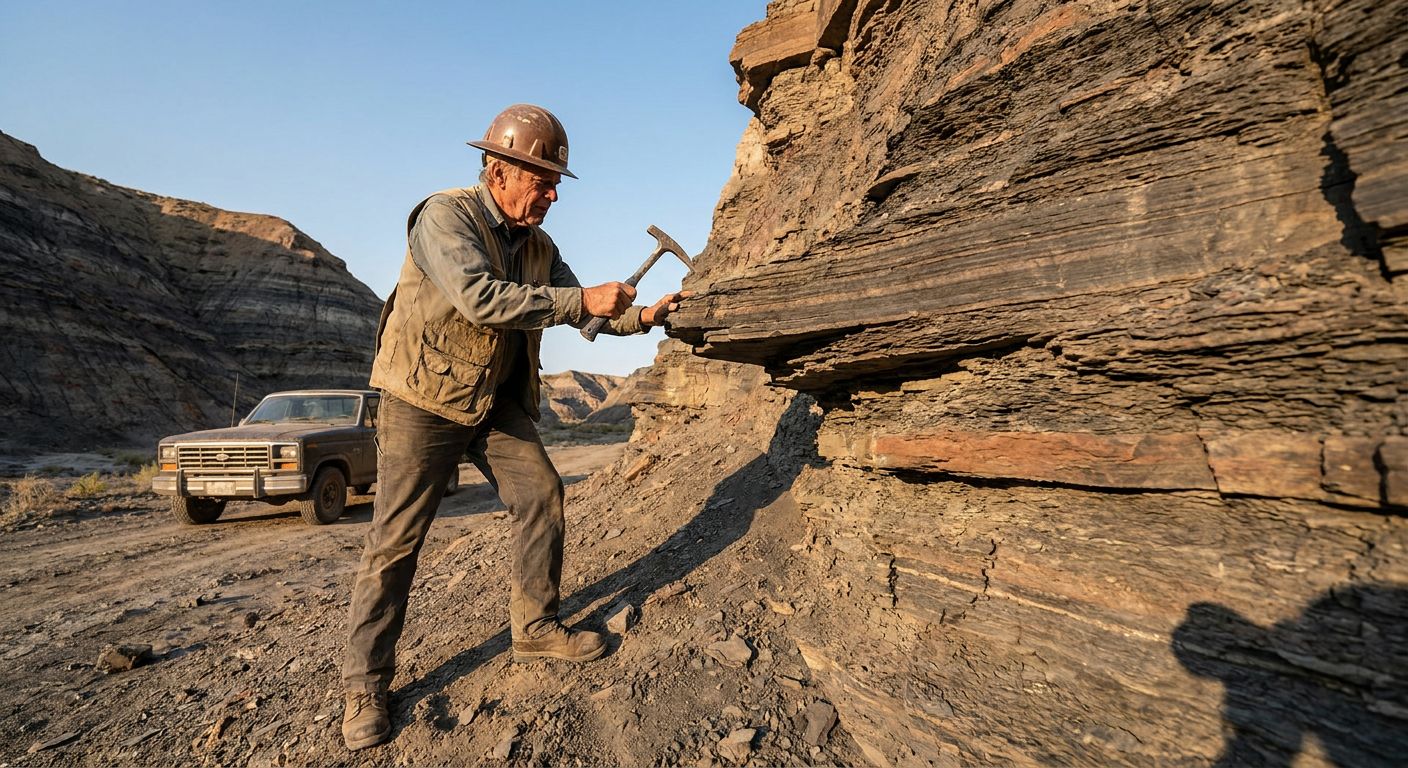
If you were to stand in the middle of a quiet, sun-baked field in Pennsylvania or the vast stretches of the Sichuan Basin, you would be standing atop a massive, silent graveyard. Hundreds of millions of years ago, these places didn't look like rolling hills or mountain shadows. They were shallow, stagnant seas, teeming with microscopic life that was busy doing what life does best: capturing energy from the sun. When those organisms died, they didn't just disappear. They became the primary ingredient for one of the most complex slow-cooking recipes in the history of the planet.
We often think of fossils as bones—the terrifying jaw of a T-Rex or the coiled shell of an ammonite. But the vast majority of the world’s fossil fuels come from a much humbler source: phytoplankton and algae. These tiny specks of organic matter are the true architects of the energy we extract today. To turn a floating cell into a pocket of gas trapped miles underground requires a specific sequence of geological accidents, a journey that begins with the "Big Sleep" at the bottom of an ancient ocean.
The Recipe of the Deep
The process begins in an environment that is, paradoxically, hostile to most life. For shale gas to form, these tiny organisms must settle in an "anoxic" environment—a place where the water is so still and so deprived of oxygen that bacteria cannot fully decompose the organic matter. Instead of rotting away, the algae and plankton mix with incredibly fine grains of clay and silt. Over millennia, this mixture settles into thick, dark layers of ooze.
As the eons pass, new layers of sediment pile on top, weighing millions of tons. The pressure begins to squeeze the water out of the mud, compressing the ooze into a dense, fine-grained sedimentary rock we call shale. Deep within these stony layers, the organic matter undergoes a chemical transformation. It becomes kerogen—a waxy, solid material that holds the potential for energy but isn't yet ready to flow.
It is at this stage that the "kitchen" of the Earth begins to heat up. The further the shale is buried, the hotter it gets, thanks to the geothermal gradient of the Earth’s crust. This temperature range is so precise that geologists refer to it as the "Oil Window" and, eventually, the "Gas Window." If the rock stays too cool, it remains just waxy shale. If it gets too hot, the organic molecules break down entirely into carbon, leaving nothing behind but graphite.
The Great Transformation
The magic happens between roughly 100 and 150 degrees Celsius. In this intense heat, the long, complex chains of molecules in the kerogen begin to "crack." The heat vibrates the chemical bonds until they snap, breaking down the heavy solids into lighter liquids and, eventually, into the simplest hydrocarbon of all: methane. This is the primary component of natural gas.
Unlike traditional gas reservoirs, where the gas migrates upward through porous sandstone until it hits a "cap" of hard rock, shale gas is a homebody. Because shale is made of such fine-grained minerals, it is incredibly "tight." The gas remains trapped within the very rock where it was born, caught in microscopic pores that are often a thousand times smaller than a human hair.
This lack of permeability is why shale gas remained a geological curiosity for decades. Engineers knew the energy was there, but it was locked away in a stone fortress. It wasn't until the marriage of two specific technologies—horizontal drilling and hydraulic fracturing—that we found a way to "crack the code" of the shale. By turning the drill bit ninety degrees and pumping high-pressure fluid into the rock, we create artificial cracks, finally giving the ancient methane a path to the surface.
A Legacy of Ancient Climate
Every time a shale gas well is flared or a stove is lit with its bounty, we are witnessing the release of solar energy that was captured by a prehistoric plant three hundred million years ago. The sheer scale of these deposits tells us something profound about the Earth's past. The massive shale plays we see today, like the Marcellus in the United States or the Vaca Muerta in Argentina, represent eras of planetary history when the oceans were vastly different than they are today.
These were times of "Greenhouse Earth," where high carbon dioxide levels and warm polar regions slowed down the ocean's circulation. Without the churning of cold, oxygen-rich water from the poles, the deep ocean floors became stagnant, allowing the organic "ooze" to accumulate in thicknesses that seem impossible. The energy we use today is effectively a recycled version of a climate crisis that happened hundreds of millions of years ago.
The irony of shale gas is that its existence depends on the very thing we are wary of today: a world so warm and still that the deep sea could no longer breathe. As we extract this gas, we are essentially completing a cycle that began in the Paleozoic era, bringing the carbon that was buried by ancient algae back into the atmosphere of the modern world. It is a reminder that the ground beneath our feet isn't just dirt and stone; it is a pressurized library of the Earth's long, turbulent biological history.
This story travelled through
Where does this story take you next?
Every story opens a door somewhere else. Pick a thread and we'll tell you that story too.
Curious about something else?
Discover another exploration