The White Gold Sentinels of Trapani
Beneath the red-roofed windmills of Sicily’s west coast lies an ancient 'white gold' industry that survived the age of machines.
This story began with a question: “Why do the salt pans of Trapani in Sicily still have windmills?”
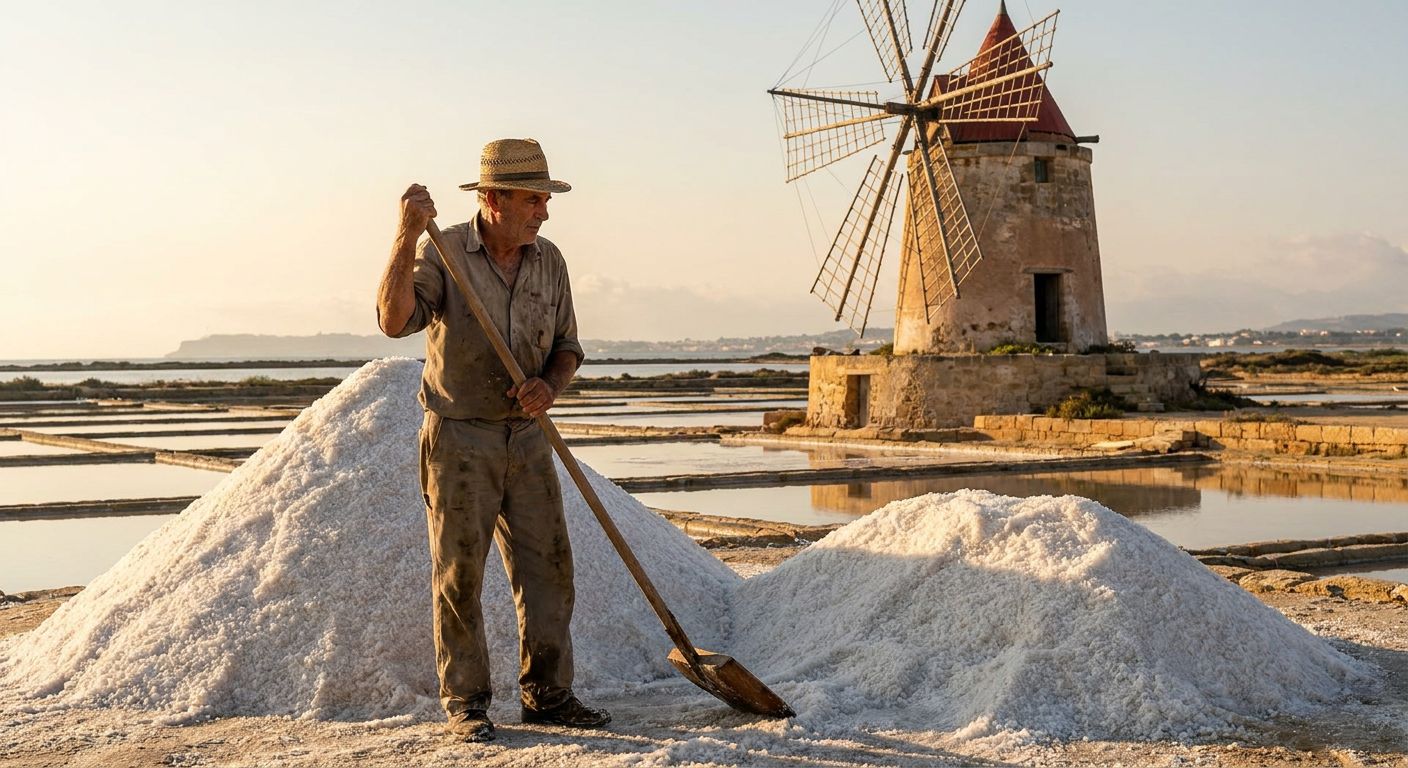
On the low-lying coast of western Sicily, the air is thick with the scent of brine and the rhythmic, hollow groaning of rotating timber. Here, the landscape is a grid of shallow basins—the Saline di Trapani e Paceco—where the Tyrrhenian Sea is systematically transformed into crystalline crusts. Amidst these shimmering mirrors stand stone towers topped with red conical roofs and latticed wooden sails. Unlike the picturesque ruins found elsewhere in Europe, these 16th-century windmills remain functional sentinels of a "white gold" industry that has resisted the total mechanization of the modern age.
To understand their survival, one must look beneath the red tiles at the specific physics of the Sicilian shore. The mills are not merely grinding grain; they are massive hydraulic engines designed to solve a three-thousand-year-old logistical problem: how to move millions of liters of seawater across a flat landscape using nothing but the air.
The Phoenician Inheritance
The story of the salt pans begins long before the first stone tower was raised. The Phoenicians, the great maritime traders of the ancient world, first realized that this stretch of coast was a natural factory. They identified a perfect convergence of environmental factors: intense Mediterranean heat, shallow coastal shelves, and a steady, drying wind known as the Ghibli blowing in from North Africa. By carving out evaporation ponds, they could harvest the mineral wealth left behind as the sun scorched the water away.
For two millennia, the process was a grueling manual labor. Before the introduction of wind power, salt workers moved water between basins using hand-turned buckets or simple animal-powered wheels. As the scale of production grew during the Middle Ages, the need for a more efficient system became urgent. Salt was the world’s most vital preservative, the essential fuel for empires that allowed navies to explore the globe without their rations rotting in the hold. By the 1500s, the Spanish rulers of Sicily introduced the windmill technology that would define the region's skyline, providing the mechanical torque needed to industrialize the harvest.
Engineering the Archimedes Screw
Inside the belly of a Trapani windmill, the engineering is deceptively simple and remarkably durable. The central shaft, driven by the sails outside, connects to a device known as an Archimedes screw—a giant wooden corkscrew encased in a tight cylinder. As the wind turns the sails, the screw rotates, drawing water upward from the lower frida (outer pools) and spilling it into the higher canningi (salination pools).
The choice of materials was dictated by the harsh, corrosive environment. Builders used oak or fir for the internal gears and screws, treating the wood to withstand the constant assault of salt and humidity. The conical red roofs are not merely decorative; their shape allows them to be rotated 360 degrees, ensuring the sails can catch the wind from any direction, whether it is a gentle sea breeze or a violent autumnal gale.
Even as steam engines and electric pumps emerged in the 20th century, the old mills proved their worth. An Archimedes screw can move thousands of liters of water an hour with zero fuel costs. In a region where energy was historically expensive, the windmills provided a perfectly calibrated, low-cost solution to the slow, seasonal rhythm of salt crystallization.
A Refuge in the Salt Crust
The salt pans of Trapani are not just industrial sites; they are a delicate ecosystem that has become a vital stopover for migratory birds. The varying levels of salinity in each pond create a specialized gradient of life. In the hyper-saline inner basins, microorganisms and tiny brine shrimp flourish, providing a feast for thousands of greater flamingos. These birds stop here during their journeys between Africa and Europe, their coral-pink plumage contrasting sharply against the blinding white salt heaps.
In 1995, this synergy between man-made industry and nature was formalized with the creation of the Riserva Naturale Orientata Saline di Trapani e Paceco. The reserve protects both the biodiversity and the architectural heritage of the mills. While modern electric pumps now handle the bulk of the water movement, the windmills are maintained in working order. They serve as a backup system and a primary tool for artisanal harvesters who believe the vibration and pace of the old mills produce a superior crystal.
The Hand-Carved Harvest
Industrial rock salt, mined from deep underground, flooded the global market in the mid-20th century, pushing these coastal pans toward obsolescence. However, a recent shift in culinary awareness has saved the salinari (salt workers). Unlike industrially refined salt, which is often stripped of its minerals, the Sale Marino di Trapani is harvested by hand between July and September. It retains high concentrations of potassium, magnesium, and calcium—minerals that are trapped within the crystal structure as the water evaporates under the Sicilian sun.
During the harvest, the salinari use large wooden shovels to scrape the salt into gleaming pyramids. These white mounds are then covered with terracotta tiles to protect them from the rare rainfall, creating a landscape that looks more like an ancient necropolis than a modern farm. The windmills stand over these pyramids, acting as a reminder that this "white gold" is a product of a specific geography.
The survival of these mills represents a rare equilibrium where ancient engineering and modern ecology meet. The salt from Trapani does not just season food; it carries the chemical signature of the Mediterranean and the mechanical history of the wind. As long as the Ghibli blows across the sea, the wooden screws of Sicily will continue to turn, pulling wealth from the tides as they have for centuries.
This story travelled through
Where does this story take you next?
Every story opens a door somewhere else. Pick a thread and we'll tell you that story too.
Curious about something else?
Discover another exploration