The Purple People: How a League of Sailors Invented the West
From the royal purple of sea snails to the very letters you are reading, a league of ancient mariners built the modern world's first global network.
This story began with a question: “What is the story of Phoenicians?”
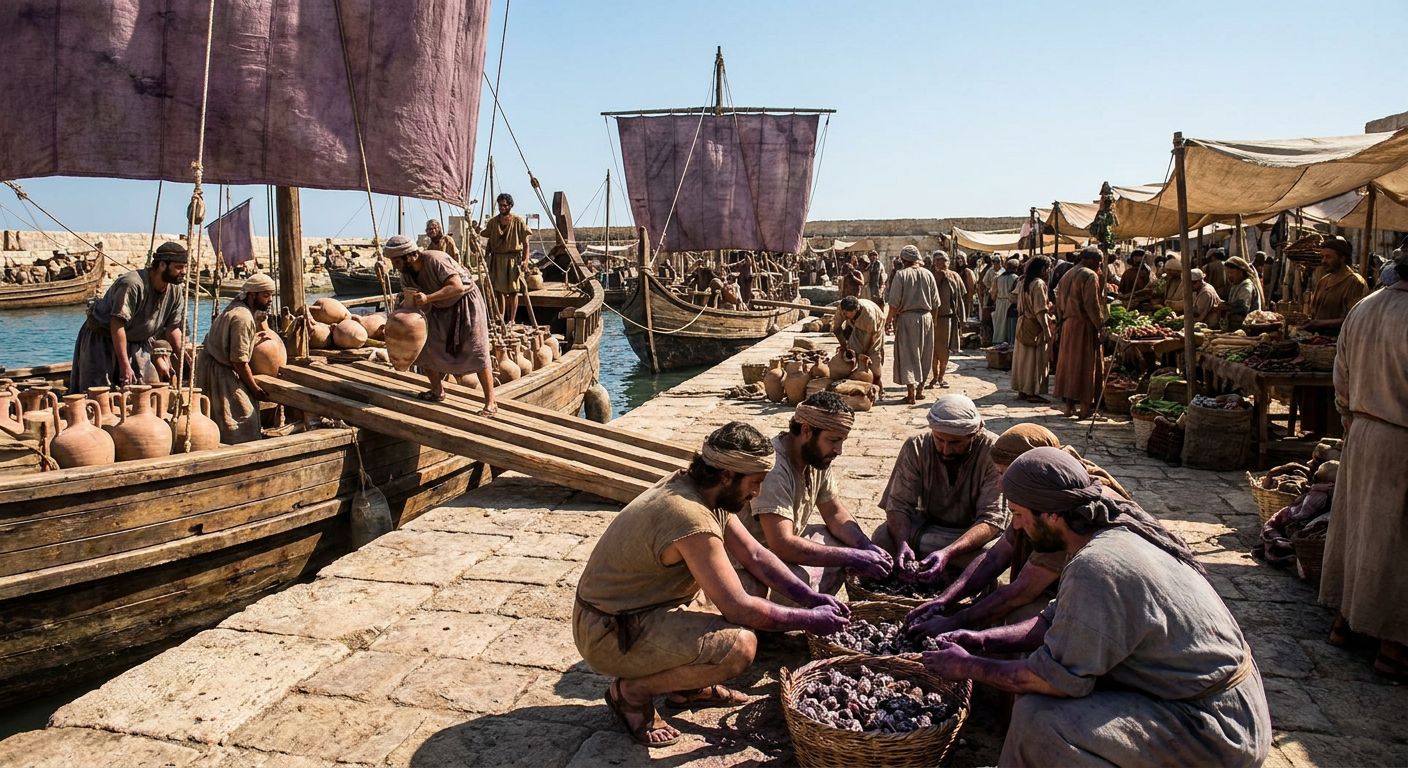
If you stood on the sun-bleached shores of the Levant three thousand years ago, near the modern cities of Tyre or Byblos, you would see a horizon dominated by the cedar-clad peaks of Mount Lebanon. These trees—tall, fragrant, and incredibly sturdy—were the engine of a revolution. While the great terrestrial empires of Egypt and Assyria focused their gaze on fertile river valleys and inland conquests, a group of Canaanite city-states looked toward the wine-dark Mediterranean. They were not a single unified nation, but a loose confederation of mariners and merchants known to history by the name the Greeks gave them: the Phoenicians, or the "Purple People."
The name itself was a tribute to their most lucrative secret. Along the coast, they harvested millions of tiny murex sea snails. Through a laborious process of fermentation and boiling, they extracted a drop of liquid that, when exposed to light, turned a deep, vibrant violet. This Tyrian purple became the ultimate status symbol of the ancient world, a color so expensive that only royalty could afford it. But the dye was merely the cargo; the true story of the Phoenicians lies in the ships that carried it.
The Cedar Queens of the Sea
To conquer the Mediterranean, the Phoenicians engineered the finest vessels the world had ever seen. Using the rot-resistant Lebanon cedar, they developed the rounded hull for cargo and the sleek hippos (horse-headed) ships for speed. Most importantly, they perfected the use of the keel, allowing their ships to slice through waves rather than simply bobbing atop them. These innovations turned the Mediterranean from a barrier into a highway.
By 1000 BCE, their networks stretched like a spider’s web from the Levant to the Atlantic. They weren't interested in vast territorial conquests; they wanted "factories"—trading posts that could service their ships and store goods. They traded Lebanese timber for Egyptian papyrus, Cypriot copper for Greek wine, and Spanish silver for Baltic amber. They were the world’s first globalized middlemen, operating on a scale that made the distant corners of the known world feel suddenly intimate.
The Alphabet and the Ledger
As their trade grew, the Phoenicians encountered a problem: bookkeeping. The complex hieroglyphics of Egypt and the cuneiform of Mesopotamia were the tools of priests and royal scribes, requiring years of study to master. For a merchant on a rocking ship in a busy harbor, these systems were too slow. They needed a shorthand for the sea.
Their solution was perhaps the most influential invention in human history. They distilled language down to twenty-two simple characters, each representing a single consonant sound. It was a phonetic system—the ancestor of the Greek, Latin, and Cyrillic alphabets we use today. By democratizing literacy, the Phoenicians ensured that ideas could travel as fast as their ships. A merchant in Gadir (modern Cádiz) could now send a precise written order to a supplier in Sidon, thousands of miles away.
A City Named New
As the Assyrian and Babylonian empires began to squeeze the Phoenician homelands in the East, the focus of their civilization shifted westward. Legend tells of Queen Dido, who fled Tyre after the murder of her husband and landed on the coast of modern-day Tunisia. There, she established Qart-Hadasht, which simply means "New City." The Romans would later call it Carthage.
Carthage was the pinnacle of Phoenician ambition. It featured a revolutionary circular harbor called a cothon, capable of housing hundreds of warships in secret, protected by massive gates. From this North African base, the Phoenicians—now often called Carthaginians or Punics—pushed even further. There is evidence they reached the tin mines of Britain and sailed down the western coast of Africa. They were the first to navigate by the stars of the Little Bear, a constellation the Greeks would later call the "Phoenician Star."
The Weight of Two Worlds
The Phoenician story is one of incredible resilience and eventual tragedy. They survived the "Bronze Age Collapse" that toppled mighty empires, only to eventually find themselves caught between the rising power of the Greeks and the relentless expansion of Rome. Their home cities in the Levant were eventually swallowed by the empires of Alexander the Great and the Persians, while Carthage famously met its end in a series of brutal wars with Rome.
Yet, the Phoenicians never truly disappeared; they simply became the foundation upon which the Western world was built. Every time we write a sentence, we use their letters. Every time we trade across an ocean, we follow their routes. They were the people who realized that the sea does not divide us—it connects us. They turned the Mediterranean into a shared space, a "middle sea" where the traditions of the East and the hunger of the West finally met.
This story travelled through
Where does this story take you next?
Every story opens a door somewhere else. Pick a thread and we'll tell you that story too.
Curious about something else?
Discover another exploration