The Song of the Forest: How Estonia Outlasted Empires
From medieval crusades and Baltic Barons to a revolution won through song, a small nation on the edge of the Baltic Sea defined itself by outlasting empires.
This story began with a question: “What is the story of Estonia?”
If you stand on the shores of the Gulf of Finland in late June, the sun refuses to set. In this "White Night," the Baltic Sea shimmers like hammered silver, and the air smells of pine resin and salt. It is a landscape that feels ancient and untouched, yet every inch of this soil has been fought over by empires. For centuries, Estonia was not a country on a map, but a prize claimed by Danes, Germans, Swedes, and Russians. The story of Estonia is one of a people who survived by keeping their language close to their chests and their songs in their hearts, waiting for the moments when the giants above them stumbled.
To understand the Estonians, you have to understand their relationship with the forest and the sea. Unlike their Indo-European neighbors, the Estonians speak a Finno-Ugric language, a complex tongue related to Finnish and Hungarian. This linguistic isolation acted as a cultural fortress. While their land was passed around by foreign kings, the Estonians remained "the people of the land" (maarahvas), deeply rooted in a pagan worldview that saw spirits in the stones and voices in the trees. Even today, they are among the least religious people in Europe, yet they maintain a spiritual reverence for their ancient woodlands.
The Northern Crusades and the Baltic Barons
The silence of the Estonian forests was shattered in the 13th century. Pope Innocent III called for a crusade against the last pagans of Europe, bringing the Livonian Brothers of the Sword—German knight-monks—to the Baltic coast. These steel-clad invaders didn't just bring the Bible; they brought a feudal system that would define Estonian life for seven hundred years. The Germans built massive stone fortresses and towering cathedrals in cities like Tallinn, which they called Reval.
For centuries, a tiny elite of German "Baltic Barons" owned the vast estates, while the Estonians worked the land as serfs. This era turned Estonia into a gateway for the Hanseatic League, a powerful trade alliance that linked the Baltic to the rest of Europe. Tallinn became a wealthy medieval hub, its warehouses bursting with furs, wax, and honey headed for London and Bruges. Yet, the people who actually gathered those goods remained outsiders in their own towns, living in wooden huts outside the stone walls of the German-dominated centers.
The Swedish Golden Age and the Russian Shadow
In the 16th and 17th centuries, the Baltic became a "Swedish Lake." Under the rule of Swedish kings like Gustavus Adolphus, Estonia experienced a brief "Golden Age." The Swedes established the University of Tartu in 1632 and began to improve the lot of the peasantry, seeing education as a way to integrate the province into their empire. It was a time of rare intellectual flourishing, but it was caught between the ambitions of two rising powers.
The Swedish era ended in the fire and plague of the Great Northern War. Peter the Great, the Russian Tsar, was determined to "open a window to Europe." In 1710, Estonia was absorbed into the Russian Empire. For the next two hundred years, the Russian Tsars allowed the German nobility to keep their local power in exchange for loyalty. The Estonian peasants were caught in a strange limbo: ruled by Russians in the name of the Tsar, but managed by German landlords who spoke a different language entirely. It was in this crucible that a modern Estonian identity began to harden.
A Republic Born of Song and Fire
The 19th century brought the "National Awakening." Encouraged by the abolition of serfdom and the spread of literacy, Estonians began to write their own newspapers and collect their ancient folklore. In 1869, they held the first Song Festival—a massive gathering where thousands sang in Estonian, asserting their culture in the face of "Russification" policies. When the Russian Empire collapsed in the chaos of the First World War and the Bolshevik Revolution, the Estonians seized their chance. In 1918, they declared independence, successfully defending their new republic in a brutal war against both the Red Army and a Baltic German militia.
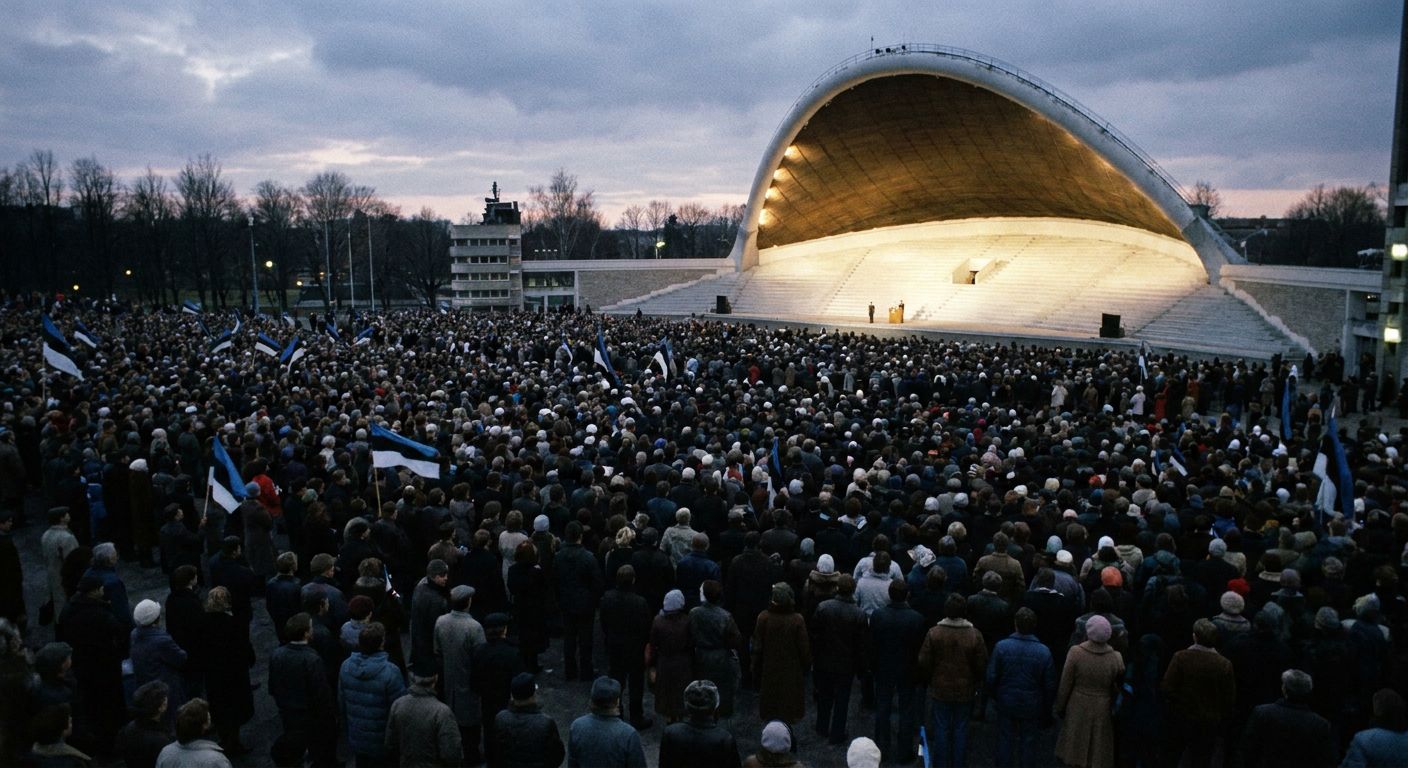
This hard-won freedom was brief. In 1940, as part of a secret pact between Hitler and Stalin, the Soviet Union occupied Estonia. What followed was a dark half-century of deportations to Siberia, forced collectivization, and the suppression of national identity. Yet, the Estonians did not forget how to sing. In the late 1980s, during the twilight of the USSR, hundreds of thousands of people gathered at the Song Festival grounds in Tallinn. They sang prohibited national hymns in a defiant, peaceful protest that became known as the Singing Revolution. By 1991, without a single shot fired by the Estonians, the Soviet occupation ended, and the republic was restored.
The Digital Frontier on the Baltic
Today, if you walk through the cobblestone streets of Tallinn’s Old Town, you see a country that has leapfrogged into the future. Having lost decades to Soviet stagnation, Estonia decided to start from scratch. They became the first country to adopt e-voting, to teach coding in primary schools, and to offer "e-residency" to entrepreneurs worldwide. It is a "paperless" society where almost every government service is digital.
Yet, despite the high-tech sheen, the heart of the country remains in the quiet places. Even the most successful tech CEO in Tallinn likely has a small wooden cabin in the woods or on an island like Saaremaa, where they go to pick mushrooms and listen to the wind. The story of Estonia is a lesson in patience. It is the story of a small people who outlasted empires not by building bigger walls, but by nurturing a culture that was impossible to colonize. They are the survivors of the Baltic, a nation that sang itself back into existence.
This story travelled through
Where does this story take you next?
Every story opens a door somewhere else. Pick a thread and we'll tell you that story too.
Curious about something else?
Discover another exploration