The Ghost Empire of the North: How the Hanseatic League Ruled by the Ledger
Long before the EU, a guild of merchants turned the North Sea into a private bank, humbling kings with the power of salt and herring.
This story began with a question: “How did the Hanseatic League control the medieval world?”
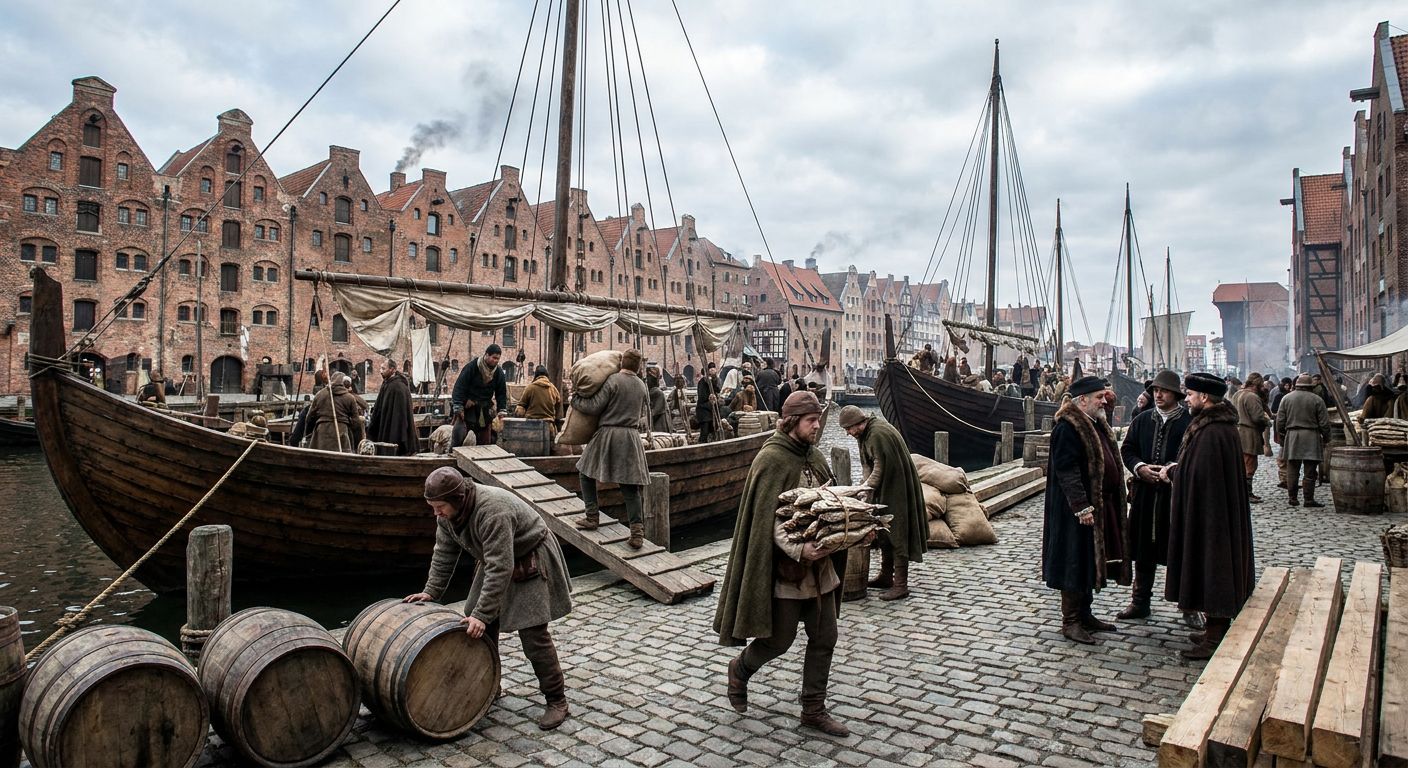
If you stand on the quays of Bergen, Norway, or Lübeck, Germany, today, you can still catch a sensory echo of the medieval world: the sharpness of drying timber and the heavy, oily scent of stockfish. For nearly four hundred years, these scents were the scent of power. It was an empire with no central government, no standing army, and no fixed borders, yet it held the kings of England and the dukes of Burgundy in a financial stranglehold. This was the Hanseatic League, a "society of the common merchant" that transformed the cold, choppy waters of the North and Baltic Seas into a private lake of profit.
It began not with a grand treaty, but with a simple need for security. In the 12th century, a merchant traveling from German lands toward the fur-rich forests of Novgorod, Russia was a walking target. To survive pirates at sea and robber barons on land, traders began to travel in Hansa—an Old High German word for a convoy or troop. They soon realized that if they pooled their resources, they could do more than just survive; they could dictate the terms of European civilization.
The Foundation of a Maritime Monopoly
The heart of this spiderweb was Lübeck. Rebuilt in 1159 after a fire, the city sat at a strategic bottleneck between the North Sea and the Baltic. By connecting the two, Lübeck’s merchants could move salt from the pits of Lüneburg to the massive herring fisheries of Scandinavia. Salt was the "white gold" of the Middle Ages; without it, the protein of the northern seas could not be preserved or traded.
As the League grew, it became a guild of cities rather than just men. At its height, over 150 towns—from London, England in the west to Novgorod, Russia in the east—were part of the network. They built a specific kind of ship to carry their ambitions: the cog. A clinker-built vessel with a massive square sail and a flat bottom, the cog was the heavy-lifter of the medieval world. It could carry hundreds of tons of grain, timber, and wine, while its high, defensive "castles" at the bow and stern made it a floating fortress against pirate raids.
The League’s power was anchored in the Kontore. These were foreign trading posts, effectively walled-off enclaves where Hanseatic merchants lived under their own laws. In London, England, their base was the Steelyard; in Bergen, it was the Bryggen. Within these walls, life was strictly regulated and nearly monastic. Young apprentices lived in "families" under the eye of a master, forbidden from marrying local women or even socializing outside the gates after dark. This enforced isolation ensured their loyalty remained solely with the League, preventing the dilution of capital into foreign bloodlines.
The Weapon of the Empty Plate
The Hanseatic League rarely went to war with knights and siege engines. Instead, they used a weapon far more terrifying to a medieval monarch: the embargo. Because the League controlled the supply of essential goods—grain from the Vistula valley, timber for shipbuilding, and the salt needed to keep a population fed through winter—they could starve a kingdom into submission without firing a single arrow.
In the 1360s, King Valdemar IV of Denmark tried to curb the League’s influence by seizing the vital trade hub of Visby, Sweden. The Hanseatic response was a rare display of military unity. They formed the Confederation of Cologne, raised a fleet of armed cogs, and crushed the Danish navy. The resulting Treaty of Stralsund in 1370 was perhaps the League’s high-water mark. It gave the merchants the right to veto the election of future Danish kings and granted them a fifteen-year monopoly on the trade in Scania. For a brief moment, the merchants were the undisputed masters of the North.
The League’s internal discipline was just as ruthless. If a member city broke the rules or traded with outsiders, it faced Verhansung—expulsion. For a medieval port, being cut off from the Hanseatic network was a death sentence. To be Verhansed meant your ships were seized in every port from Riga to Bruges, Belgium, and your merchants were treated as outlaws. It was a closed-loop economy that predated the modern corporate monopoly by centuries.
The Architecture of the Merchant Class
You can still see the League’s fingerprints in the "Brick Gothic" cathedrals and warehouses that line the Baltic coast. These red-brick giants, often built with bricks standardizing in size across the network, were more than religious spaces; they were monuments to the burghers. In an age where power usually flowed from the bloodlines of nobility, the Hanseatic cities were islands of republicanism governed by councils of wealthy merchants who valued ledger-books over chivalry.
The League introduced uniform weights and measures and a common legal code, the Lübeck Law, which was adopted by over 100 cities. This predictability allowed trade to flourish. A merchant in Cologne could send a shipment of wine to Tallinn and know exactly what kind of silver he would receive and which court would hear his case if the deal went sour.
However, this rigidity—the refusal to adapt to a changing world—would eventually lead to their undoing. The Dutch began building faster, more efficient ships that could bypass Hanseatic ports. Simultaneously, nature itself turned against the League. The massive shoals of herring, which had spawned in the Baltic for centuries, began a biological migration into the North Sea. As the fish moved toward the Dutch coast, the foundation of the Hanseatic monopoly literally swam away.
The Long Sunset of the Merchant Kings
The League didn't vanish overnight; it faded like a slow-moving tide. The final formal meeting, or Hansetag, took place in 1669 with only nine cities represented. The world had outgrown the guild. National states were rising, and kings were no longer willing to let a private club of merchants dictate their foreign policy or hold their harbors hostage. As the discovery of the Americas shifted the world’s economic focus to the Atlantic, the Baltic became a backwater.
Yet, the legacy of the Hanseatic League remains deeply embedded in the identity of Northern Europe. The German airline Lufthansa carries the "Hansa" name, and the "Free and Hanseatic" cities of Hamburg and Bremen still maintain their status as distinct states within modern Germany. The League proved that trade could be a more powerful force than territory. Out of the cold mists of the Baltic, they built the first true common market, proving that the pursuit of profit could reshape the map of the world long before the first modern treaties were ever signed.
This story travelled through
Where does this story take you next?
Every story opens a door somewhere else. Pick a thread and we'll tell you that story too.
Curious about something else?
Discover another exploration