The Oilman’s Forest: George P. Mitchell’s Vision for The Woodlands
He was the billionaire oilman who birthed the fracking revolution, yet he spent his life trying to prove humanity could live in harmony with the woods.
This story began with a question: “What was George Mitchell's vision for a sustainable future?”
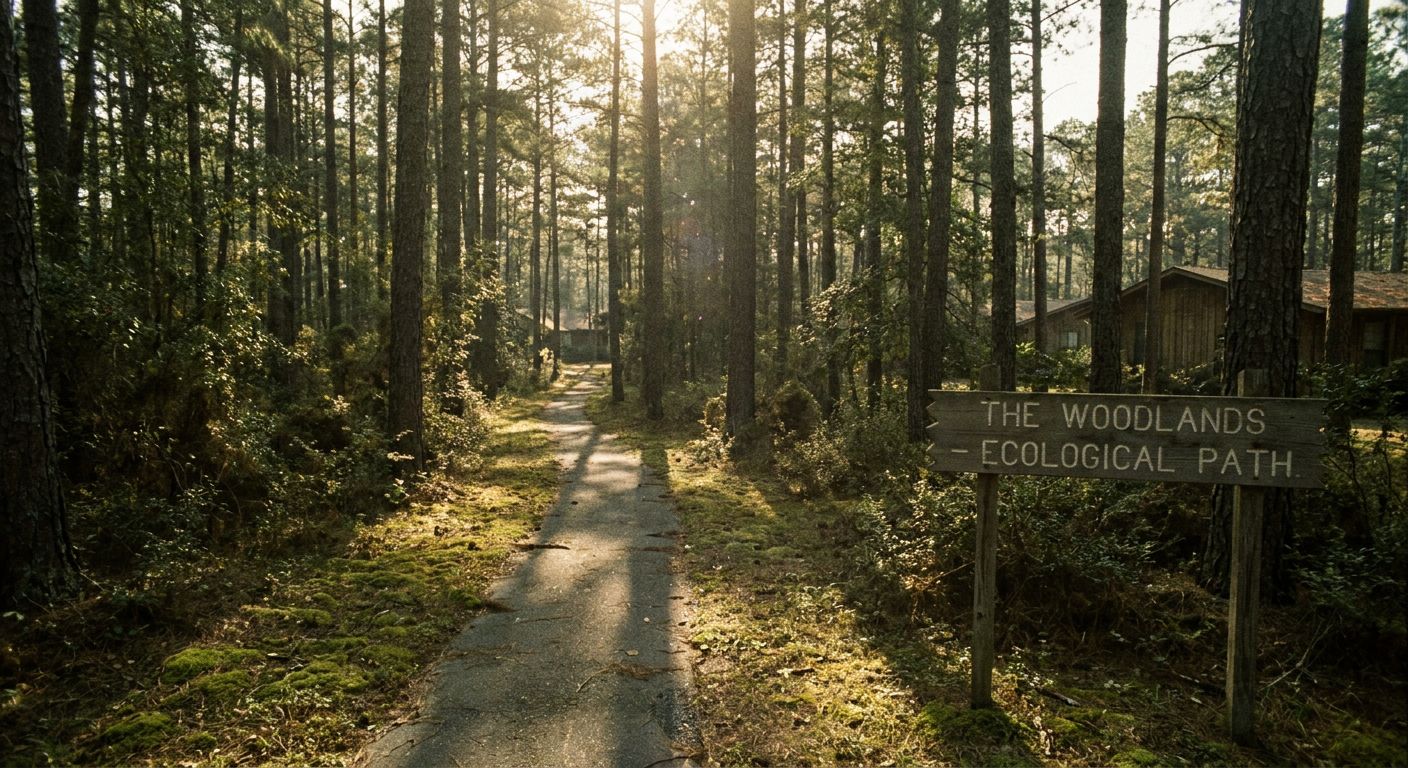
If you drive forty minutes north of Houston’s shimmering glass skyline, the concrete sprawl begins to soften into a dense, seemingly impenetrable canopy of loblolly pines and sweetgum trees. You might expect to find a typical American suburb—a grid of asphalt and manicured lawns—but instead, you find a place where the sidewalks disappear into forested trails and the shopping centers are tucked behind thick, verdant screens of vegetation. This is The Woodlands, Texas. It was the lifelong project of George P. Mitchell, a man whose legacy is a walking paradox: he is simultaneously the "father of fracking" who revolutionized global energy and a radical visionary who spent decades trying to figure out how humanity could live without destroying the planet.
Mitchell’s vision for a sustainable future wasn't born in a laboratory, but from a deep, uneasy sense that the post-war American dream was physically and ecologically unsustainable. He watched as the cities he helped build became clogged with smog and disconnected from the natural world. He didn't want to just build a neighborhood; he wanted to build a blueprint for how a species of ten billion could survive on a finite Earth.
The Forest and the Flood
In the early 1970s, the dominant philosophy of land development in Texas was "pave and drain." Developers typically cleared every tree and funneled rainwater into concrete pipes as quickly as possible, essentially treating the earth as a flat, sterile board. Mitchell, the son of a Greek immigrant who had grown up in the harsh, salt-sprayed landscape of Galveston, saw this as a recipe for disaster. He believed that the land already knew how to manage itself.
He hired Ian McHarg, a landscape architect who pioneered the idea of "designing with nature." Together, they mapped the soil types, the flow of water, and the health of the forest before a single shovel hit the ground. They decided that the natural drainage system—the creeks and the mossy, low-lying swales already present—would remain untouched. This wasn't merely an aesthetic choice; it was a radical experiment in hydrology. Instead of the sterile roar of water through concrete culverts, rain in The Woodlands was allowed to soak into the forest floor, filtered by the roots of the pines. By letting the earth absorb the water, Mitchell proved that a massive human settlement could exist without exacerbating the downstream flooding that plagued nearby Houston.
The Social Ecosystem of the Piney Woods
Mitchell’s definition of sustainability was broader than just green space. He often spoke about a "triad" of needs: the environment, the economy, and the social fabric. He realized that a town that was merely beautiful but lacked jobs would result in long, carbon-heavy commutes. To counter this, he designed The Woodlands to be a "complete" city—a self-contained ecosystem where residents could live, work, and play without leaving the forest.
He spent millions of dollars of his own fortune to attract major corporations to the piney woods, ensuring the town had a tax base and a pulse. But he also insisted on a form of social cohesion rare for the era. In a time when many suburbs were becoming gated enclaves of wealth, Mitchell’s original master plan included subsidized housing and a wide range of price points. He aimed for a community where a CEO and a schoolteacher might share the same hiking trail. He believed that for a society to be sustainable, it had to remain unified, not fractured by the economic walls that usually defined American urban growth.
The Paradox of the Shale Gale
It is impossible to discuss Mitchell’s vision without addressing the geological elephant in the room: hydraulic fracturing. While he was dreaming of sustainable cities, his company was spending seventeen years and countless millions trying to unlock natural gas from the stubborn, tight rock of the Barnett Shale. He eventually succeeded, sparking a global energy revolution.
To Mitchell, this wasn't a betrayal of his environmental ideals, but a pragmatic, calculated gamble. In the 1980s and 90s, he viewed natural gas as a "cleaner" bridge fuel—a way to move away from coal and buy humanity the time it needed to transition to true renewables. He was obsessed with the concept of "The Great Transition," the period where humanity would have to shift its entire energy and economic basis. The profits from the Barnett Shale weren't just for wealth; they funded his intellectual laboratory, the Houston Advanced Research Center (HARC). There, he gathered scientists and thinkers to solve the riddle of long-term survival, hosting the "Mitchell Prize" to reward radical solutions for a sustainable planet. The same stubbornness he used to crack the shale was applied to cracking the problem of human longevity on Earth.
The Eternal Question of Growth
Later in his life, Mitchell became increasingly concerned with the one thing most developers refuse to question: growth itself. He spent his final decades focused on the intersection of population and finite resources. He wondered aloud if a world obsessed with infinite economic growth could ever truly be sustainable on a planet with hard physical boundaries.
Today, The Woodlands stands as a testament to his successes and his compromises. It is one of the most successful master-planned communities in history, proving that humans value the presence of nature in their daily lives. Yet, the wider world still struggles with the carbon legacy of the fracking boom he ignited. Mitchell’s vision wasn't a finished map, but a restless, ongoing inquiry. He left behind a question that remains the central challenge of our century: how do we provide a high quality of life for billions of people without consuming the very foundations—the forests, the water, and the climate—that make that life possible?
The trails in The Woodlands still wind through the pines, a quiet reminder that even in the heart of the oil and gas capital of the world, someone was trying to find a different path forward.
This story travelled through
Where does this story take you next?
Every story opens a door somewhere else. Pick a thread and we'll tell you that story too.
Curious about something else?
Discover another exploration