The Merchant Who Saw the World: The Travels of Marco Polo
A Venetian teenager walked across the world to serve a Mongol emperor, returning twenty-four years later with stories so strange that his neighbors called them 'a million lies.'
This story began with a question: “expedition of Marco Polo”
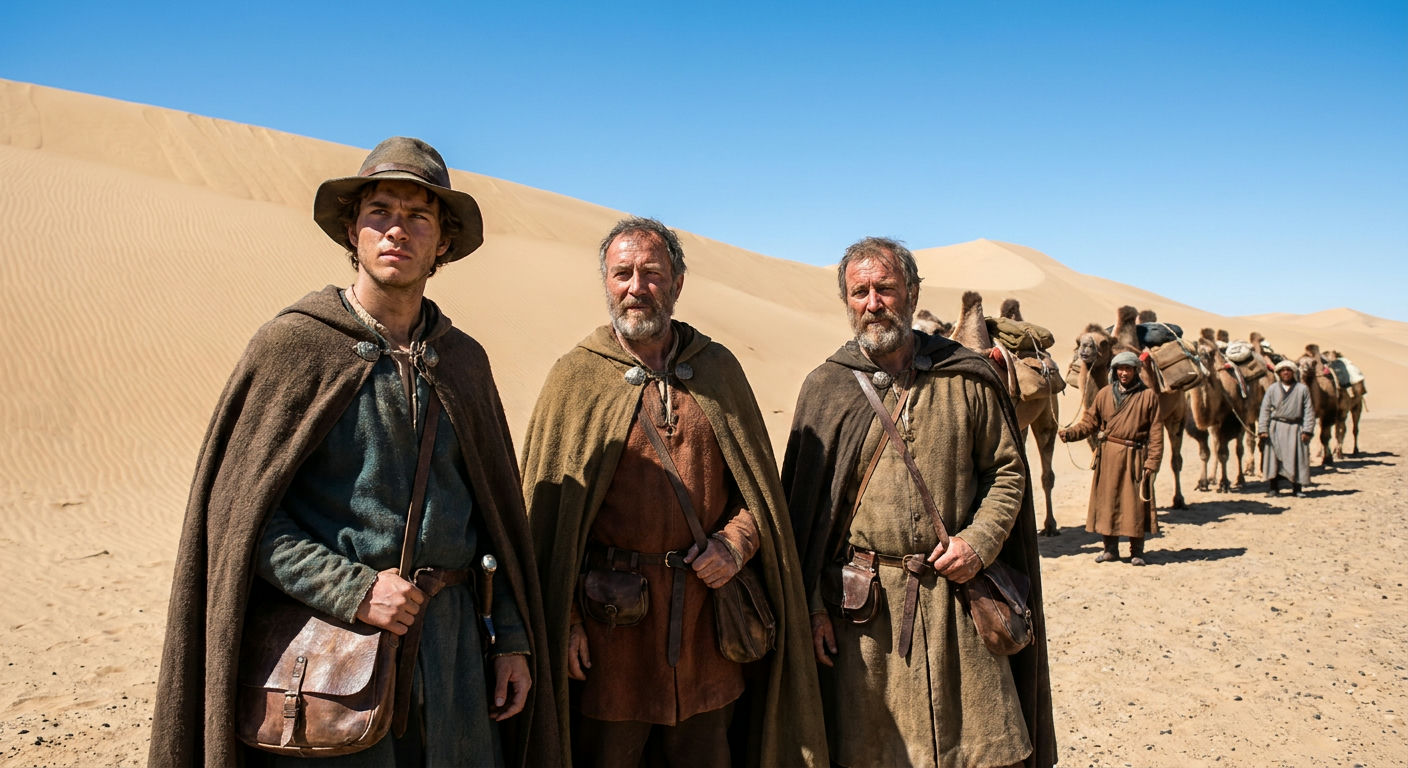
In the year 1298, a Genoese prison cell held a man who claimed to have seen the ends of the earth. While most of his fellow inmates were concerned with their immediate freedom, Marco Polo was busy dictating a manuscript that would rewrite the Western understanding of geography. He spoke of cities where the streets were paved with stone, of black rocks that burned like wood, and of a postal system that could span a continent in days. To his listeners in the Mediterranean, these were the hallucinations of a traveler lost too long at sea, yet Polo insisted he was merely reporting what he had witnessed during twenty-four years in the service of the Mongol Empire.
The journey had not begun as a grand expedition of discovery, but as a family business venture. In 1271, a young Marco set out from Venice alongside his father, Niccolò, and his uncle, Maffeo. The elder Polos had already visited the East once, returning with a request from the Great Khan for oil from the Holy Sepulcher and a hundred Christian scholars. They carried the oil, but the scholars, fearing the grueling journey across the mountains of Anatolia and the deserts of Persia, turned back almost immediately. Marco, barely seventeen years old, did not.
The Roof of the World and the Singing Sands
The travelers followed the ancient arteries of the Silk Road, a network of trade routes that had facilitated the exchange of goods and ideas for centuries. Their passage was made possible by the Pax Mongolica, a period of relative stability where the Great Khan’s protection allowed a Venetian teenager to walk through territories that had been impassable for centuries. Their path took them through the high, oxygen-thin passes of the Pamir Mountains, which Marco described as the "Roof of the World." Here, he noted the presence of great wild sheep with massive curling horns, a species that would centuries later be named the Ovis ammon polii in his honor. These animals were not just curiosities; they were vital indicators of the high-altitude ecology that sustained the Mongol scouts.
It was in the shifting sands of the Gobi Desert that the expedition truly felt the isolation of the East. Marco recorded legends of spirits that called out to travelers by name, leading them away from the caravan to their deaths in the dunes. These "singing sands," now understood as a rare acoustic phenomenon caused by shifting grains, created a psychological landscape as treacherous as the physical one. By the time they reached Shangdu, the legendary summer capital of the empire, the young Venetian had transformed from a sheltered merchant’s son into a seasoned survivor of the world’s most demanding terrain.
The Paper Empire
When the Polos finally stood before Kublai Khan, the grandson of Genghis Khan, they were met not with hostility, but with intense curiosity. The Khan was a ruler of unprecedented reach, governing a territory that stretched from the Pacific Ocean to the gates of Europe. Recognizing Marco’s knack for languages and his keen eye for detail, the Khan took him into his inner circle as a foreign diplomat. While his father and uncle focused on the trade of jewels and silk, Marco was dispatched on administrative missions to the furthest corners of the empire, including regions of modern-day Yunnan and Burma.
During these missions, Marco encountered wonders that defied European logic. He observed the use of paper money, a concept entirely alien to a world that traded in heavy gold and silver coins. He saw the "black stones" being dug from the earth and burned for heat—coal—at a time when Europe relied almost exclusively on timber. Most importantly, he documented the efficiency of the Yam, the Mongol relay system. This network used thousands of stations and 200,000 horses to transmit messages across the empire with a speed that would not be matched in the West for another five hundred years.
The Voyage of the Fourteen Ships
After seventeen years in the Khan’s service, the Polos grew anxious to return home. The aging Kublai Khan was reluctant to let his useful informants go, but a diplomatic opportunity finally provided their exit. They were tasked with escorting a Mongol princess, Kököchin, to Persia, where she was to marry a local ruler. This final leg of the expedition was not an overland trek, but a massive maritime undertaking involving a fleet of fourteen large junks departing from the port of Quanzhou.
The sea voyage was a harrowing ordeal that lasted two years. They sailed through the South China Sea, stopped in the kingdom of Champa in modern Vietnam, and navigated the treacherous waters around Sumatra and the Andaman Islands. By the time the fleet reached the Persian Gulf, hundreds of sailors and passengers had perished from disease and storms. Only a handful of the original party survived, including the three Polos. When they finally walked into Venice in 1295, dressed in tattered Mongol robes and speaking their native tongue with difficulty, their own relatives failed to recognize them until they sliced open the seams of their clothes to reveal a fortune in rubies and emeralds.
The Legacy of the Million Lies
Marco Polo’s story might have ended as a local Venetian legend if he hadn't been captured by the Genoese during a naval skirmish shortly after his return. In prison, he met a writer of romances named Rustichello da Pisa, who helped him compile his memories into the book known as The Travels of Marco Polo. The work was an instant sensation, though widely dismissed as a collection of "a million lies." Skeptics noted curious omissions: Polo never mentioned tea, chopsticks, or the Great Wall, leading some to wonder if he had ever reached China at all.
Yet, for all the skepticism, the book provided the first detailed European account of the Spice Islands, the wealth of Japan, and the sophisticated urban planning of Hangzhou. The maps of the medieval world began to shift based on these descriptions, most notably influencing the 1375 Catalan Atlas. Two centuries later, a Genoese navigator named Christopher Columbus would obsessively study his own copy of Polo’s book, marking the margins with notes as he planned his own voyage to reach the riches of the Khan by sailing West. Polo’s expedition did not just bring back jewels; it brought the realization that the world was far larger, more populated, and more technologically advanced than the West had ever dared to imagine. On his deathbed in 1324, when urged to recant his stories, Marco famously replied that he had not told half of what he saw.
This story travelled through
Where does this story take you next?
Every story opens a door somewhere else. Pick a thread and we'll tell you that story too.
Curious about something else?
Discover another exploration