The Green Gold of the Volcanic Staircase: Madeira’s Banana Legacy
On the sheer volcanic cliffs of Madeira, a small and fragrant 'green gold' saved the island's economy and created one of the world's most complex irrigation landscapes.
This story began with a question: “Bananas in Madeira”
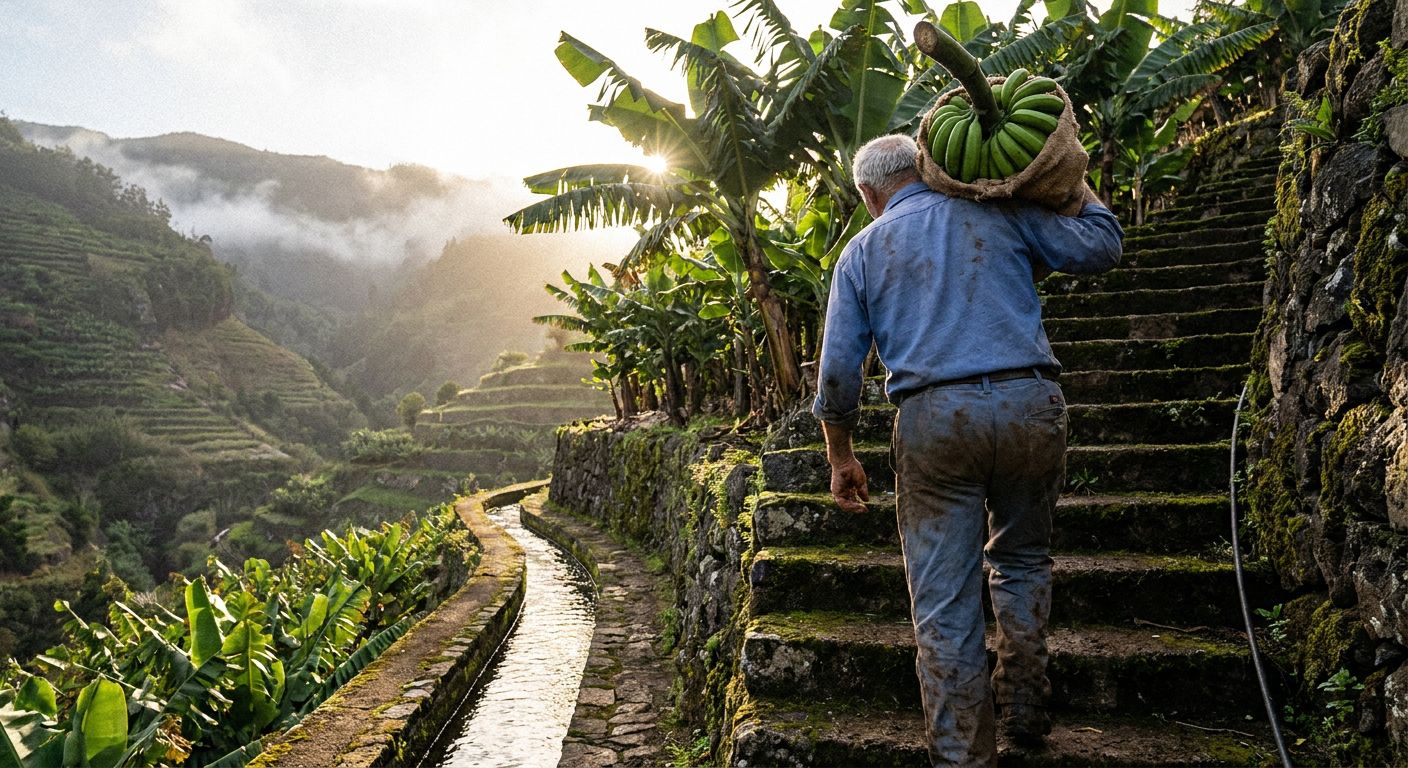
Standing on the southern terraces of Funchal and looking toward the Atlantic, the view is defined by a dense canopy of broad, waxy leaves. These are the banana groves of Madeira. Clinging to the steep, volcanic ribs of the island, these plants occupy nearly every available meter of the lower elevations. While the banana appears as a permanent fixture of the landscape, it is a relatively recent arrival, a tropical migrant that fundamentally restructured the island’s economy and its physical geography during a period of agricultural crisis.
To understand the dominance of the banana, one must look at the island’s vertical architecture. Madeira is the summit of a massive shield volcano, characterized by sheer slopes and a lack of flat plains. Over centuries, Madeirans carved the basalt and tuff into poios—narrow, stone-walled terraces that climb from the shoreline to the misty interior. For centuries, these terraces were the domain of sugarcane and later Malvasia grapes for the island’s famous fortified wine. By the late 19th century, however, a combination of grapevine diseases and the rise of beet sugar in Europe forced a pivot toward a new export.
The Rise of the Cavendish in Madeira
The transition was accelerated by British maritime logistics. In the late 1800s, Funchal served as a vital coaling station for British shipping lines, such as the Union-Castle Line, on the long route to South Africa. These ships arrived with coal and often returned to Europe with empty holds. Enterprising merchants realized that the island’s southern microclimates—specifically in sun-drenched areas like Madalena do Mar and Ponta do Sol—were ideal for the Musa cavendishii, or Dwarf Cavendish banana. Unlike the large, industrial varieties grown on massive Latin American plantations, the Madeiran cultivar grew smaller and denser due to the subtropical climate, which slowed the ripening process and concentrated the sugars.
By the early 20th century, the banana had become the island’s "green gold." It was uniquely suited to the local social structure. Unlike the seasonal labor required for wine or sugar, bananas could be harvested year-round, providing a consistent cash flow for smallholder families. This led to a fragmented but resilient agricultural system where most production occurred on plots of less than half a hectare, often maintained by a single family.
The Engineering of Madeira's Levada System
The proliferation of these thirsty plants was only possible through a massive hydraulic undertaking. Because the island’s rainfall is concentrated in the high-altitude laurel forests of the interior, the coastal agricultural zones sit in a permanent rain shadow. To bridge this gap, the islanders expanded an ancient network of stone and concrete channels known as levadas.
These levadas stretch for over 2,000 kilometers, carrying snowmelt and rainwater from the peaks down to the coastal terraces. The distribution of this water is governed by a complex legal framework of "water rights" known as the heréus (heirs) system. In this arrangement, water ownership is decoupled from land ownership; a farmer may own the terrace but must lease or inherit the specific hours of water flow required to irrigate it.
The physical management of this flow falls to the aguadeiro (water warden). Moving through the hills with a heavy iron tool, the aguadeiro opens and closes sluice gates at precise intervals. It is a system of timed scarcity: if a farmer misses their window, the water continues its gravity-fed journey to the next plot, and the plants must wait another cycle. Without this synchronized plumbing, the southern slopes would revert to arid volcanic scrub.
The PGI Status and the Smallholder Economy
In the late 20th century, the Madeiran banana faced an existential threat from the standardization of the European market. Following Portugal’s entry into the European Union, new regulations regarding the size and "curvature" of fruit threatened to classify the naturally smaller Madeiran variety as substandard. This regulatory pressure could have decimated the island’s smallholders, who could not compete with the economies of scale found in Central American monocultures.
In response, Madeira pivoted toward quality and origin. The island secured Protected Geographical Indication (PGI) status, certifying that the "Banana da Madeira" is grown in volcanic soil enriched by organic matter and irrigated by the unique levada system. This designation preserved the partilha (share) system, where cooperative centers collect fruit from thousands of small farmers rather than a few large estates.
Today, the logistics remain as vertical as the landscape. Because the poios are too narrow for machinery, the heavy bunches, often weighing 30 to 50 kilograms, are still carried out on the shoulders of farmers. They navigate the narrow basalt walls and steep stairs, a labor-intensive process that links the island’s volcanic geology to the global fruit trade. The banana grove is not merely a plantation; it is a high-maintenance machine of stone, water, and human effort that continues to hold the island’s soil in place.
This story travelled through
Where does this story take you next?
Every story opens a door somewhere else. Pick a thread and we'll tell you that story too.
Curious about something else?
Discover another exploration