The Wine That Cooked at Sea
A logistical disaster in the sweltering holds of 17th-century ships accidentally created a wine that is virtually immortal.
This story began with a question: “How was Madeira wine invented by accident?”
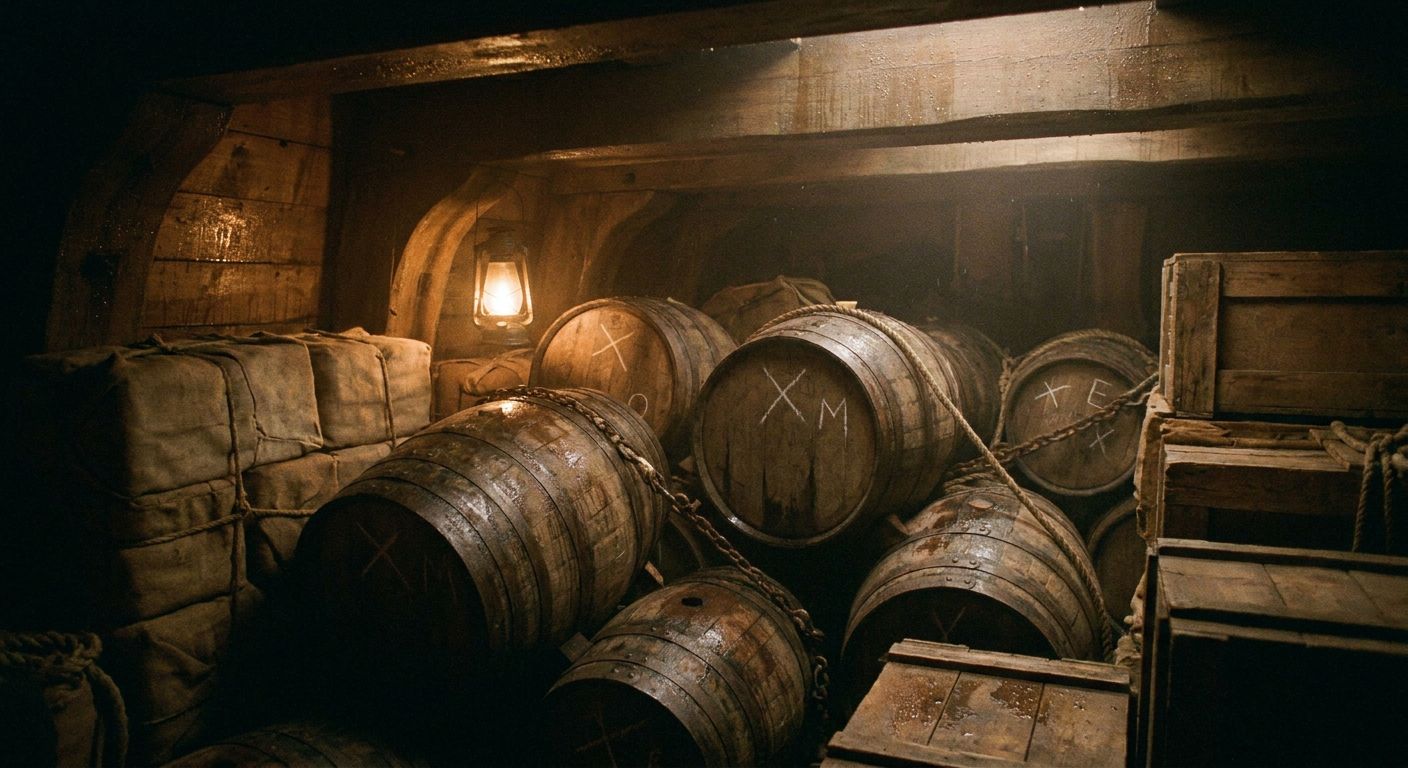
In the lightless hold of a 17th-century merchant vessel, the air was heavy with the smell of damp oak and the slow evaporation of spirits. Tucked between crates of salted cod and textiles were barrels of fortified wine from Madeira, a volcanic archipelago situated off the coast of North Africa. These casks were destined for the humid trading posts of the East Indies or the fledgling ports of the Americas, but they were never intended to be cooked. As the ships crossed the equator, the ambient temperature in the hold routinely exceeded 100 degrees Fahrenheit, effectively stewing the wine for months. By the established rules of viticulture, this extreme heat should have accelerated oxidation to a ruinous degree, turning the liquid into acrid vinegar.
Instead, when the vessels returned to Europe or reached their distant markets, merchants discovered a transformation. The relentless heat and the constant agitation of the Atlantic swell had acted as a catalyst, mellowing the harsh, young wine into something dark, complex, and remarkably stable. The wine had not spoiled; it had evolved. This accidental discovery gave birth to a beverage that is virtually immortal, capable of surviving for centuries in a bottle.
The Island of Fire and Vine
To understand how a wine could survive a tropical furnace, one must look at the jagged geology of Madeira itself. The island is a massive shield volcano rising nearly 20,000 feet from the seafloor. When Portuguese explorers reached it in the early 1400s, the landscape was a dense, impenetrable thicket of laurel forest. Historical lore suggests the settlers set fires to clear the land that burned for seven years, though modern historians view this as a hyperbolic tale of the struggle to tame the wilderness. Regardless, the result was a soil saturated with potash and volcanic minerals, creating an environment that produced grapes with exceptionally high acidity.
The Portuguese settlers carved precarious terraces, called poios, into the sheer cliffs and engineered an intricate system of stone irrigation channels known as levadas to carry water from the misty peaks to the sun-drenched slopes. This labor-intensive hydrology, drawing water through basalt and ash, contributed to a must—the unfermented grape juice—that was naturally high in tartaric acid. In the early centuries of trade, this acidity was a liability; the wine was often thin and sharp until it was fortified with a splash of cane-sugar brandy to help it survive the initial journey to the docks of Funchal.
The Tropical Kiln at Sea
The accidental invention of the Madeira we recognize today coincided with the Age of Discovery. Madeira was the final port of call for ships heading into the "Torrid Zone" near the equator. Because fresh water frequently turned brackish and green in the heat of the tropics, wine was a vital necessity for sailors. The barrels acted as ballast, shifting and rolling with every wave.
During these long voyages, the wine underwent a process now known as maderization. In a standard cellar, oxygen is the enemy, but the unique chemistry of Madeira’s high-acid grapes, combined with the presence of fortifying spirits, allowed the liquid to withstand the heat. The thermal energy catalyzed a series of Maillard reactions—the same chemical process that browns bread or sears a steak—caramelizing the residual sugars and smoothing the volatile acids.
These barrels were designated as Vinho da Roda, or "wine of the round voyage." Merchants soon realized that the wine that had traveled to India and back was vastly superior to the wine that remained in the cool cellars of Funchal. The rocking of the ship ensured a consistent exposure to the oak of the cask, while the equatorial heat functioned as a slow-cooker, developing deep notes of toasted walnuts, dried apricots, and burnt sugar.
Madeira and the American Revolution
By the 18th century, Madeira had become the preferred drink of the British colonies in America. Unlike other European products, which were heavily taxed under the Navigation Acts, Madeira enjoyed a peculiar tax loophole that made it more accessible and affordable than French or Spanish wines. It quickly became the beverage of the American elite, suited to a climate that was notoriously hard on more delicate vintages.
It is said that Thomas Jefferson, a renowned oenophile, was so enamored with the stuff that he used it to toast the signing of the Declaration of Independence. The wine’s durability was its greatest asset in the New World; it did not spoil in the humid summers of Virginia or the freezing winters of Massachusetts. In fact, Madeira is one of the few wines in the world that can stay open in a decanter for months, or even years, without losing its character—a trait that mirrored the rugged resilience the colonists prided themselves on.
However, the "round voyage" method was expensive, requiring years of travel and the risk of shipwrecks. As global demand soared, producers on the island developed the estufa—a specialized heating system. Initially, these were rooms warmed by wood fires or steam pipes, designed to mimic the sweltering heat of a ship's hold without the need for a transatlantic ticket.
The Immortals in the Attic
Today, the most prestigious Madeiras bypass the modern stainless-steel estufas in favor of the canteiro method. In the venerable wine lodges of Funchal, barrels are placed in the warm attics, where they sit for decades, exposed to nothing but the natural heat of the sun. This slow, gentle heating process replicates the historical voyages at a glacial pace.
Because the wine has already been subjected to extreme heat and oxidation during its maturation, it is fundamentally stable. It is a liquid that defies the very nature of decay. There are bottles of Madeira from the 1800s that remain perfectly drinkable today, offering a direct, sensory link to the past. In an era of mass-produced, fragile wines intended for immediate consumption, Madeira stands as a testament to a logistical failure. What began as the "problem" of wine sitting too long in a hot ship resulted in the creation of a drink that, quite literally, has all the time in the world.
This story travelled through
Where does this story take you next?
Every story opens a door somewhere else. Pick a thread and we'll tell you that story too.
Curious about something else?
Discover another exploration