The Banner County: A Journey Through the Stone and Song of Clare
From the moon-like limestone of the Burren to the soaring Cliffs of Moher, Clare is a kingdom of stone, defiance, and song.
This story began with a question: “What is the story of County Clare?”
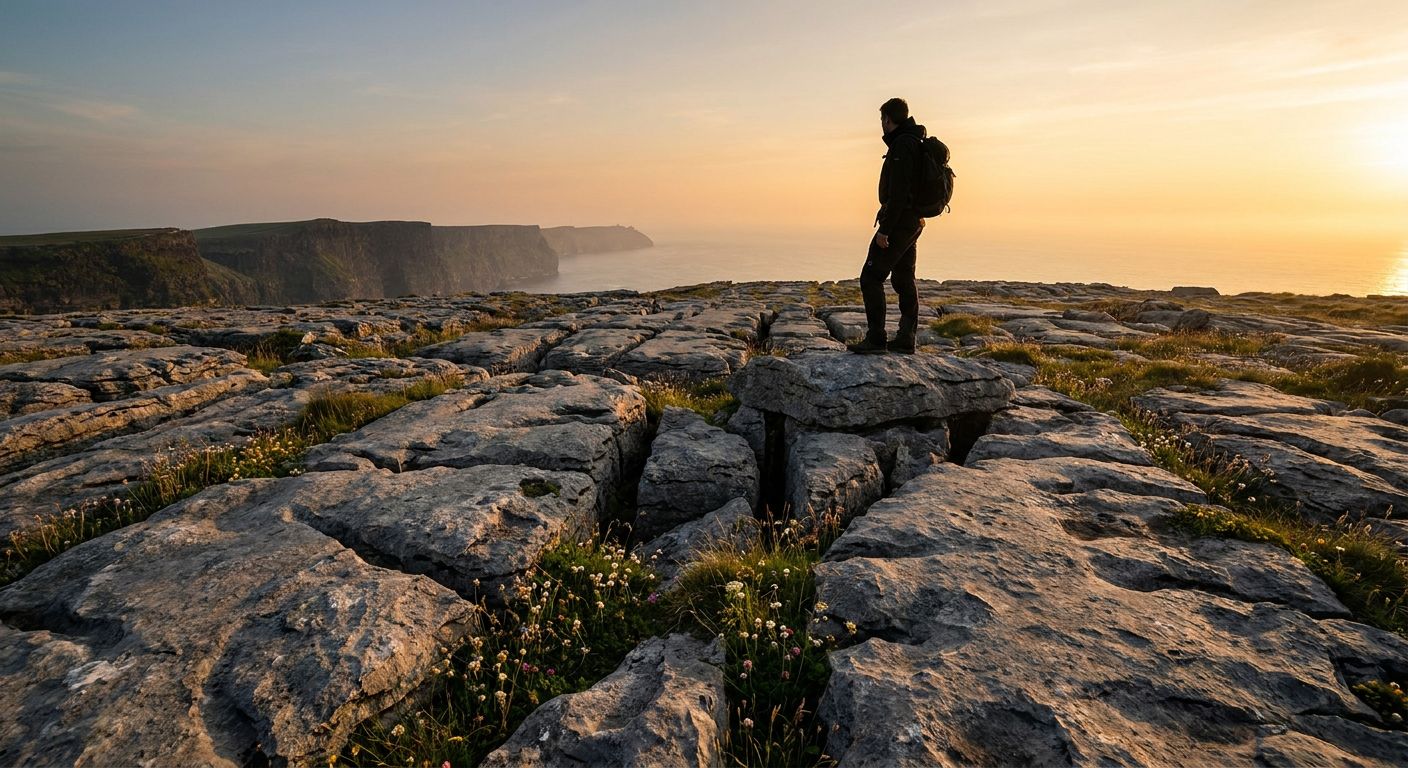
If you stand on the edge of the Cliffs of Moher, the world seems to dissolve into a vertical drop of seven hundred feet. Below, the Atlantic Ocean churns into a white froth against dark Namurian shale; above, the wind carries the cry of thousands of puffins and razorbills. It is a place that feels like the very end of the earth, yet for the people of County Clare, this dramatic limestone fringe is just the doorstep to a land that has been inhabited, fought over, and sung about for six millennia.
County Clare, often called the "Banner County," sits on the mid-western coast of Ireland, shaped like a rough wedge by the Atlantic to the west and the mighty River Shannon to the east. It is a landscape of stark contrasts. To the north lies the Burren, a vast, moon-like plateau of grey limestone that looks utterly desolate until you look closer and find Arctic, Alpine, and Mediterranean flowers growing together in the cracks of the rock. To the south and east, the land softens into the rolling green hills and deep lakes that define the Irish pastoral ideal.
The Kingdom of Thomond
Long before it was a county on a map, this region was the heart of the Kingdom of Thomond, the domain of the Dál gCais clan. In the 10th century, a leader emerged from these limestone hills who would change the course of Irish history: Brian Boru. Born near Killaloe on the banks of the Shannon, Boru rose from a provincial chieftain to become the High King of Ireland, famously breaking the power of the Vikings at the Battle of Clontarf in 1014.
The legacy of the O’Brien dynasty—Boru's descendants—is etched into the very stone of the county. Throughout the medieval period, they managed a delicate balancing act, resisting Anglo-Norman encroachment while building soaring tower houses and majestic abbeys. You can see this defiance in the ruins of Quin Abbey or the stout walls of Bunratty Castle. Even when the English crown eventually asserted control, the O’Briens transitioned from kings to the Earls of Thomond, ensuring that the political DNA of Clare remained distinct and fiercely independent.
A Landscape of Stone and Spirit
To understand Clare, one must walk the "pavements" of the Burren. The name comes from the Irish Boireann, meaning "rocky place." An officer in Oliver Cromwell’s army famously complained that it was a country where there was "not water enough to drown a man, nor wood enough to hang a man, nor earth enough to bury a man." Yet, for the Neolithic farmers who lived here 5,000 years ago, this was a land of abundance.
The Poulnabrone Dolmen, a massive stone portal tomb that stands silhouetted against the Burren sky, is a testament to these ancient inhabitants. They cleared the original pine forests, grazing their cattle on the thin soils and unintentionally creating the unique ecosystem that exists today. The limestone absorbs the sun's heat in the summer and releases it slowly through the winter, allowing cattle to graze outdoors year-round in a practice known as "winterage," a tradition that continues to this day.
The Dál gCais clan maintained a unique system of law and land ownership that lasted centuries longer than in other parts of Ireland.
The Hunger and the Banner
The 19th century brought a darkness to Clare that still haunts the ruins of abandoned cottages scattered across the hillsides. The Great Famine of the 1840s hit the county with devastating force. As a potato-dependent population faced blight, thousands died or were forced onto coffin ships bound for America. The population of Clare plummeted, and the scars of eviction and mass emigration became central to the local identity.
However, this hardship also forged a spirit of political radicalism. In 1828, Clare became the epicenter of a peaceful revolution. Daniel O’Connell, known as "The Liberator," stood for election in the Clare by-election. Despite being a Catholic—and therefore legally barred from sitting in the British Parliament—the people of Clare defied their landlords and voted for him in a landslide. This act of mass civil disobedience forced the British government to pass the Catholic Emancipation Act, a turning point in the history of the United Kingdom and Ireland. It was this reputation for political defiance that earned Clare its nickname, the Banner County.
The Pulse of the Iron Age
As the 20th century dawned, Clare found a new way to assert its identity: through the bow and the bellows. While other parts of Ireland saw their traditional music fade under the influence of global radio, Clare became a fortress for the old tunes. The village of Ennistymon and the town of Ennis became hubs for a style of fiddling and concertina playing that was rhythmic, lonesome, and deeply connected to the land.
Today, if you walk into a pub in Doolin or Feakle, the music is not a performance for tourists; it is a living language. The tunes played today often have roots stretching back to the harpists of the Gaelic courts. In the 1970s, Doolin famously became a pilgrimage site for musicians from all over the world, drawn by the raw, soulful playing of the Russell brothers.
The village of Doolin transformed from a quiet fishing outpost into the undisputed capital of Irish traditional music.
The story of County Clare is ultimately one of resilience. It is written in the resilient wildflowers that bloom in the limestone grikes, in the stone forts that have withstood a millennium of Atlantic gales, and in the stubborn independence of a people who refused to be told how to vote or how to pray. As the sun sets over the Aran Islands, visible from the Clare coast, the county remains a place where the ancient past isn't behind you—it’s right beneath your feet.
This story travelled through
Where does this story take you next?
Every story opens a door somewhere else. Pick a thread and we'll tell you that story too.
Curious about something else?
Discover another exploration