The Sound of the Atlantic Shore: Doolin’s Musical Legacy
How a remote village in County Clare became the unofficial capital of traditional Irish music.
This story began with a question: “Why did Doolin become the center of Irish music?”
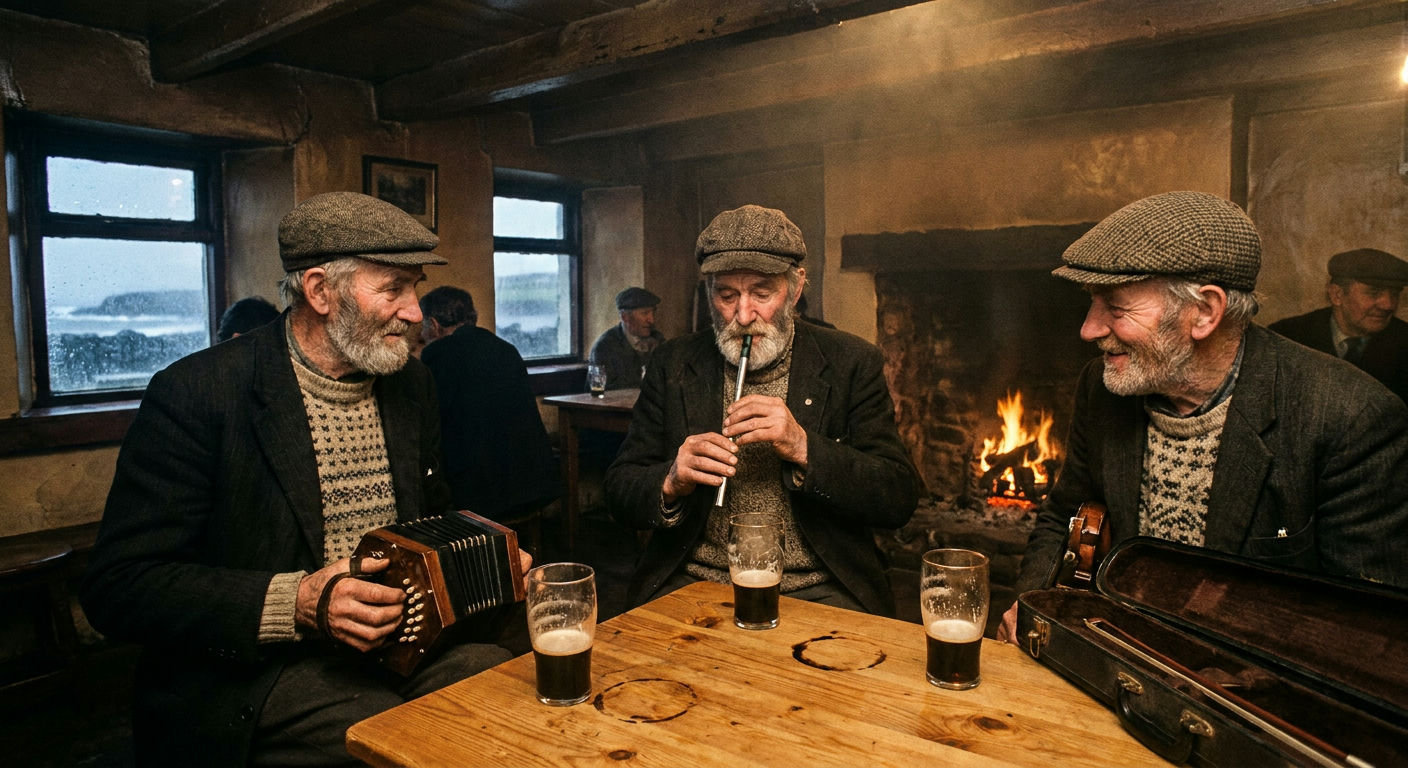
A sharp Atlantic wind rattles the windows of Gus O'Connor’s Pub, a low-slung, white-walled building that stands at the very edge of the County Clare coastline. Inside, the noise defines the room: the frantic, rhythmic pulse of a wooden flute and the driving beat of a bodhrán drum. For decades, this tiny village, a mere collection of houses scattered along the road to the Cliffs of Moher, has served as the unofficial capital of traditional Irish music.
To look at Doolin on a map, its prominence seems accidental. It is a remote outpost in The Burren, a limestone wilderness where the soil is too thin for heavy farming. Yet, it was this very isolation that acted as a preservative. While the rest of Ireland was being transformed by the arrival of global pop culture in the mid-20th century, the music in this corner of Clare remained untouched by modern ornamentation, played exactly as it had been for generations.
The Russell Brothers and the Oral Tradition
The story of Doolin’s rise does not begin with a concert hall, but with three brothers who lived in a small cottage near the bridge. Micho, Pakie, and Gussie Russell were not professional entertainers; they were laborers and farmers who happened to possess a vast, mental library of regional tunes. Micho, the eldest, became a folk hero for his distinctive style on the tin whistle, a playing method that favored a breathy, rhythmic "staccato" over the flashy speed found in other parts of the country.
In the 1960s, a decade when Ireland was looking outward, the Russell brothers were looking inward. They played for themselves and for their neighbors in kitchens and small back rooms. When the first outsiders began to arrive—travelers and students who had heard rumors of a "pure" sound—they found the Russells sitting by the fire, willing to share tunes that had never been written down on paper. This was a living link to a pre-industrial past, where music was a functional tool for social cohesion rather than a commodity.
The arrival of these visitors changed the local geography. Small pubs like McGann's and McDermott's, which had previously been quiet stops for local tradesmen, began to stay open late to accommodate the growing crowds. By the 1970s, Doolin had become a pilgrimage site for musicians from across Europe and America, all drawn by the chance to sit in on a "session"—an informal, unrehearsed gathering where the music is passed from person to person like a conversation.
The Physics of Sound and Stone
There is a physical reason why the music of Doolin sounds the way it does. The village sits on the edge of the Burren, a vast plateau of cracked limestone that reflects sound with a peculiar clarity. In the days before electronic amplification, musicians in Clare developed a style that was incredibly percussive and driving, designed to carry across a crowded room or cut through the roar of the Atlantic gale.
This regional style is known for its "lift," a rhythmic bounce that distinguishes it from the faster, more fluid fiddle traditions of Sligo or the aggressive piping of Donegal. In Doolin, this was perfected on the concertina, a small, hexagonal accordion. The instrument was rugged enough to survive the salt air that often warped the delicate bellows of uilleann pipes, and it was portable enough to be carried to the frequent house dances that served as the community's primary social outlet.
As word of the Doolin sessions spread, the village became a crossroads. The environment was democratic; a world-famous fiddler might spend the evening playing alongside a local farmer who had just finished his day’s work. This lack of a stage or a barrier between the performer and the listener created an intimacy that could not be replicated in a city theater.
A Legacy in the Limestone
By the late 1980s, the quiet fishing village had transformed into a destination. The nightly sessions in the pubs now attract thousands, yet the core of the music remains tied to the local weather and the local pace of life. Even today, a session in Doolin is rarely a planned event with a start time; it is something that emerges organically when the right people happen to be in the room at the same time.
The success of the village has brought challenges, as the sheer volume of visitors threatens to turn a living culture into a static performance. However, the music survives because it is still functional. It is played for weddings, for wakes, and for the simple purpose of passing a long, dark winter night. The Russell Memorial Weekend, held every February, ensures that the specific, minimalist style of the founding brothers is not lost to the faster, more aggressive styles of modern commercial music.
The true secret of Doolin lies in the fact that it never tried to become a center for anything. It was a place where the music was simply allowed to stay behind when the rest of the world moved on. The wind still howls off the Aran Islands, and the limestone still rings underfoot, providing the same raw backdrop that inspired the first tunes centuries ago. One can still hear Micho’s influence in the "tight" playing of local whistlers, a reminder that in the Burren, the sound is as permanent as the stone.
This story travelled through
Where does this story take you next?
Every story opens a door somewhere else. Pick a thread and we'll tell you that story too.
Curious about something else?
Discover another exploration