Why are the Faroe Islands Treeless? The Wind’s Verdict
A relentless combination of salt-laden gales and centuries of sheep grazing has carved a unique, treeless landscape into the heart of the North Atlantic.
This story began with a question: “Why do the Faroe Islands have so few trees?”
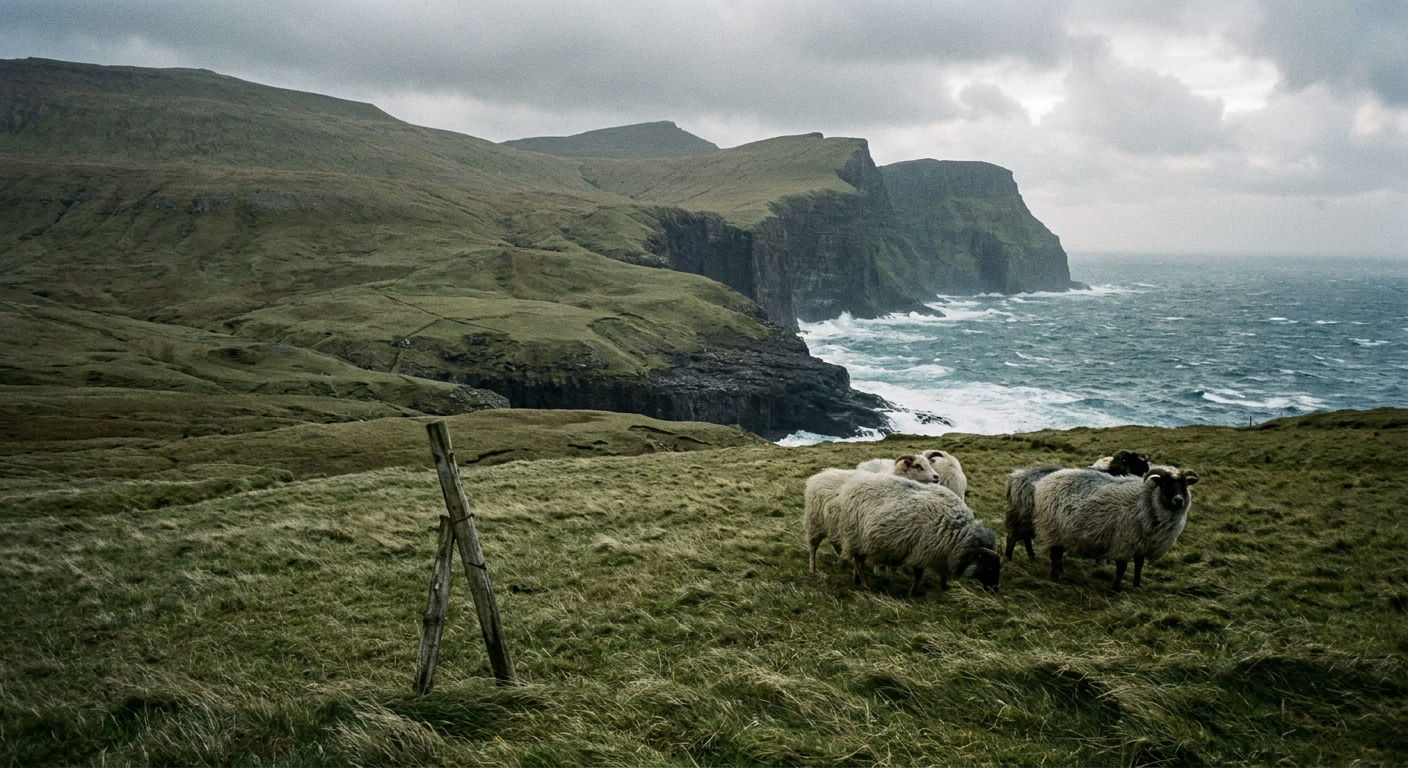
If you stand on the slopes above Tórshavn, the small, colorful capital of the Faroe Islands, the horizon is a rhythmic progression of green and grey. Basalt cliffs drop into a churning sea, and steep, treeless mountains rise like the backs of sleeping whales. It is a landscape defined by what is missing. While their neighbors in Scotland and Norway are draped in birch and pine, these eighteen islands sit bare under a heavy sky.
The visitor’s first instinct is often to blame the cold, but the temperature here rarely drops to the bone-chilling depths of the continental north. Instead, the islands are held in the grip of the North Atlantic Drift, a warm ocean current that keeps the harbors ice-free all winter. The problem isn't the frost; it is a relentless, multidirectional pressure that defines every living thing on the archipelago.
The Weight of the Air
In the Faroes, wind is not a seasonal event but a constant neighbor. The islands sit directly in the path of the Atlantic depressions, storms that gather strength over thousands of miles of open water before slamming into the basalt walls of Suduroy or Vagar. When the air hits these vertical obstacles, it accelerates. During extreme weather events, such as the destructive 1999 hurricane, gusts have been recorded at over 150 miles per hour.
For a sapling, this environment is hostile. To grow tall is to offer the wind a lever. A tree’s own height becomes the instrument of its destruction; the leverage of a long trunk allows the gale to snap the wood or heave the root ball out of the thin, waterlogged soil. The native vegetation—grasses, mosses, and cushion-forming wildflowers—has adapted by hugging the ground, staying beneath the fastest currents of the air.
Even when a tree manages to stand, the wind brings a chemical weapon: salt spray. The air is so thick with brine from the crashing surf that it coats the leaves, drawing moisture out of the plant cells and "burning" the foliage. In a land where every breeze carries the ocean, only the hardiest, waxiest leaves can survive. The tall, broad-leafed forests of the European mainland simply cannot gain a foothold.
The Four-Legged Mowers
The wind may have set the stage, but the current emptiness of the islands was finalized by a different force. When Norsemen arrived during the Landnám period in the 9th century, they brought with them a creature that would fundamentally change the ecology of the islands: the sheep. The name Føroyar itself translates to "Sheep Islands," and for over a millennium, these animals have been the backbone of the local economy.
Before the sheep arrived, botanical evidence suggests that small thickets of downy birch and willow existed in sheltered gullies, clinging to life in the lee of the great cliffs. However, sheep are indiscriminate grazers. In a landscape where the soil is shallow and the growing season is short, any new shoot or sapling is a vital source of nutrients. Over centuries, continuous grazing prevented the natural regeneration of these small woody pockets.
The sheep transformed the islands into a perpetual grassland. By eating the young trees before they could develop bark thick enough to withstand the elements, the flocks ensured that the forest could never return on its own. The result is a climax grassland, a stable ecosystem where the pressure of grazing is so consistent that the landscape remains frozen in a treeless state.
The Secret Gardens
However, there are places in the Faroes where the rules do not apply. If you walk into a walled garden in the center of Tórshavn, or visit Viðarlundin park—established in 1903 as a municipal project—you are suddenly surrounded by the rustle of leaves. Here, towering Japanese larch, Sitka spruce, and sycamore thrive, reaching heights that seem impossible given the surrounding bareness.
These woods are not accidents; they are carefully managed experiments that began with 19th-century botanical interest. By building high stone walls and planting trees in dense, communal clusters, humans have created artificial windbreaks. Inside these enclaves, the humidity remains high and the wind speed drops just enough for the trees to survive their vulnerable early years. Once a canopy is established, the trees protect one another, the outer layer taking the brunt of the salt and wind while the inner trees grow straight and tall.
These tiny forests prove that the climate can support trees, provided they are shielded from the twin pressures of the gale and the tooth. They serve as a green contrast to the wild hills of Eysturoy, reminding locals and visitors alike that the barrenness of the islands is a delicate balance between the power of the ocean and the history of the people who live there.
A Landscape of Moss and Light
Today, the lack of trees defines the Faroese aesthetic. Without a canopy to block the view, the light plays across the mountains in ways that are impossible in a forested land. A single break in the clouds can illuminate an entire valley, turning the wet basalt into a mirror and the grass into a glowing, emerald velvet. The locals have learned to value the clarity of the horizon, where the eye can travel from the mountain peak to the sea without interruption.
This openness has shaped the architecture, the myths, and the very identity of the Faroese people. They live in a world where the earth is visible, where the geological bones of the planet are not hidden under a blanket of green. The absence of trees is not a void, but a presence—a testament to the enduring strength of the wind and the ancient rhythm of the flocks that have claimed these rocks as their own.
In recent years, researchers have begun to look at these treeless slopes not as a lost forest, but as massive carbon sinks stored in deep peat layers. While the forest may never conquer the cliffs again, the grass and moss continue their quiet work, anchoring the islands against the North Atlantic.
This story travelled through
Where does this story take you next?
Every story opens a door somewhere else. Pick a thread and we'll tell you that story too.
Curious about something else?
Discover another exploration