The Suns of the Savannah: A Journey Through Africa's Lost Empires
From the golden courts of Mali to the stone towers of Zimbabwe, rediscover the empires that shaped the world.
This story began with a question: “A story from Africa”
If you stand on the shores of the Gulf of Guinea as the sun begins to set, the air carries a heavy, humid sweetness that masks the complex history written into the landscape. For centuries, this stretch of West Africa was the center of a world defined not by what it lacked, but by its immense sophistication and wealth. Before the arrival of European ships, empires here had mastered the art of statecraft, the science of metallurgy, and the delicate balance of trans-continental trade. To understand Africa is not to look at a single timeline, but to witness a tapestry of rising and falling suns, each illuminating a different peak of human achievement.
The Lion of Mali and the Golden Path
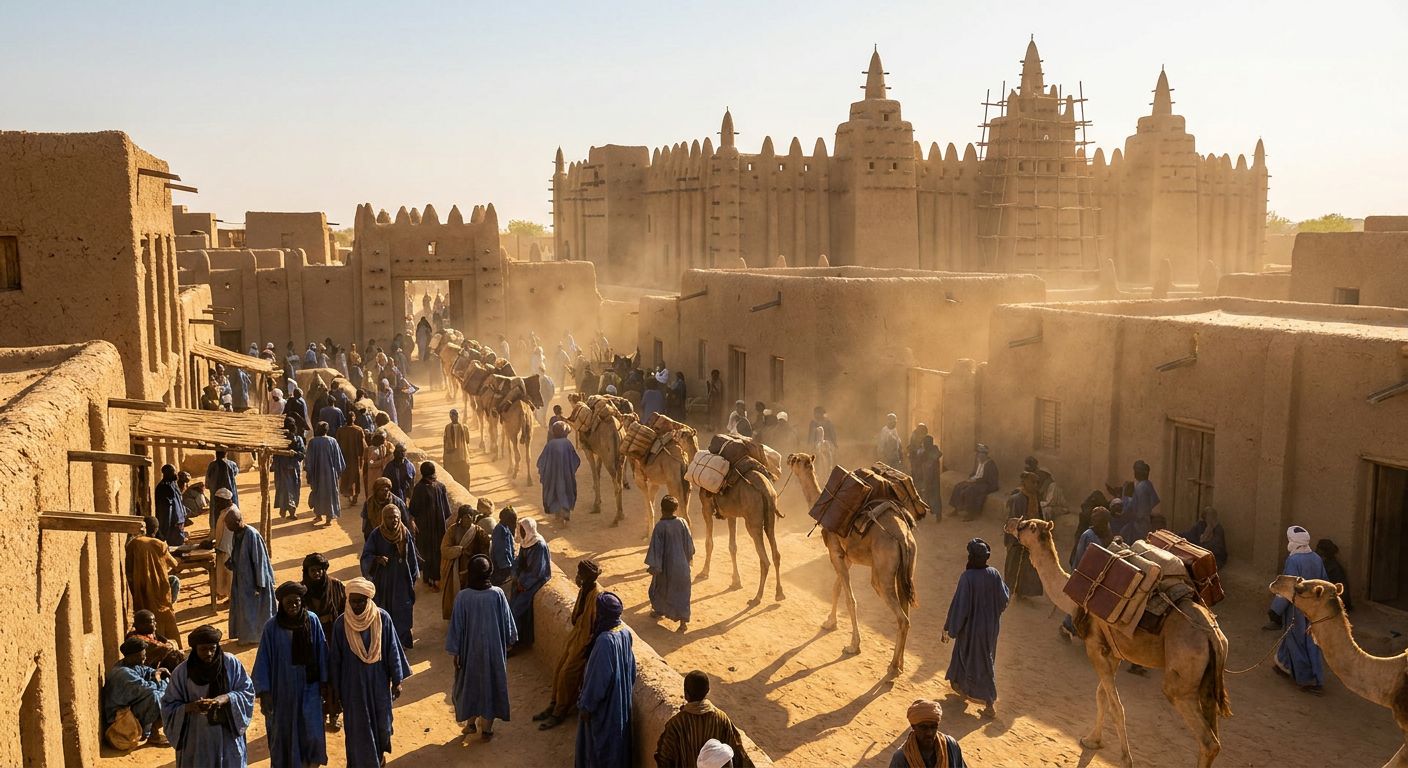
In the 14th century, the eyes of the Mediterranean and the Middle East were turned toward the interior of the continent, specifically to a man named Mansa Musa. He was the ruler of the Mali Empire, a vast territory that stretched from the Atlantic coast to the Niger River. Mali was not just a kingdom; it was a global powerhouse built on the control of two essential commodities: salt and gold. The salt came from the mines of the Sahara, and the gold from the secret deposits of Bambuk and Bure.
When Mansa Musa embarked on his pilgrimage to Mecca in 1324, he didn't just travel; he moved an entire city across the desert. Thousands of soldiers, heralds draped in silk, and camels laden with bars of gold followed his trail. In Cairo, he spent and gave away so much gold that the local value of the metal crashed for over a decade. But Musa’s legacy wasn't just about wealth. Upon his return, he transformed Timbuktu into a beacon of intellect. He commissioned the construction of the Djinguereber Mosque and established the University of Sankore, where scholars gathered to study everything from Islamic law to astronomy and mathematics. Timbuktu became a city where books were valued more than any other commodity, proving that the heart of the Sahel was a place of deep thought and refined culture.
The Bronze Masters of Benin
While the desert empires flourished on trade and manuscripts, the forest kingdoms to the south developed a different kind of mastery. Deep within the tropical rainforests of what is now Nigeria, the Kingdom of Benin rose to prominence. The Edo people, led by their divine ruler, the Oba, created a society so organized that early European visitors compared their capital, Great Benin, to the finest cities in Europe. It was a city of wide streets, meticulously planned districts, and a massive earthen wall system that was once considered one of the largest man-made structures on Earth.
The true signature of Benin, however, was cast in metal. The Benin Bronzes—intricate plaques and sculptures made of brass and bronze—served as the historical records of the empire. These weren't just decorations; they were the "court archives," depicting battles, royal ceremonies, and diplomatic encounters. The level of technical skill required for the lost-wax casting process used by Benin’s smiths was so high that when the British first encountered them in the 19th century, they couldn't believe African artists had created them. These artworks captured the poise and power of a kingdom that had governed itself with complex laws and artistic brilliance for hundreds of years.
The Stone Sentinels of the South
Thousands of miles to the southeast, another story was being etched into the granite hills of the Zimbabwean plateau. Long before the first European explorers arrived, a powerful Shona civilization built a city that defied the expectations of the outside world. Great Zimbabwe was a metropolis of stone, constructed without a single drop of mortar. Its soaring walls and conical towers, built from perfectly hewn granite blocks, rose out of the landscape like a natural extension of the cliffs.
Great Zimbabwe was the hub of a trade network that reached as far as China and Persia. Archaeologists have found Chinese porcelain and Persian glass among the ruins, exchanged for the gold and ivory that the kingdom exported through the coastal ports of the Indian Ocean. The city was a testament to the ability of African engineers to manage a large population in a challenging environment, using the thermal properties of stone to keep the interior cool and designing drainage systems that have lasted for centuries. Yet, for years, colonial historians refused to believe the Shona people had built it, attributing the ruins to fictional wandering Phoenicians or biblical kings—a myth that the stones themselves eventually dismantled.
The Living Pulse of the Continent
The story of Africa is often told through its struggles, but its true narrative is one of resilience and continuous reinvention. From the sophisticated irrigation systems of the Aksumite Empire in the Ethiopian highlands to the vibrant Swahili city-states along the East African coast, the continent has always been a crossroads of innovation. Even in the face of the devastating Atlantic slave trade and the subsequent "Scramble for Africa" by European powers, the cultural foundations of these empires remained.
Today, you can see these ancient threads in the modern fabric of African life. You see it in the vibrant kente cloths of Ghana, which carry the geometric wisdom of the Asante, and you hear it in the polyrhythmic music that has influenced every corner of the globe. The history of Africa is not a closed book; it is a living, breathing record of humanity’s ability to build, to learn, and to endure. It reminds us that no matter how much time passes, the sun always rises on a continent that has been at the center of the human story since the very beginning.
This story travelled through
Where does this story take you next?
Every story opens a door somewhere else. Pick a thread and we'll tell you that story too.
Curious about something else?
Discover another exploration