The Submerged Forest: The Wooden Bones of Venice
Deep beneath the marble palaces of Venice lies a submerged forest of timber that has defied rot for over a millennium.
This story began with a question: “How do wooden foundations survive centuries in a lagoon?”
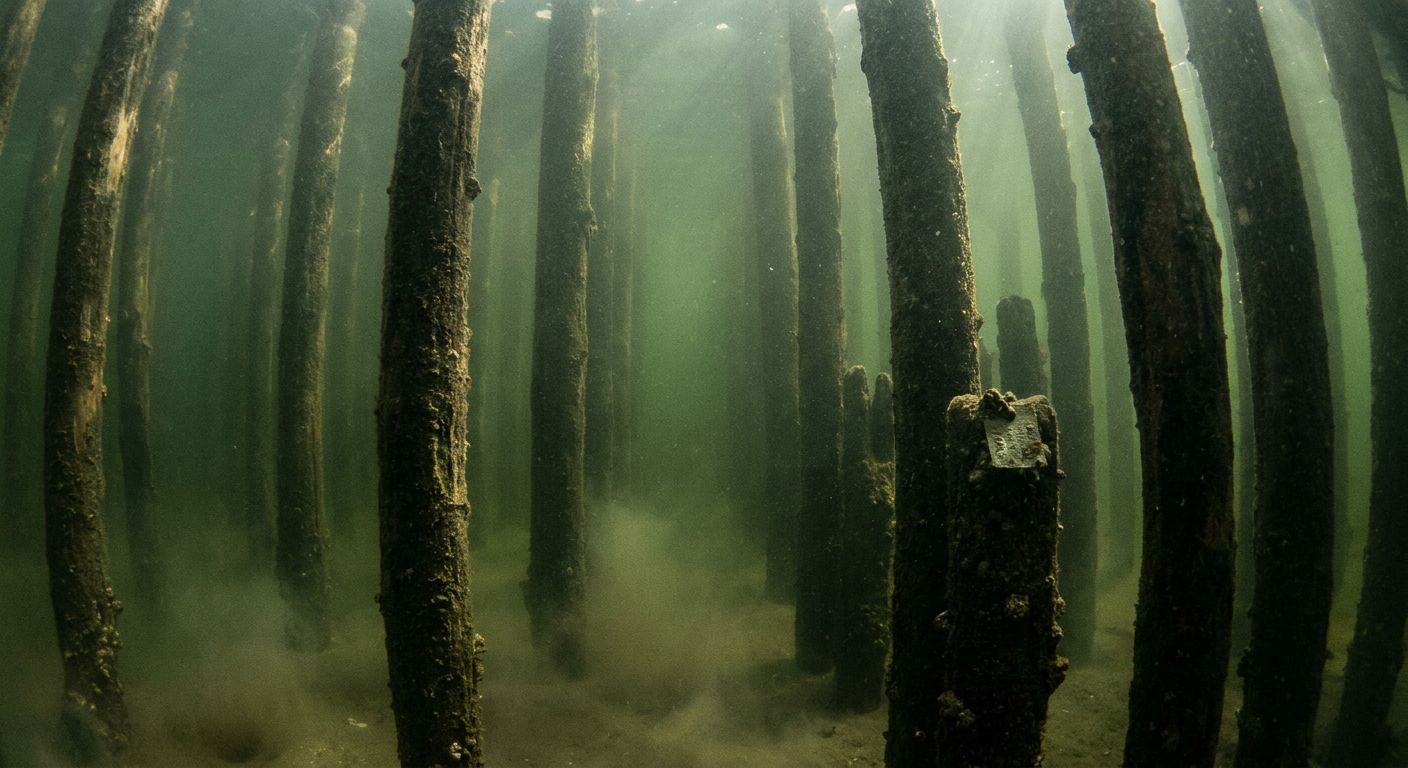
If you walk across the marble floors of the Basilica di San Marco in Venice, you might notice a slight, undulating tilt in the stone. It feels like the ghost of a wave. Beneath these heavy slabs, and beneath the feet of millions of visitors, lies a hidden forest. Thousands upon thousands of tree trunks are driven deep into the mud, holding up the weight of a city that, by all laws of physics, should have vanished into the Adriatic Sea long ago.
Standard logic suggests that wood rots. A fence post in a garden will crumble in a decade; a fallen branch in the woods turns to soil in a few seasons. Yet the foundations of Venice have remained structurally sound for over half a millennium. The secret to their survival is not found in the strength of the wood itself, but in the peculiar chemistry of the lagoon’s suffocating embrace.
The Pincushion of the Lagoon
When refugees fled the mainland to escape the Huns and Longobards during the decline of the Roman Empire, they found a marshy archipelago that offered safety but no solid ground. To build anything substantial, they had to invent a new kind of geography. They imported millions of logs—primarily oak and larch—from the Istria and Dalmatia regions of the Balkan coast, transporting them by raft across the water.
These logs were sharpened into points and driven through the loose silt and sand until they hit a much harder layer of clay known as caranto. This was not a foundation in the sense of a flat platform, but a dense pincushion of vertical piles. For the church of Santa Maria della Salute alone, it is estimated that builders hammered more than 1.1 million wooden piles into the mud.
The sheer density of these logs is what allows them to distribute the immense weight of Istrian limestone and brick. But even the best engineering cannot stop the natural process of decay unless the environment itself intervenes. In the Venice lagoon, the environment did exactly that by cutting off the one thing rot requires to survive.
Life Without Breath
Wood does not rot simply because it is wet; it rots because fungi and bacteria consume it. However, these microorganisms are aerobic, meaning they require oxygen to fuel their metabolism. When a wooden pile is driven deep into the thick, waterlogged silt of a lagoon, it enters an anaerobic environment.
The heavy mud seals the wood away from the atmosphere. Without a fresh supply of oxygen, the microbes that cause decay cannot survive. The wood is effectively "pickled" in a low-oxygen brine. While the tops of the piles—the parts exposed to the fluctuating tides and air—eventually degrade and must be replaced, the submerged sections remain remarkably intact.
Beyond the lack of air, the Venetian builders were selective about their timber. They favored Larch, a conifer known for its high resin content. This resin acts as a natural waterproofing agent, filling the cellular structure of the wood and making it nearly impenetrable to water even before it reaches the silt. Over centuries, the wood undergoes a secondary transformation: it absorbs minerals from the surrounding sediment. While it does not truly petrify into stone, the timber becomes mineral-hardened, gaining a metallic, iron-like density that makes it even more resistant to the weight of the palaces above.
The Salt and the Silt
The stability of Venice is a delicate balance between the wood, the mud, and the salt. The saltwater acts as a preservative, preventing the growth of freshwater molds. Meanwhile, the silt provides a protective casing, ensuring that the water surrounding the piles remains stagnant.
However, this ancient system is not invincible. The biggest threat to the wooden foundations today isn't the passage of time, but the changing movement of the water. As modern deep-water channels were carved through the lagoon to accommodate massive vessels, the natural hydrodynamics were disrupted. Increased currents and the heavy wakes of ships can wash away the protective silt, exposing the wood to oxygen-rich water and aggressive wood-boring mollusks like the Teredo navalis, also known as the naval shipworm.
These creatures, which can honeycomb a wooden hull in months, were historically kept at bay by the lagoon’s specific salinity and oxygen levels. As the environment changes, the "forest under the city" faces its first real existential threat in a thousand years. The survival of Venice depends on keeping its foundations hidden, dark, and breathless.
A Legacy in the Mud
Venice is not the only city built on this "wet foundation" principle. From the medieval bridges of Lucerne to the historic warehouses of Amsterdam, much of Europe’s architectural heritage rests on submerged timber. The builders of the past understood a fundamental truth about the earth: sometimes the best way to preserve something is to bury it where the air cannot reach it.
Today, as the Adriatic rises, Venice has turned to modern technology to protect its ancient bones. The MOSE barrier system—a series of mobile steel gates—now guards the lagoon inlets against extreme high tides. It is a striking juxtaposition: massive 21st-century steel lungs designed to protect a 5th-century forest of wood.
The ground beneath a Venetian campo is not solid earth, but a vast, silent congregation of trees, standing upright in the dark. They are a reminder that the most enduring structures in human history often rely on what we cannot see—the hidden, drowned pillars that hold the weight of civilization on their shoulders.
This story travelled through
Where does this story take you next?
Every story opens a door somewhere else. Pick a thread and we'll tell you that story too.
Curious about something else?
Discover another exploration