The Stone Pavement of County Clare
Discover how ancient farming and Atlantic rains stripped the soil to reveal a vast, cracked limestone plateau in Ireland.
This story began with a question: “Why is the Burren in Ireland covered in bare limestone?”
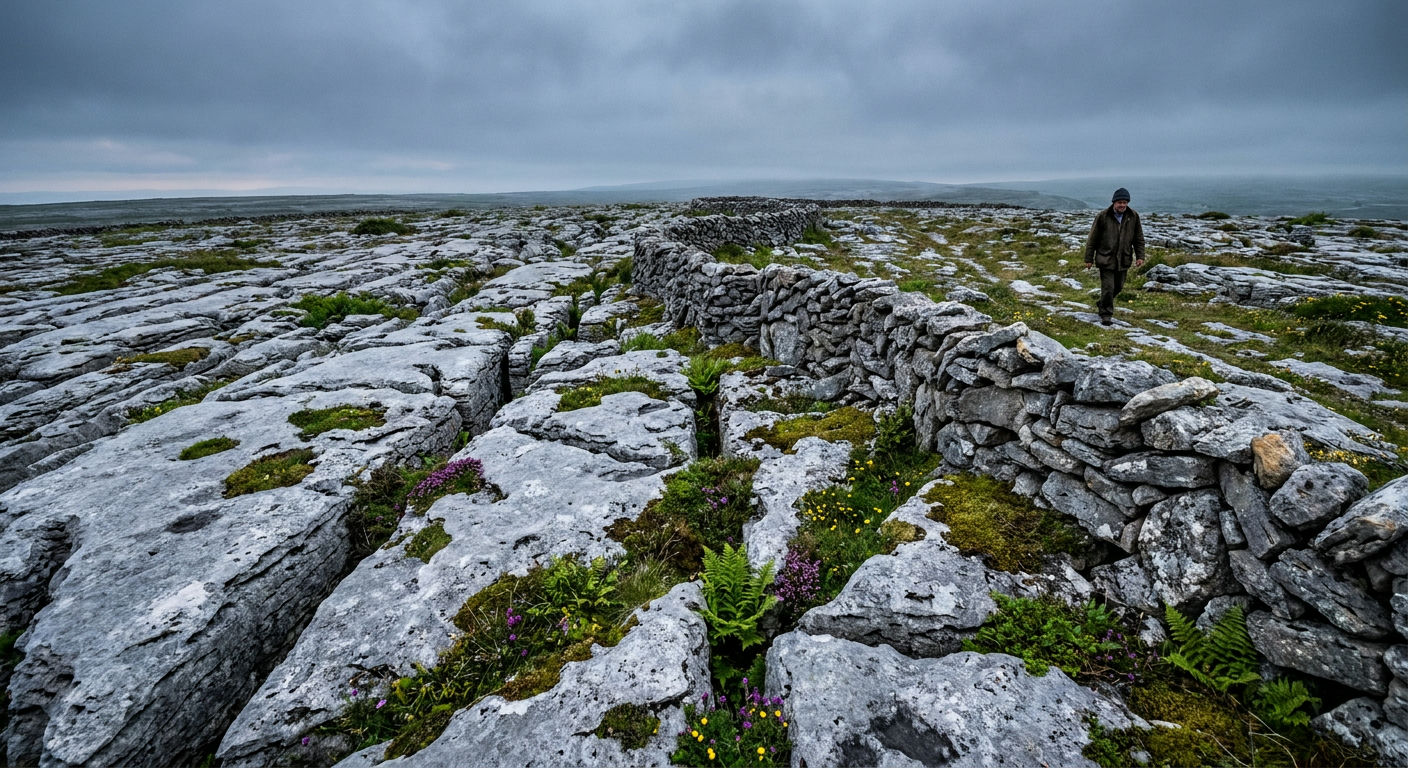
In the far west of Ireland, there is a place where the green ends. On the edge of the Atlantic, the soft rolling hills of County Clare suddenly give way to a landscape of pale, grey rock that stretches toward the horizon, cracked and scarred as if the earth were a fossilized giant. During the Cromwellian campaign of 1651, General Edmund Ludlow famously remarked of the region that it was a country where there was not water enough to drown a man, wood enough to hang one, nor earth enough to bury him.
The Burren—a name derived from the Irish word Boireann, meaning \"a rocky place\"—is a 150-square-mile desert of limestone that defies every expectation of what a landscape should be. While the rest of Ireland is famous for its peat and clover, this region is a world of stone. But the most striking thing isn't just the presence of the rock; it is the way the rock is laid out. It forms a karst pavement, a series of massive, flat slabs separated by deep, vertical fissures that look like deliberate masonry.
The Ecology of Clints and Grikes
Walking across these slabs, known as clints, requires a careful step. Between the slabs are the grikes, deep crevices that act as hidden greenhouses. While the surface of the stone is wind-swept and harsh, these narrow cracks are filled with shade and moisture. It is a paradox of geography: in the middle of a rocky wasteland, you can find Arctic, Alpine, and Mediterranean plants growing side by side.
Brilliant blue Spring Gentians from the mountains of Europe sit inches away from Mountain Avens, a flower typical of the high Arctic. Nearby, Maidenhair Ferns, which usually thrive in the humid crevices of southern Europe, find sanctuary in the sheltered dampness of the grikes. The secret to this unusual ecology lies in the stone itself. The Carboniferous limestone that makes up the Burren is the compressed remains of an ancient sea floor, composed of the skeletons of tiny marine creatures and shells. Unlike granite, limestone is soluble in rainwater. As rain falls, it becomes slightly acidic, slowly eating away at the rock. Over millions of years, the water has seeped into the natural joints, widening them into the deep, dark nurseries that now harbor such diverse life.
Why the Burren Lost its Soil
However, the geology alone does not explain why the Burren is so naked. If you look closely at the edges of the rock, you will find traces of the history of human hunger. Thousands of years ago, this region was not a grey desert, but a dense forest of pine and hazel. Around 6,000 years ago, the first farmers of the Neolithic period arrived here and began to clear the trees to make room for their livestock.
As the trees disappeared, the thin layer of soil that covered the limestone became vulnerable. Without the roots of the forest to hold it in place, the soil was rapidly washed away by the relentless Atlantic rains. The earth tumbled into the deep fissures or flowed down into the sea. By the time the Bronze Age was in full swing, the Burren had been transformed into a skeleton of a landscape, its ribs exposed to the sky. The farmers who remained were forced to adapt, developing a unique system of transhumance known as winterage. In a reversal of typical European farming, cattle are moved up into the hills during the coldest months because the limestone acts as a giant radiator, holding the summer’s heat and providing dry footing and year-round grazing.
The Disappearing Water of the Karst
Because the rock is so porous, the Burren possesses a strange relationship with water. There are almost no permanent rivers or lakes on the surface of the plateau. Instead, the water acts like a ghost. It falls on the stone, disappears instantly into the cracks, and journeys through a vast, hidden network of underground caves and tunnels. Sometimes, this water re-emerges in the form of turloughs, or disappearing lakes, which can fill up after a heavy storm and vanish entirely a few days later.
This disappearing act has shaped the lives of everyone who has lived here, from the builders of the Poulnabrone Dolmen—a massive stone tomb that has stood on the plateau for over 5,000 years—to the modern herdsmen. The lack of surface water meant that ancient settlements had to be built near specific springs or seasonal wells. The stone wasn't just a floor; it was a barrier and a resource, providing the material for the thousands of miles of dry-stone walls that now crisscross the Burren like a spiderweb.
How Rainwater Dissolves the Burren
Despite its appearance as a dead wasteland, the Burren is constantly moving. The process of dissolution never stops. Every rainfall deepens a grike; every winter frost chips at the edge of a clint. The landscape is a slow-motion collapse, a shelf of ancient sea floor that is being steadily dismantled by the weather. Yet, the very nakedness that makes the Burren seem so hostile is what allows it to be so vibrant. Without the cover of thick soil, the limestone acts as a stage for a biological performance found nowhere else on the planet.
The grey stone of Clare is a reminder of what happens when the balance between people and their environment shifts. It is a monument to a forest that vanished and a sea that lived 350 million years ago. When the sun sets over the Atlantic, the limestone catches the light and turns a pale, ghostly white, reflecting the sky and making the ground seem to glow. It is in this light that you realize the Burren isn't a place where life ended, but a place where life learned to hide in the cracks. The stone continues to dissolve, opening new spaces for the next generation of Arctic blooms to take root.
This story travelled through
Where does this story take you next?
Every story opens a door somewhere else. Pick a thread and we'll tell you that story too.
Curious about something else?
Discover another exploration