The Stare-Down in Stone: A Tale of Two Fortresses
Two massive fortresses stand just 150 meters apart, creating an architectural counterpoint between East and West that has lasted 500 years.
This story began with a question: “How did the specific architectural layout of the Narva and Ivangorod fortresses create a unique 'gateway of two worlds' on the riverbanks?”
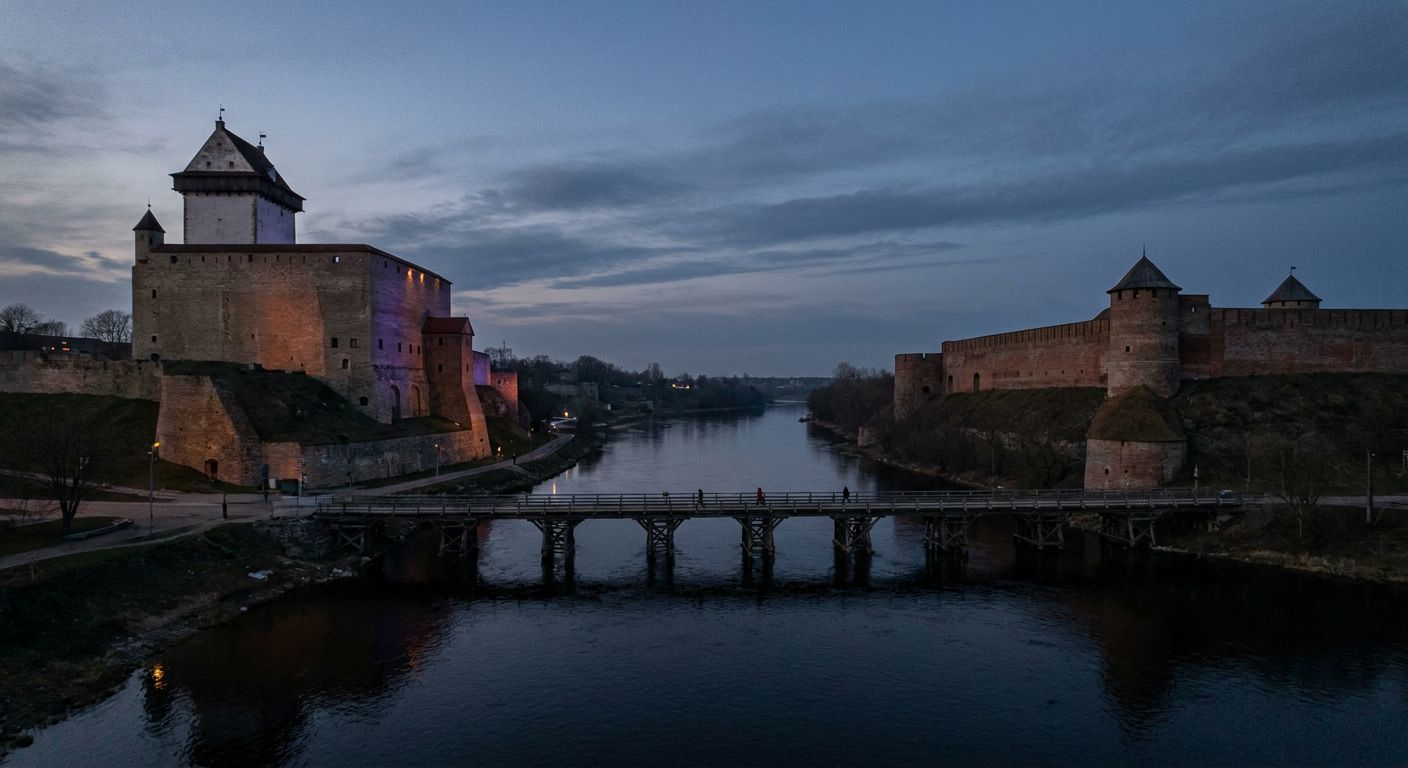
If you stand on the bridge connecting Estonia to Russia today, you are caught in a geographical confrontation that has lasted for over five centuries. To your left, the chalky limestone walls of Narva Castle rise in a stiff, vertical defiance, topped by a long-necked tower that seems to be peering over the horizon. To your right, just across the rushing waters of the Narva River, the sprawling, red-tinted ramparts of Ivangorod Fortress crouch like a massive, coiled predator.
This is not a random placement of stone. The architectural layout of these two giants was a deliberate, centuries-long conversation in masonry. Nowhere else in Europe do two major fortresses sit so close—separated by barely 150 meters of water—representing the precise friction point where the Latin West and the Slavic East meet. It is a gateway where architecture was used not just to protect, but to define the very edge of two different worlds.
The Long Shadow of the Tall Hermann
The story of this architectural counterpoint began with the Danes and was perfected by the Livonian Order. When they developed Narva Castle on the western bank, they weren't just thinking about walls; they were thinking about height. The castle’s layout is dominated by the "Tall Hermann" tower, a slender, square mast of stone that serves as the ultimate lookout post.
In medieval defensive theory, the bank of the Narva River offered a natural elevation. The builders utilized a concentric layout, where each layer of the castle became harder to penetrate the closer an attacker got to the central keep. The architecture was inward-looking and vertical. It reflected the mindset of the Northern Crusades: a lonely outpost of Western Christendom and Germanic law perched on the edge of a vast, unknown wilderness. From the top of the tower, a guard could see for miles into the Russian interior, making the architecture itself an act of visual dominance.
The Russian Response in Red Stone
For a long time, the eastern bank remained empty, a buffer of trees and marshes. That changed in 1492, when Ivan III of Russia decided to plant a flag—or rather, a mountain of stone—directly opposite the outpost held by the Livonian Order. He built Ivangorod. Unlike the vertical, compact nature of Narva Castle, Ivangorod was designed with a sprawling, horizontal logic. It was a "fortress-city," built with massive, thick walls and rounded towers that were better suited to withstand the emerging power of gunpowder and heavy cannon fire.
The symmetry is haunting. If you look at an aerial map, the two fortresses feel like two halves of a single machine. While the Western castle emphasized the height of its tower to see the enemy, the Eastern fortress emphasized the thickness of its curtains to absorb the enemy’s blows. The Ivangorod layout eventually expanded into a massive quadrilateral, its walls tracing the very lip of the riverbank, ensuring that not a single boat could pass upriver without being caught in a crossfire of Russian musketry.
The Engineering of a Crossfire Zone
The most unique feature of this "gateway" is the architectural tension of the river gap itself. In most border regions, fortresses are miles apart, separated by valleys or forests. Here, the narrowness of the Narva River forced the architects into a peculiar kind of defensive zoning. Every window, every embrasure, and every battlements-walk was designed with the other side in mind.
When the Swedes took control of Narva in the 16th and 17th centuries, they didn't just maintain the castle; they wrapped the entire city in a star-shaped "bastion" system. This evolution was led by the renowned Swedish military engineer Erik Dahlbergh. He designed a sophisticated network of seven bastions—named after lions and symbols of power—that used low-slung, earth-filled stone triangles to deflect cannonballs. These represented the pinnacle of early modern military engineering.
This created a fascinating visual contrast: the medieval towering heights of the old castle rising above the modern, geometric precision of the Swedish bastions. Across the water, Ivangorod remained a stubborn, colossal block of traditional Russian fortification. This proximity meant that soldiers on the ramparts could often see the faces of their rivals across the water, hear their songs, and smell their cooking fires. The layout turned the river from a highway into a narrow corridor of mutual observation.
The Modern Scars of the Gateway
History eventually moved past the era of stone walls, but the layout of the "Two Worlds" left a permanent mark on the landscape. During the brutal fighting of World War II, the town of Narva was almost entirely leveled, leaving the stone skeletons of the fortresses as the only survivors. The post-war reconstruction of the area respected this ancient symmetry, preserving the visual corridor between the two giants.
Today, the gateway functions as one of the most significant land borders between the European Union and Russia. The modern bridge, known as the Friendship Bridge, sits exactly where the medieval architects calculated their ranges. However, the "friendship" is currently a strained one; the bridge often serves as a site of heavy restriction and closed gates, reflecting the renewed geopolitical tension. To walk across it—when permitted—is to transition between two distinct urban layouts: the reconstructed, orderly European grid of Narva and the rugged, monumental scale of the Russian side. The fortresses no longer fire cannons, but their very presence—looming over the water—continues to dictate the atmosphere of the border. They remain two different languages of power, spoken in the same dialect of stone.
This story travelled through
Where does this story take you next?
Every story opens a door somewhere else. Pick a thread and we'll tell you that story too.
Curious about something else?
Discover another exploration