The Star That Stayed Behind: Skye’s Ice Age Survivor
High above the Atlantic, the jagged Black Cuillin ridges hold a secret: a tiny star-shaped flower that has survived since the Ice Age.
This story began with a question: “How did a tiny Arctic flower survive on the Cuillin ridges while its neighbors vanished?”
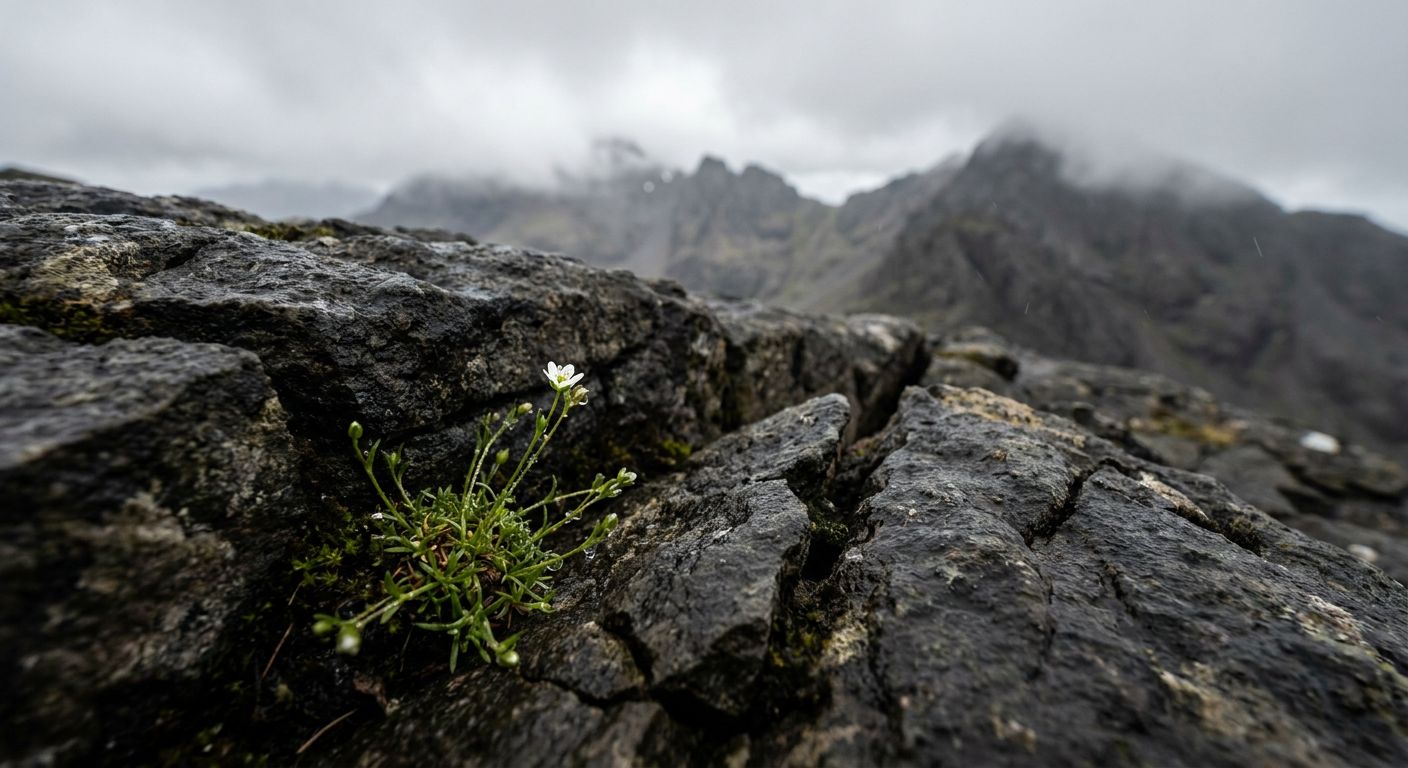
If you stand at the base of the Black Cuillin on the Isle of Skye, the landscape feels less like a Scottish glen and more like the jagged teeth of a prehistoric predator. The peaks are composed of gabbro—a dark, coarse-grained volcanic rock that grips the soles of your boots but offers little hospitality to life. While the lower slopes are carpeted in damp purple moor grass and bog myrtle, the high ridges are a realm of mist, ice, and screaming winds. Yet, tucked into the basalt ledges and damp crevices of these unforgiving summits, lives a tiny survivor that has no business being here: the Skye Pearlwort (Sagina nivalis).
This delicate, star-like plant is a ghost of the Ice Age. It is an Arctic-Alpine specialist, usually found in the high latitudes of Svalbard or the tundra of Scandinavia. On Skye, it clings to a few secret locations, a botanical refugee that refused to leave when the world warmed up. To see it is to look at a living map of the Earth’s frozen past, a testament to how a specific cocktail of geology and weather can create a sanctuary for the displaced.
The Long Retreat North
Roughly 11,500 years ago, as the great Devensian ice sheets began to pull back from the British Isles, they left behind a scarred, treeless tundra. For a time, the entire landscape of Scotland looked like the modern Arctic. Plants that thrived in the cold—mountain avens, moss campion, and various saxifrages—followed the retreating ice, colonizing the raw mineral soil left in its wake. But as the climate stabilized and warmed, a new wave of colonizers arrived from the south.
Birch, hazel, and pine forests began to march northward, accompanied by aggressive grasses and shrubs. These taller, faster-growing species began to shade out the tiny pioneers. For most of the Arctic flora, there were only two choices: migrate further north toward the pole or climb higher into the mountains where the trees could not follow. The Isle of Skye became one of the few places in Britain where the mountains were high enough, and the conditions harsh enough, to provide a "refugium"—a biological bunker where the Ice Age never truly ended.
The Gabbro Sanctuary
The survival of these plants on the Cuillin isn't just about height; it’s about the very bones of the island. The Black Cuillin is the remains of the root of an ancient volcano. The gabbro rock that forms the ridges is rich in minerals but holds very little water on its surface. More importantly, it breaks down into a specific type of scree and grit that mimics the disturbed, raw soils of the high Arctic.
While the softer, older hills of the Scottish mainland were eventually smothered by peat and thick vegetation, the Cuillin remained sharp and unstable. The constant cycle of freezing and thawing—known as cryoturbation—keeps the soil on these ridges "moving," preventing larger plants from establishing roots. This instability, which would be a death sentence for a tree, is exactly what the Skye Pearlwort requires. It is a specialist in the "open" ground, thriving where the competition has been literally shaken off the mountain.
The microclimate here is equally peculiar. The Cuillin ridges are often shrouded in a "hat" of cloud even when the rest of the island is bathed in sun. This persistent moisture and the cooling effect of the Atlantic winds create a pocket of the Arctic in the middle of the Inner Hebrides. In these high-altitude niches, the temperature rarely rises enough to allow the "temperate" world to invade.
The Mystery of the Skye Pearlwort
For centuries, these botanical treasures lived in total obscurity, known perhaps only to the golden eagles or the occasional shepherd brave enough to climb the scree. It wasn't until the Victorian era that botanists began to realize Skye was a treasure trove of rare flora. Among the most elusive was the Pearlwort, a plant so small and unassuming that it can be mistaken for a tuft of moss until its tiny white flowers open.
In the mid-20th century, the hunt for these rarities became a matter of intense academic focus. Experts like the botanist J.E. Lousley and later explorers dedicated years to mapping these populations. They found that the plants on Skye were genetically isolated, cut off from their Scandinavian cousins for thousands of years. This isolation has turned the Cuillin into a natural laboratory. Because the Pearlwort cannot travel across the lowlands to reach other mountains, each colony on a specific ridge is a tiny, self-contained evolution experiment.
The local folklore of Skye often speaks of the "hidden folk" or the Sìth who live in the high corries, protecting the mountain's secrets. In a way, the Pearlwort is the ultimate hidden inhabitant. It survives not through strength, but through a miraculous fit with a very specific, very difficult home.
A Fragile Persistence
Today, the tiny survivors of the Cuillin face a new threat that the ice never posed. As global temperatures rise, the "coolth" of the summits is evaporating. The treeline is creeping upward, and the specialized niches that have protected the Arctic-Alpine flora for 10,000 years are shrinking. Unlike the mobile animals that share these peaks, the Pearlwort has nowhere left to climb. It is already at the top.
Walking the ridges of the Cuillin today, one feels the weight of this persistence. You are standing on a landscape that has remained virtually unchanged since the last mammoths walked the earth. The fact that a plant as thin as a thread and as small as a fingernail has weathered ten millennia of Atlantic storms is a reminder that survival isn't always about being the biggest or the strongest. Sometimes, it is simply about finding the one place where no one else can live, and refusing to leave.
The star-shaped flowers still bloom in the mist, tiny beacons of a frozen era, waiting for the next winter to reclaim the rocks. When you spot one, you aren't just looking at a flower; you are looking at a living piece of the Pleistocene, still breathing on a Scottish ridge.
This story travelled through
Where does this story take you next?
Every story opens a door somewhere else. Pick a thread and we'll tell you that story too.
Curious about something else?
Discover another exploration