The Spindles of the Rapids: Narva’s Industrial Fortress激
On a rocky island between the Russian Empire and the Baltic, a German merchant harnessed a massive waterfall to build the largest textile mill in Europe.
This story began with a question: “How did the 19th-century Kreenholm Manufacture create a 'city within a city' on the edge of the Narva waterfalls?激”
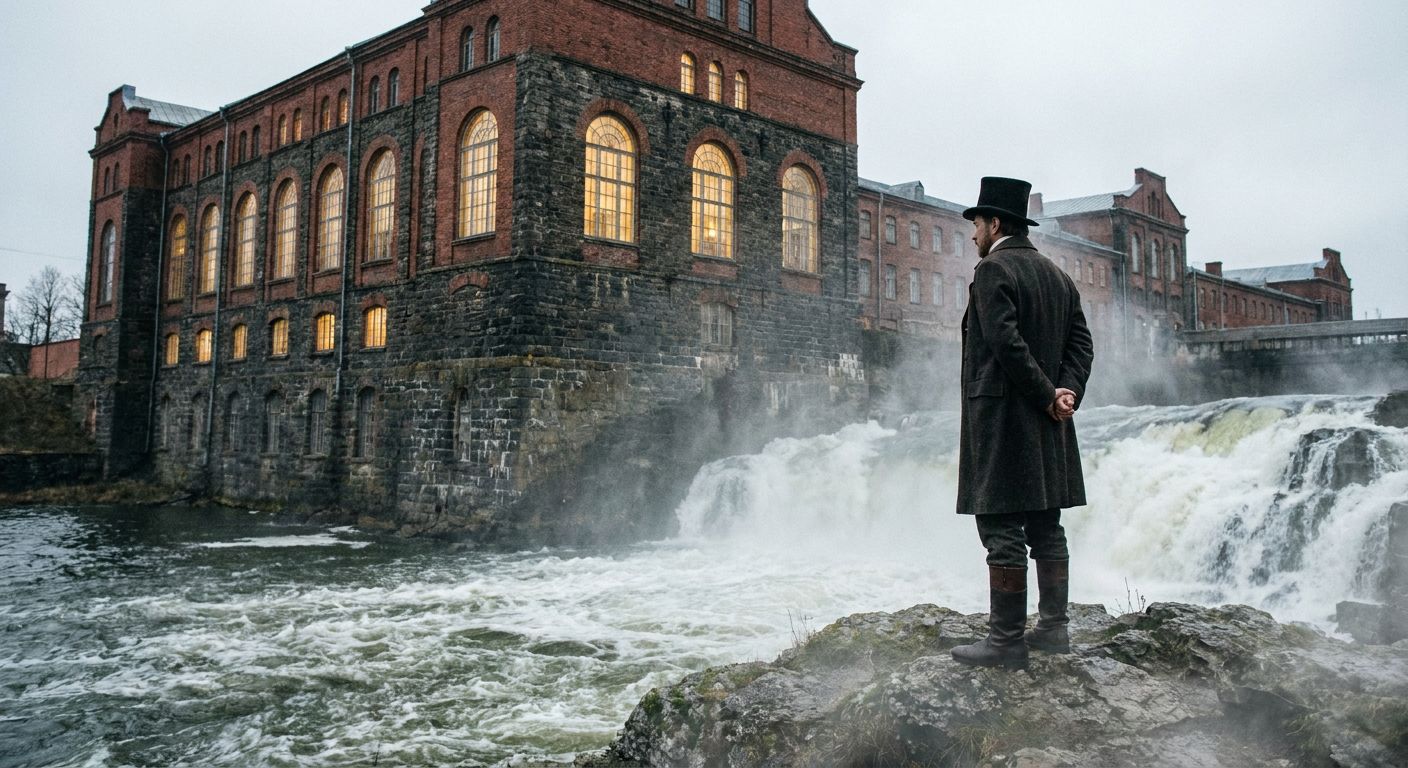
If you stand on the banks of the Narva River today, you are met with a curious, heavy silence where there should be thunder. The Narva waterfalls, once a natural spectacle of raw hydraulic power on the border of Estonia and Russia, were largely silenced in the 1950s by a Soviet-built hydroelectric dam. The riverbed is now a dry, lunar landscape of grey stone, coming to life only during rare sluice openings when the water is allowed to reclaim its ancient path. Yet, rising from the mist of history and the limestone of the riverbed is an architectural titan: the Kreenholm Manufacture.
In the mid-19th century, this geography caught the eye of Ludwig Knoop, a merchant from Bremen who had cut his teeth in the cotton trade of Manchester. Where others saw a dangerous torrent, Knoop saw the heartbeat of an industrial empire. By 1857, he had acquired the island of Kreenholm—from the Swedish Kråkholm or "Crow Island"—and began constructing a textile city so vast it would soon be known as the "Manchester of the East." It was a bold gamble on the edge of the Russian Empire, turning a frontier into the largest cotton mill in Europe.
The Engineering of the Rapids
The sheer scale of Kreenholm was a marvel of Victorian-era industrialism. The main buildings were constructed from local limestone and dark red brick, characterized by high ceilings and massive windows designed to harvest every scrap of northern light. The architecture was functional yet grand, borrowing the neo-Romanesque and Gothic styles that defined the era’s belief in progress. Inside, the floors were supported by cast-iron columns, creating vast open spaces that once hummed with the vibration of thousands of spindles and looms.
The heart of the operation was the river’s gravity. Before the advent of large-scale electrification, the Kreenholm Manufacture relied on a sophisticated system of water turbines. The Narva waterfalls provided an immense volume of water that was diverted through man-made canals to turn these turbines. This mechanical energy was transmitted through a labyrinth of shafts and leather belts spanning the length of the factories. This physical link connected the power of the rapids directly to the production of yarn, turning the island into a literal city of machines.
A Utopian Experiment in Brick
Beyond the spindles, Knoop and his architects were building a "city within a city." The Kreenholm island and its surrounding banks became a carefully planned urban environment designed to house, feed, and manage a population that would eventually swell to 10,000 workers. This was the era of the paternalistic employer, where the company provided for every aspect of a worker's life in exchange for absolute discipline.
The residential districts were segregated by rank, creating a visual map of the industrial hierarchy. While the directors lived in ornate villas surrounded by manicured gardens, the workers were housed in massive brick barracks. For the time, the Kreenholm housing was advanced, featuring centralized heating systems and thick walls designed to withstand the brutal Baltic winters. The company provided a hospital, a pharmacy, a school for the workers' children, and even a Lutheran church and an Orthodox cathedral to serve a diverse workforce of Estonians, Russians, Germans, and Swedes.
The Micro-Society of the Borderland
Life inside Kreenholm was regulated by the factory bell. The manufacture operated its own police force and its own judicial system, effectively becoming an autonomous state. It was a place where the rural peasantry was forged into a modern industrial proletariat, a linguistic and cultural melting pot where the scent of raw cotton from the American South mixed with the smell of river silt and local coal.
However, the utopia had sharp edges. The work was grueling, often lasting twelve to fourteen hours a day in air thick with fine cotton dust. The same paternalism that provided a hospital also meant that losing your job meant losing your home and your social standing. This tension reached a breaking point in 1872, when Kreenholm became the site of one of the first and largest industrial strikes in the Russian Empire. The workers demanded shorter hours and better pay, proving that even a masterfully engineered city could not fully contain the human spirit.
The Echoes of the Spindles
By the early 20th century, Kreenholm was a global powerhouse, its textiles sold from St. Petersburg to Shanghai. The island survived the tectonic shifts of the First World War and the subsequent independence of Estonia, though its markets shifted from the vast Russian interior to the international stage. Even as steam and later electricity replaced the direct drive of the turbines, the manufacture remained anchored to the river that gave it life.
Walking through the empty courtyards of Kreenholm today, the "city within a city" feels like an industrial cathedral. The machines are gone, and the waterfalls are largely diverted, but the massive red-brick silhouette of the Old Spinning Mill remains a testament to a time when Narva was the center of the textile world. It is a haunting landscape where the grandeur of 19th-century engineering meets the quiet of the post-industrial age, waiting for the rare moments when the dam opens and the roar of the falls returns to its stone walls.
This story travelled through
Where does this story take you next?
Every story opens a door somewhere else. Pick a thread and we'll tell you that story too.
Curious about something else?
Discover another exploration