The Silent Language of the Painted People
While their carved stones still stand, the language of the Picts vanished so completely that it transformed the very identity of Scotland.
This story began with a question: “What does the silence of the Pictish language tell us about the cultural assimilation of Scotland?”
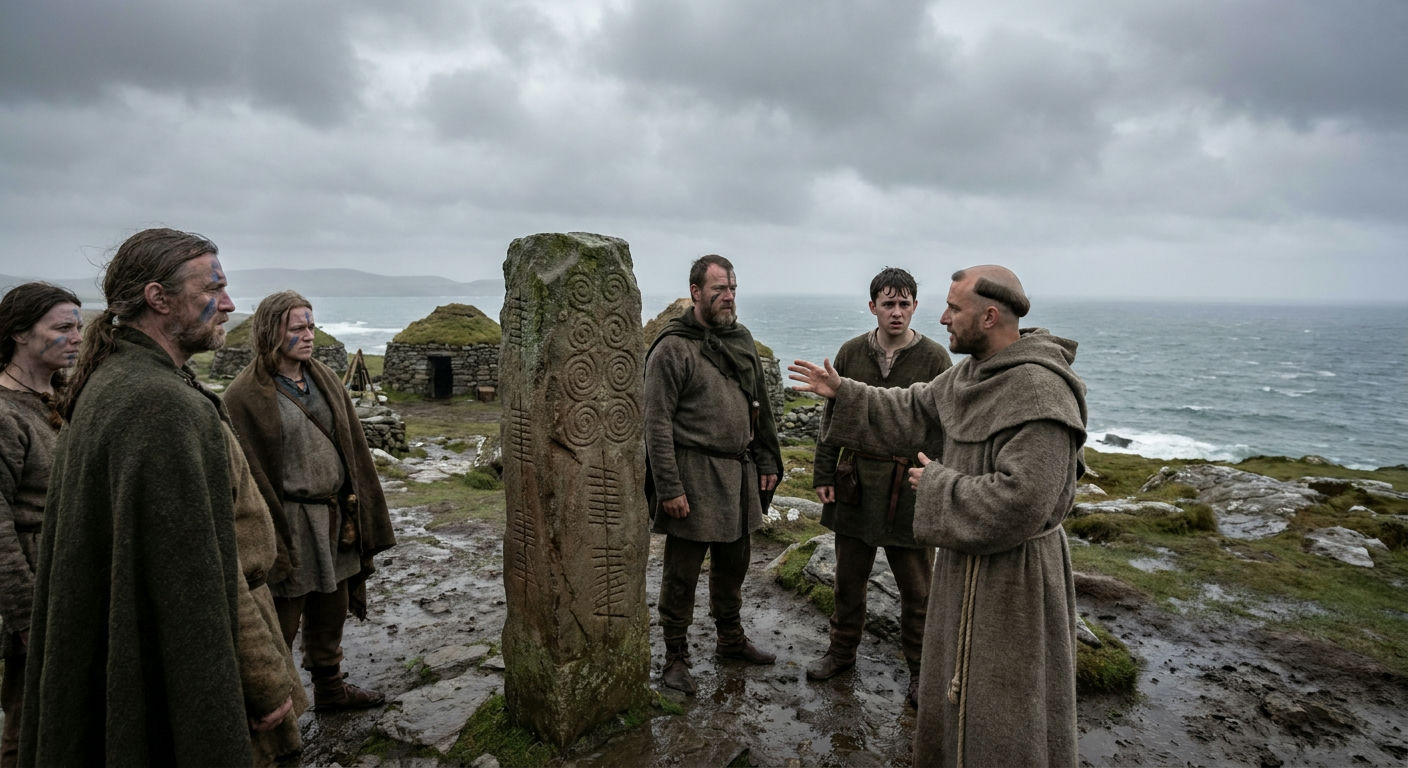
If you drive through the fertile glens of eastern Scotland today, you will encounter towns with names like Pitlochry, Pittenweem, and Pitsligo. These names are the echoes of a ghost. The prefix "Pit-", meaning a portion of land or a farmstead, is the most visible remnant of a language that once dominated the northern half of Britain but left behind not a single book, poem, or legal code. The Picts did not simply disappear; they were absorbed into a new Gaelic-speaking identity, leaving a linguistic vacuum that historians have spent centuries trying to fill.
The silence is particularly striking because the Picts were not illiterate. They carved intricate symbols and beasts into standing stones, and by the 5th century, they were using a cryptic system of notches known as Ogham. Yet, when we look at the Ogham inscriptions on Pictish stones, we find a paradox. While some names look familiar, others—like the "ettuyevunt" found at Lunnasting—defy translation into any known language family. In the late 19th century, scholars like John Rhys argued that the Picts may have been the last speakers of an ancient, non-Indo-European tongue. This theory suggests their speech predated the arrival of the Celts in Europe, remaining a lonely survival of the Bronze Age.
The Language Barrier: Columba and the Pictish Court
The mystery of this lost speech comes into sharp focus during the 6th century, when the Irish missionary Columba of Iona traveled to the court of the Pictish King Bridei near Inverness. According to his biographer, Adomnán, Columba was a speaker of Goidelic (Early Irish), but he could not make himself understood to the King or his people. To preach the Gospel, Columba was forced to use an interpreter, a detail that proves Pictish was not merely a dialect of Irish but a distinct, unintelligible language.
This linguistic wall suggests that the North of Britain was a far more diverse tapestry than the later "unified Scotland" narrative implies. Linguists generally classify Pictish as a P-Celtic language, more closely related to the ancestor of Welsh than to the Gaelic spoken by the Scots of the Kingdom of Dál Riata. The tension between these two Celtic branches—the P-Celtic of the indigenous Picts and the Q-Celtic of the incoming Scots—set the stage for a cultural struggle where the spoken word would eventually become the ultimate tool of conquest.
The Strathearn Evidence: A Kingdom in Transition
As the centuries turned, the sharp edges of the Pictish language began to blur. The Church and the rise of a unified kingship demanded a common tongue for administration and liturgy, a process accelerated by the brutal reality of the 9th century. As Viking raids shattered the coastal defenses of the Pictish heartland, the survivors were forced into a strategic union with their Gaelic neighbors to the west.
Evidence of this transition is frozen in stone on the Dupplin Cross, a magnificent 9th-century monument in Strathearn. The cross bears an inscription dedicated to Caustantín mac Fergusa, a king who ruled over both Picts and Scots. While the art is distinctly Pictish, the names and the context point toward a shifting political reality where the Pictish elite were beginning to adopt the Gaelic language of their neighbors. Through the influence of the monastery at Iona, Gaelic became the language of the court and the church—the high-status tongue that promised advancement in the new, unified kingdom of Alba. By the time Kenneth MacAlpin supposedly united the realms in the mid-9th century, the Pictish language was likely already retreating to the remote glens and coastal fishing villages.
A Landscape of Ghostly Prefixes
The Picts were not wiped out by the sword; they were spoken out of existence as their children found it more useful to speak Gaelic than the tongue of their ancestors. Though the grammar and vocabulary of the Picts are gone, the geography of Scotland remains a coded map of their presence. The distribution of "Pit-" names precisely matches the historical heartland of the Pictish kingdoms, stopping abruptly at the borders of the Gaelic-speaking West and the Brythonic-speaking South.
These names are linguistic fossils, hybrid creations where a Pictish prefix was often paired with a Gaelic personal name, capturing the exact moment two cultures merged. The final silence of Pictish tells us that cultural assimilation is rarely about the total destruction of a people. Instead, it is about the displacement of a worldview by the language that describes it. When the last Pictish speaker died, a unique way of categorizing the world vanished, replaced by the Gaelic tongue that would eventually define the Scottish Highlands. Today, the only way to "hear" the Picts is to read the map of the land they once farmed, where the word "Pit" still marks the boundaries of a kingdom that forgot its own name.
This story travelled through
Where does this story take you next?
Every story opens a door somewhere else. Pick a thread and we'll tell you that story too.
Curious about something else?
Discover another exploration