The Shimmering Forest: Inside the Lost Temple of Artemis
Enter the 'forest of stone' in Ephesus, where a many-breasted goddess presided over the ancient world's most extravagant bank and sanctuary.
This story began with a question: “What was it like to visit the Temple of Artemis?”
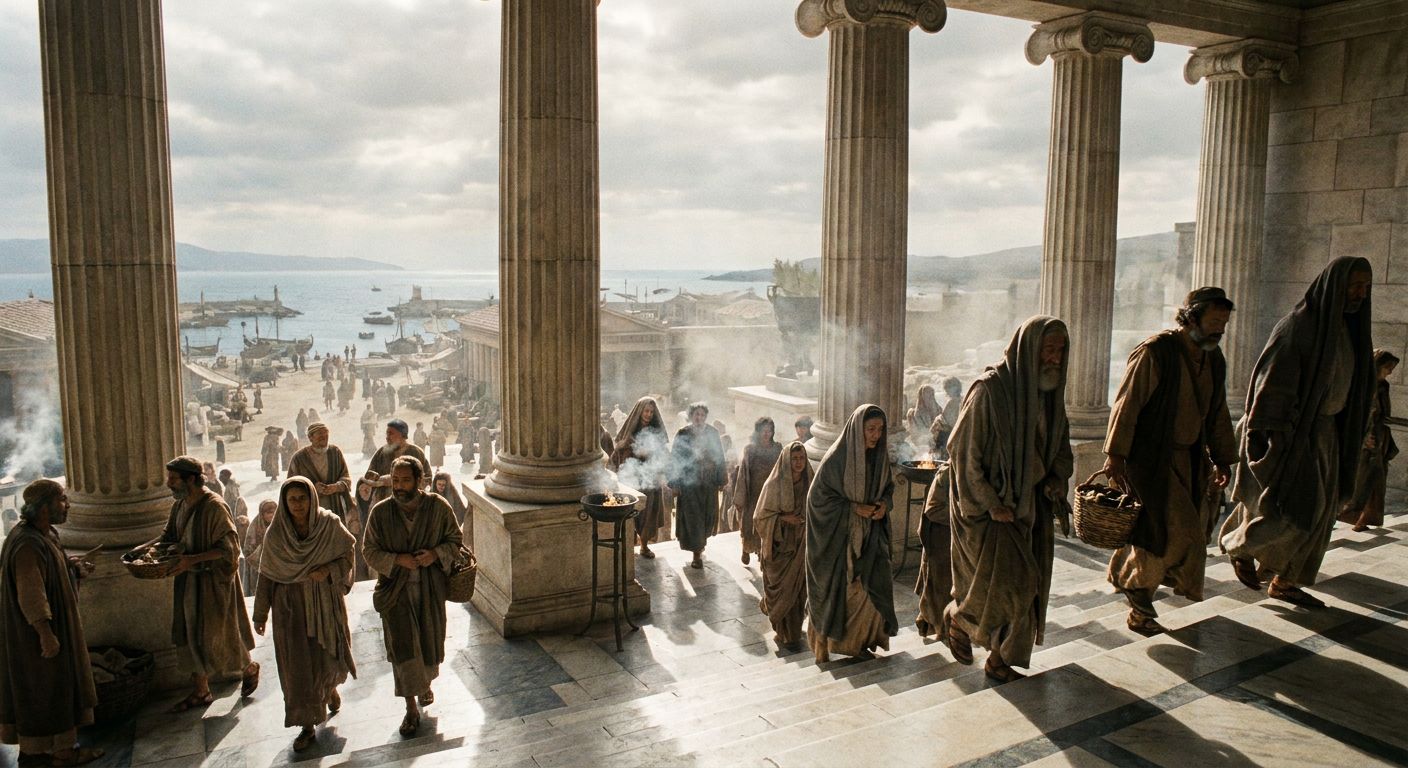
If you stood on the marshy plains near the mouth of the Küçük Menderes (then the Kaystros River) in the fourth century BCE, you would be dwarfed by a structure so immense it seemed to have been lowered from the heavens by pulleys of light. This was the Artemision, the Temple of Artemis at Ephesus. Even from a distance, the building defied the proportions of the ancient world. It was not merely a house for a god; it was a forest of stone, a shimmering white lighthouse of Hellenic ambition that lured travelers, pilgrims, and fugitives from every corner of the Mediterranean.
To approach the temple was to leave the dust of the bustling port of Ephesus behind and enter a realm of cool, echoing marble. It was one of the first massive structures to be built almost entirely of marble, a feat of engineering that required the hauling of titanic blocks from quarries seven miles away. The sheer scale of the building—stretching over 425 feet long and 225 feet wide—meant that it remained a permanent fixture of the horizon, a man-made mountain in a land of shifting tides. Because Ephesus was a crossroads where the Greek West met the Persian East, the temple became the ultimate expression of a culture defined by incredible wealth and artistic fusion.
The Forest of a Hundred Pillars
The experience of the temple began with the climb. You would ascend a series of wide marble steps to a platform that raised the sanctuary above the damp, unstable soil of the river delta. Before you stood a double colonnade of 127 columns, each one rising sixty feet into the air. These were not the plain, austere pillars of the Parthenon in Athens. In Ephesus, the columns were Ionic, topped with graceful scrolls and, most remarkably, their lower sections were wrapped in life-sized relief carvings of gods and heroes.
Walking between these pillars felt like navigating a petrified grove. The air here was different—scented with the salt of the nearby Aegean and the heavy, sweet perfumes of burning incense. The sunlight filtered through the gaps in the columns, creating a rhythmic strobe of light and shadow as you moved deeper into the structure. This was the "Dipteral" design, a double-row of columns that created a deep, shaded porch where merchants, philosophers, and travelers would linger, protected from the fierce Anatolian sun.
A Goddess of Many Breasts
At the heart of this forest of stone lay the cella, the inner sanctuary. Unlike many Greek temples where the roof was a solid canopy of wood and tile, the Artemision’s central chamber was likely open to the sky, allowing the moonlight—the celestial domain of Artemis—to wash over the cult statue.
When you finally reached the threshold and peered into the dim interior, you wouldn't see the lean, athletic huntress of Greek myth, bow in hand and deer at her side. The Artemis of Ephesus was something far older and stranger. She was a stiff, upright figure, her body encased in a tight garment adorned with lions, bulls, and griffins. Most strikingly, her chest was covered in clusters of spherical objects. Later scholars have debated whether these were breasts, bull testicles, or perhaps even gourds. To the ancient visitor, however, they represented the terrifying, inexhaustible fertility of the earth itself.
The statue was made of blackened wood—perhaps cedar or ebony—and plated in gold and silver. In the flickering light of oil lamps, the goddess seemed to vibrate with a dark, ancient power. She was a protector of the wild, but also a sovereign of the city. The temple acted as a sacred bank, holding the treasures of empires because no general dared to loot a site protected by such a formidable deity. It was a place where religion, high finance, and the safety of the desperate all converged.
The Night the Sky Turned Red
To visit the temple was also to hear the story of its greatest tragedy. In 356 BCE, a man named Herostratus, driven by a pathological desire for immortal fame, set fire to the wooden roof beams of the second temple. Legend says the temple burned on the very night Alexander the Great was born, with the goddess too distracted by the birth to save her own home.
The Ephesians did not just rebuild; they surpassed the original. They refused Alexander’s offer to fund the reconstruction in exchange for his name being inscribed on the facade, famously replying that it was "inappropriate for one god to build a temple to another." This third and final version of the temple was the one that stunned the Roman-era traveler Antipater of Sidon, who claimed that after seeing the Artemision, the hanging gardens of Babylon and the Pyramids of Giza paled in comparison.
The Echo of the Silversmiths
By the time the sun began to set, the area around the temple would be a hive of commerce. You could not leave without a souvenir. A thriving industry of silversmiths lived off the temple’s fame, casting small silver shrines and figurines of the goddess to be carried home to distant lands. These craftsmen were so influential that when a new religion—Christianity—began to take root in the city, they incited a riot, fearing that the preaching of the Apostle Paul would ruin their trade and diminish the glory of the great Artemis.
Standing in the shadow of the temple, listening to the roar of the crowd and the clinking of silver coins, you would have felt the pulse of a world where art was inseparable from survival. Today, only a single, lonely column stands in a marshy field, reconstructed from fragments. Much of the marble was eventually carted off as "spolia"—the practice of repurposing ancient stones—to be used in the construction of the Hagia Sophia in Constantinople. Other blocks were burned for lime, a common fate for ancient masterpieces during the Middle Ages when the chemical secret of Roman concrete was lost and marble was seen as little more than a source for mortar. The stones of Ephesus eventually found new life in the great monuments of the Byzantine Empire, but the silence of the marsh today belies the fact that this was once the loudest, brightest, and most expensive spot in the ancient world.
This story travelled through
Where does this story take you next?
Every story opens a door somewhere else. Pick a thread and we'll tell you that story too.
Curious about something else?
Discover another exploration