The Salt Merchants of Malaka: The Phoenician Birth of Málaga
Long before the Romans or the Moors, Levantine sailors arrived on the Spanish coast to build a city out of salt and silver.
This story began with a question: “What is the story of the Phoenicians in Malaga?”
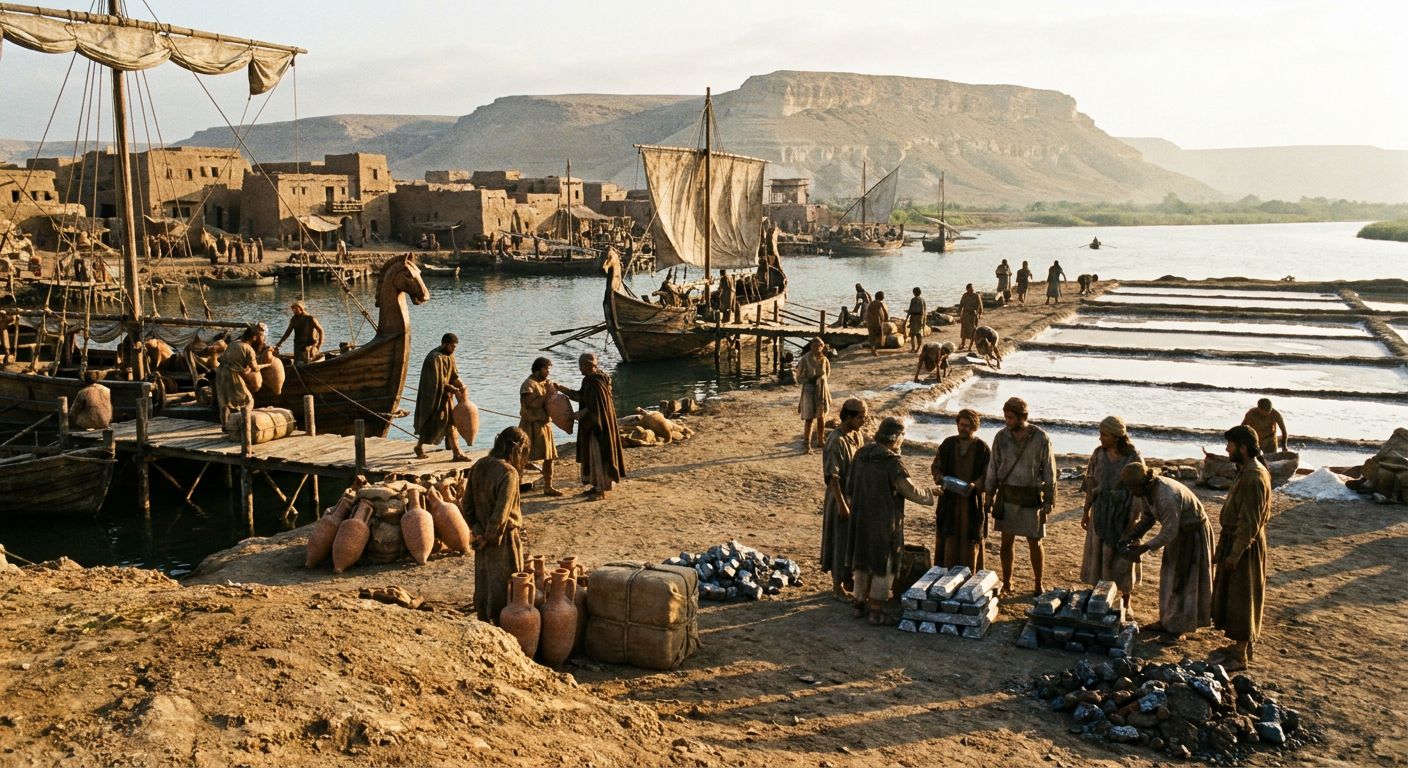
High above the modern sprawl of the Costa del Sol, a limestone ridge known as Cerro del Villar holds a secret beneath its silt. If you stood here nearly three thousand years ago, you wouldn't see the glass high-rises or the sun-bleached tourists of modern Málaga. Instead, you would see the mouth of the Guadalhorce River opening into a protected bay, where sturdy ships with cedar hulls and horse-headed prows bobbed in the Mediterranean swell. These were the vessels of the Phoenicians, the "purple people" of the Levant, who had sailed the length of the known world not to conquer, but to trade.
They came from the cities of Tyre and Sidon, in what is now Lebanon, driven by a hunger for the silver and tin hidden in the mountains of the Iberian Peninsula. When they landed on these shores around 770 BCE, they didn't just build a temporary camp; they laid the foundations of a city they called Malaka. The name likely stemmed from the Phoenician word for salt, mlk, signaling the birth of an industry that would define the region for millennia.
The Architecture of Exchange
The Phoenicians were masters of the coastal niche. Unlike the later Romans who would march inland to impose their will, the Phoenicians in Malaka were content to hug the shore, building their settlement on a small island or peninsula at the river’s mouth. This allowed them to act as the ultimate middlemen. They brought with them luxury goods that the local indigenous communities had never seen: translucent glass, finely woven textiles dyed in expensive murex purple, and ornate pottery.
Life in early Malaka was centered around the harbor. Excavations have revealed a structured urban grid, a surprising level of sophistication for the eighth century BCE. The houses were built of mudbrick on stone foundations, organized along narrow streets that funneled the sea breeze. In these homes, archaeologists have found evidence of a cosmopolitan lifestyle. The Phoenicians were not just trading; they were settling, blending their Levantine traditions with the geography of the Iberian coast. They introduced the iron plow, the potter’s wheel, and, perhaps most importantly, the systematic cultivation of the vine and the olive tree.
A Legacy Written in Salt and Wine
While silver was the primary draw, the Phoenicians realized that the real wealth of Malaka lay in its ecology. The surrounding waters were teeming with fish, particularly tuna and mackerel. To transport this bounty back to the eastern Mediterranean, they needed a way to preserve it. This is where the city’s name comes into play. They established massive salting factories, using the abundant solar heat of the south of Spain to evaporate seawater and create the salt necessary to pack fish into clay amphorae.
This wasn't just survival; it was the start of an industrial-scale export business. The salt-fish of Malaka became a luxury staple across the Mediterranean. Along with the fish came the wine. The Phoenicians brought the first domesticated grapevines to the region, transforming the rugged hillsides into the vineyards that still produce the sweet wines of Málaga today. As the ships left the harbor, their holds were heavy with silver bars from the hinterland, but their decks were stacked with the flavors of the Spanish coast—salted fish, olive oil, and potent wine.
The Sacred Rock of the Alcazaba
If you walk through the heart of modern Málaga today, you will eventually reach the foot of the Gibralfaro hill, crowned by the medieval Alcazaba fortress. Beneath these layers of Moorish and Roman stone lies the heart of the Phoenician colony. As Malaka grew, it shifted from its original river-mouth island to the more defensible slopes of this hill. Here, the Phoenicians built a sanctuary, likely dedicated to their goddess Astarte, the queen of the stars and the protector of seafarers.
The relationship between the Phoenicians and the local Tartessian people was largely symbiotic. There is little evidence of the scorched-earth warfare that characterized later empires. Instead, Malaka functioned as a "gateway community," a place where two worlds met and blurred. The Phoenicians traded their craftsmanship for the locals' knowledge of the mountains and their labor in the mines. This cultural exchange changed the genetic and social map of southern Spain forever, introducing an alphabet, a monetary system, and a religious landscape that would persist long after the last Phoenician ship sailed.
The Transition to Carthage and Rome
By the 6th century BCE, the original Phoenician city-states in the Levant fell under the shadow of the Persian Empire. The western colonies, including Malaka, began to look toward their powerful sister city in North Africa: Carthage. Under Carthaginian influence, Malaka became a vital military and commercial hub in the Punic wars against the rising power of Rome.
However, the Phoenician DNA of the city was too strong to be erased. Even after the Romans eventually took control in 205 BCE, renaming it Malaca, the city retained its character as a salt-processing powerhouse. The Roman theater that sits at the base of the Alcazaba today was built atop the bones of the Phoenician town. When you sit in those ancient stone tiers, you are resting on centuries of Levantine ambition. The Phoenicians didn't leave behind massive pyramids or crumbling temples as grand as those in Egypt or Greece, but they left something more enduring: the very blueprint of the Mediterranean lifestyle, built on the foundations of trade, salt, and the sea.
This story travelled through
Where does this story take you next?
Every story opens a door somewhere else. Pick a thread and we'll tell you that story too.
Curious about something else?
Discover another exploration