The Red Snake: Persia's Forgotten Great Wall
Stretching nearly 200 kilometers across the Iranian plain, a massive barrier of millions of fire-hardened red bricks once guarded the Persian world from nomadic invaders.
This story began with a question: “Why did the Sasanian Empire build a 195km 'Red Snake' across the Iranian plain?”
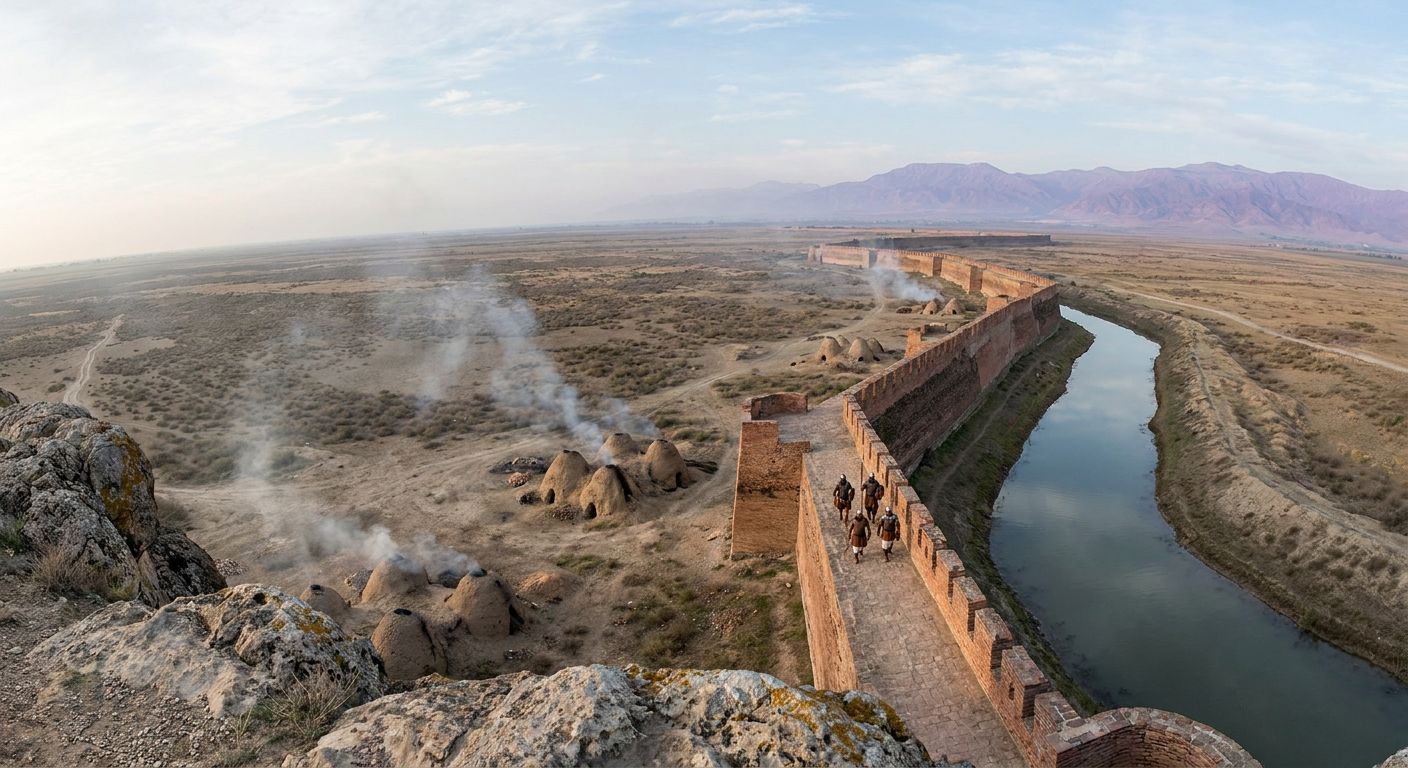
If you stand on the dusty plains of northeastern Iran today, near the southeastern shores of the Caspian Sea, you might notice a subtle, straight-line disturbance in the topography—a long, low ridge that seems too purposeful to be natural. For centuries, locals called it the "Red Snake." To the archaeologists who finally mapped its full extent, it revealed itself as one of the most sophisticated engineering projects of the ancient world: the Great Wall of Gorgan.
Stretching approximately 195 kilometers (121 miles) from the Caspian coast to the jagged Pishkamar Mountains, this barrier was not built by the Chinese or the Romans. The wall effectively sealed the Gorgan Plain, using the rugged mountains as a natural eastern terminus to create an impenetrable line. It was the work of the Sasanian Empire, the last great Persian dynasty before the arrival of Islam. Built primarily in the 5th or 6th century CE, the Red Snake was a desperate, high-tech response to a shifting world where the nomadic tribes of the Central Asian steppes were becoming an existential threat to the sedentary Persian heartland.
The Kilns of the Caspian
The wall earned its nickname from the millions of standardized, fire-hardened red bricks used in its construction. While the Great Wall of China is famous for its stone and rammed earth, the Sasanians faced a different challenge: the Gorgan Plain lacked immediate access to large stone quarries. To solve this, they turned the entire landscape into a massive open-air factory.
Archaeologists have identified hundreds of ancient kilns situated right alongside the wall. The Sasanians dug the local loess soil, shaped it into massive bricks—often 40cm square and weighing 20kg—and fired them on-site. The sky would have been thick with the acrid smoke of thousands of fires burning simultaneously. This industrial-scale production allowed them to build a wall that was ten meters wide and three meters high, flanked by a massive ditch. Under the direction of ambitious monarchs like Khosrow I, the state demonstrated a command over labor and logistics that rivaled the contemporary Roman Empire.
A Machine for Water
The Red Snake was more than just a wall; it was a complex hydraulic machine. Because the barrier cut across a semi-arid plain, the Sasanians had to ensure that their soldiers and the horses of their famous heavy cavalry, the Savaran, had access to water. More importantly, they needed to fill the defensive ditch that ran along the northern side of the wall.
This required the creation of an elaborate canal system that diverted water from the Gorgan River. Engineering surveys have revealed that the canals were designed with a precise, consistent gradient—a staggering feat of surveying for the 6th century—to ensure water flowed steadily along the entire 195-kilometer span. By maintaining this water level, the Sasanians created a permanent wet moat in a region prone to drought, turning a simple brick fence into a formidable amphibious fortification. The wall wasn't just holding back people; it was controlling the very elements of the frontier.
The Sasanians didn't just worry about the northern nomads; their southern flank was a gateway to the riches of the Indian Ocean. While the Red Snake guarded the north, Sasanian merchants were building a maritime empire in the south.
Fortresses in the Dust
Along the length of the Red Snake, the Sasanians built over 30 massive forts, spaced at regular intervals. These weren't mere guard posts; they were barracks capable of housing a standing army estimated at 30,000 soldiers. The density of these forts suggests that the Gorgan Plain was one of the most heavily militarized zones in the ancient world.
Life in these forts was a constant vigil against the Hephthalites, often called the White Huns, and later the Turks. These nomadic confederations were masters of mobile warfare, capable of launching lightning raids that could bypass traditional defenses. The Red Snake acted as a "tripwire" and a force multiplier. Even if a nomadic party managed to scale the wall, the ditch and the garrisoned forts meant they couldn't easily bring their horses or plunder back across. It forced the fast-moving nomads into slow-moving sieges—a type of warfare the Sasanians, with their sophisticated siege engines and supply lines, were far more likely to win.
The Ghost of a Frontier
Despite its architectural brilliance, the Red Snake eventually fell silent. As the Sasanian Empire exhausted itself in a series of "world wars"—most notably the ruinous Byzantine-Sasanian War of 602–628—the resources required to man the 30 forts began to dwindle. By the time of the Arab conquests in the 7th century, the wall had likely been largely abandoned, its bricks slowly reclaimed by the earth or local villagers.
The Red Snake remains a testament to a specific moment in human history when two worlds—the nomadic and the sedentary—collided with such force that it rewrote the geography of the earth. It stands as a reminder that the Great Wall of China was not a unique phenomenon, but part of a global "Age of Walls," where empires from Britain to Persia tried to draw a line in the sand and tell the rest of the world that civilization ended here.
The end of the Sasanian era didn't just mean the fall of walls; it meant a total transformation of how Persians viewed the heavens and the earth.
***
The spiritual life behind the wall The religious world the Red Snake was built to protect was as unique as its engineering. How did the Zoroastrian Towers of Silence define the ancient Persian relationship with death?
***
Today, the Red Snake is largely hidden, its fired bricks buried beneath the silt of the Gorgan River and the expanding wheat fields of modern Iran. Yet, from above, the ghost of the wall is still visible—a 195-kilometer scar that marks where an empire once stood, staring north into the dust, waiting for the horses to appear on the horizon.
This story travelled through
Where does this story take you next?
Every story opens a door somewhere else. Pick a thread and we'll tell you that story too.
Curious about something else?
Discover another exploration