The Purple Merchants: How the Phoenicians Unlocked the Sea
From the scent of rotting snails to the invention of the alphabet, a civilization of sailors connected the ancient world.
This story began with a question: “What is the story of Phoenicians?”
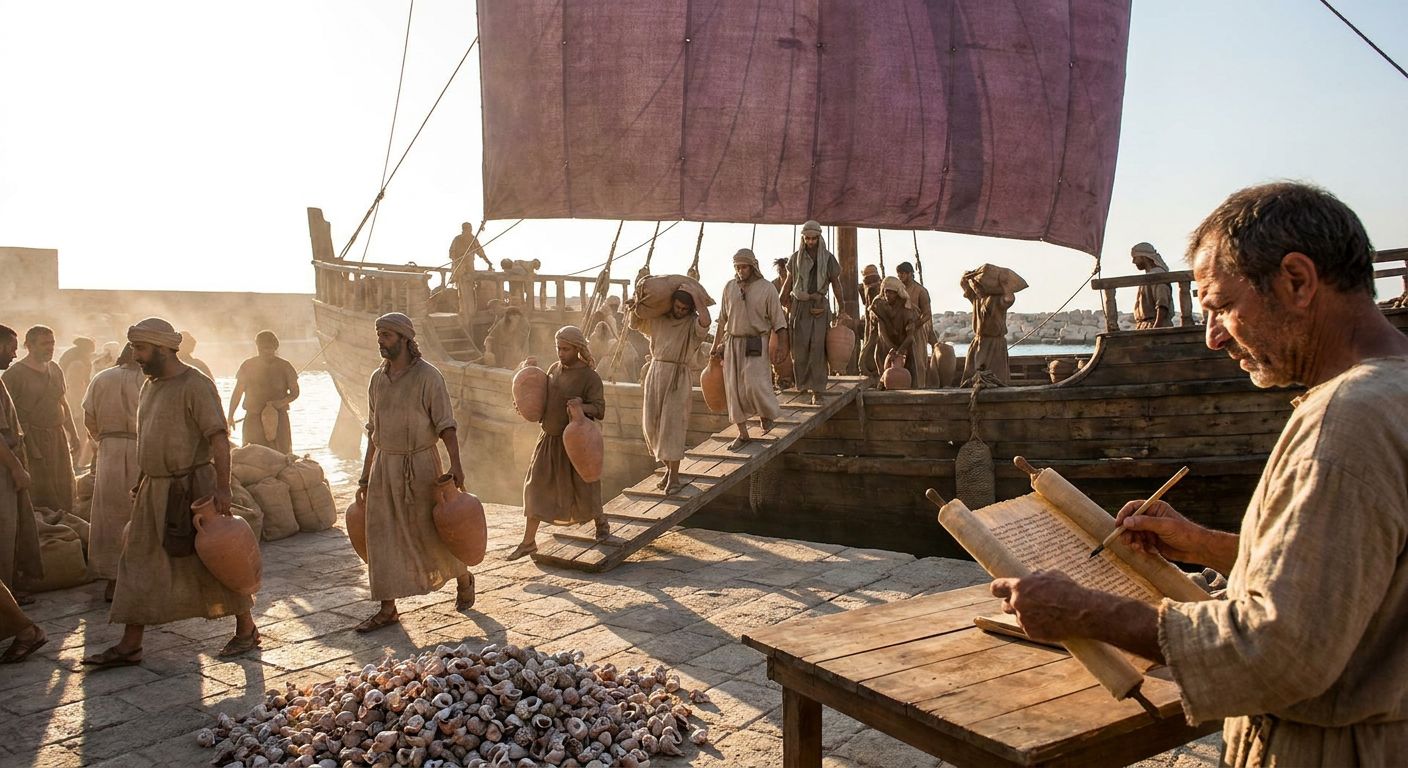
If you stood on a beach in the eastern Mediterranean three thousand years ago, looking out from what is now Lebanon, you would have seen a horizon dominated by the square sails of cedar-wood ships. These were not the vessels of a conquering army, but the floating warehouses of a people who realized that the sea was not a barrier, but a highway. They were the Phoenicians—a name given to them by the Greeks, meaning "the purple people"—and they were the architects of the first truly globalized economy.
They did not think of themselves as a single empire. Instead, they were a loose collection of fiercely independent city-states, most notably Tyre, Sidon, and Byblos. Hemmed in by the rugged mountains of the Levant to the east and the endless blue of the Mediterranean to the west, they turned their backs on the soil and looked to the waves. They became the ancient world’s greatest mariners, navigating not just by the sight of land, but by the stars, long before the compass was even a dream.
The Secret of the Murex
The wealth that fueled this maritime expansion began with a small, unassuming sea snail. The Phoenicians discovered that the Murex snail produced a mucus that, when exposed to sunlight and air, transformed into a vibrant, light-fast dye ranging from rose to deep violet. Producing even a single gram of this "Tyrian Purple" required thousands of snails and a process so pungent that dye-works had to be located far downwind of the city centers.
This color became the ultimate status symbol of antiquity. It was the color of kings, emperors, and high priests. Because the Phoenicians held a near-monopoly on its production, gold flowed into their coffers from every corner of the known world. With this wealth, they didn't just buy luxury; they bought wood. The famed Cedars of Lebanon provided the rot-resistant timber necessary to build hulls that could withstand the Atlantic swells beyond the Pillars of Hercules.
A Legacy Written in Sound
Perhaps their most enduring contribution to the modern world wasn't something they traded, but the way they tracked those trades. As their commercial empire grew, the cumbersome cuneiform of Mesopotamia and the complex hieroglyphs of Egypt proved too slow for a busy merchant on a dock. The Phoenicians needed a shorthand.
They developed a script of 22 characters, each representing a single consonant sound. It was the world's first phonetic alphabet. Unlike earlier writing systems that required years of scribal training to master hundreds of symbols, this system was democratic and portable. When the Phoenicians traded, their alphabet went with them. The Greeks eventually adopted it, added vowels, and passed it to the Romans. Every time you read a line of text in a Latin-based language today, you are using a direct descendant of the tool Phoenician merchants used to inventory their jars of wine and oil.
The Expansion to the West
The Phoenicians were the first to treat the Mediterranean as a single neighborhood. Their ships ventured further than any had dared, reaching the tin mines of Britain and potentially circumnavigating Africa. Along these routes, they established a network of "factories" or trading posts that grew into some of the Mediterranean’s most famous cities: Palermo in Sicily, Cádiz in Spain, and most significantly, Carthage in modern-day Tunisia.
Carthage began as a humble outpost of Tyre, allegedly founded by the exiled Queen Dido. But as the original Phoenician heartland fell under the shadow of the Assyrian and Persian empires, the Western colonies flourished. Carthage eventually eclipsed its mother cities, becoming a superpower that would one day challenge Rome for control of the entire western world. The Phoenician spirit of enterprise had shifted its center of gravity, moving from the Levant to North Africa, but the core identity remained: a civilization built on the deck of a ship.
The Vanishing Act
For all their influence, the Phoenicians remain a "ghost civilization." Because they wrote primarily on papyrus, which rotted away in the humid coastal air, almost none of their own literature or histories survive. We know them mostly through the eyes of their rivals—the Greeks who admired their skill but feared their cunning, and the Hebrews who recorded their interactions with the Kings of Tyre.
Even their cities were built over again and again by the Romans, Byzantines, and Crusaders. Yet, the Phoenician DNA persists. It is there in the vibrant fishing culture of the Lebanese coast, in the ruins of the great circular harbor at Carthage, and in the very letters we use to tell their story. They were the ones who taught the world how to connect, proving that trade could bridge the gaps between vastly different cultures long before the first maps were even complete.
This story travelled through
Where does this story take you next?
Every story opens a door somewhere else. Pick a thread and we'll tell you that story too.
Curious about something else?
Discover another exploration