The Price of a Chin: Russia's War on the Beard
To drag Russia into the modern age, Peter the Great didn't just change the laws—he changed the face of his people, one copper coin at a time.
This story began with a question: “How did a simple piece of stamped copper become the primary tool for erasing the visual identity of medieval Muscovy?”
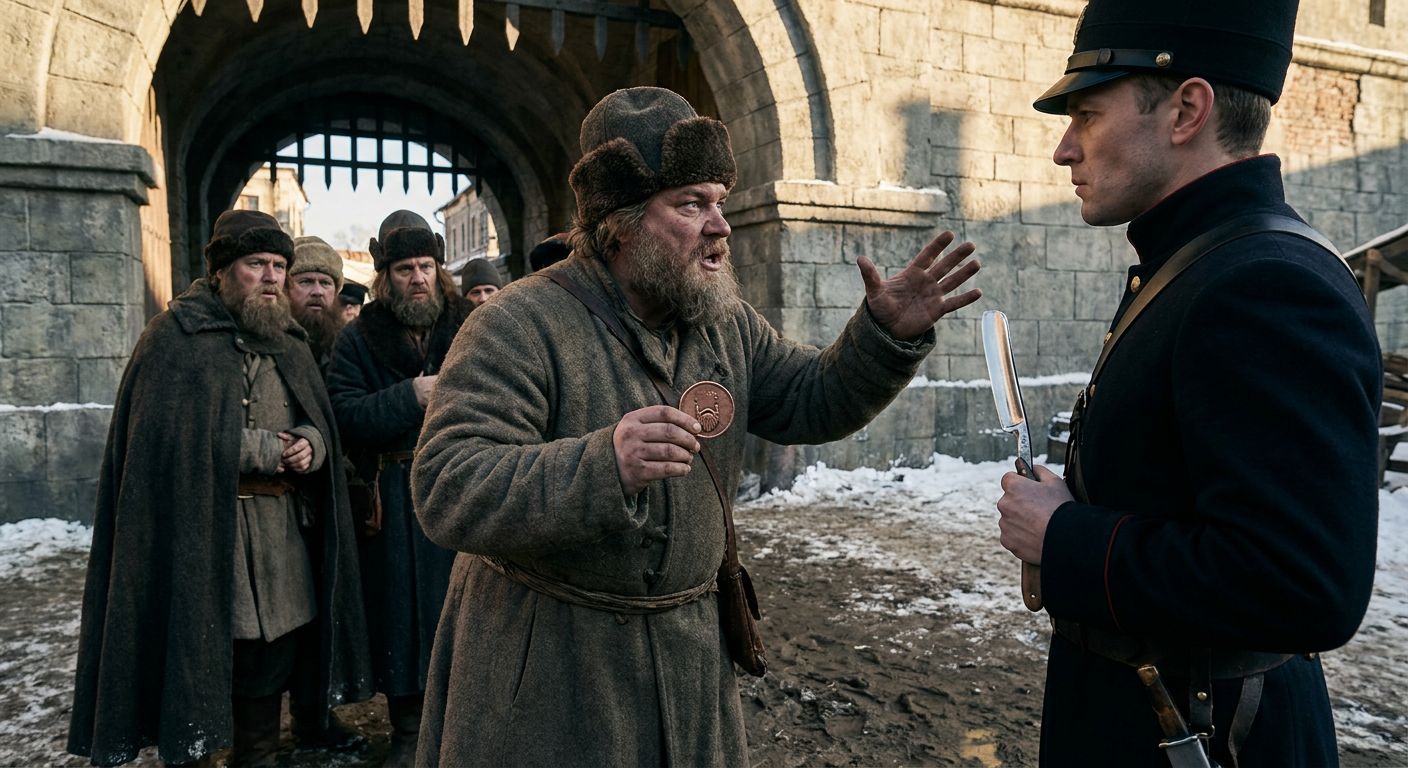
If you were a man of standing in Moscow at the turn of the 18th century, your dignity was measured in the length of your facial hair. To the Russian Orthodox mind, the beard was not a fashion choice; it was the imago Dei—the image of God. A man without a beard was considered effeminate, a "bare-faced" creature who had physically renounced his place in the celestial order. Yet, in 1698, a young, six-foot-eight Tsar named Peter I of Russia returned from his Grand Embassy to Western Europe with a pair of barber’s shears and a radical conviction: the Russian face was an obstacle to the Russian future.
The transformation began not with a law, but with a violent performance. Having been inspired by the clean-shaven courts of William III in England and the Dutch Republic, Peter I personally took a razor to the faces of his horrified boyars—the high-ranking nobles of the land—during a royal reception. It was a visceral declaration of war against the visual identity of medieval Muscovy. But Peter knew that even a Tsar could not shave every chin in a vast empire spanning from the Baltic to the Urals. To truly scrub the Middle Ages off the Russian face, he needed something more efficient than a razor: he needed a tax.
The Mechanics of the Beard Token
By 1705, the beard was no longer a religious requirement; it was a luxury commodity. Peter I established a tiered tax system that targeted every level of society to fund his modernization efforts and the Great Northern War. A wealthy merchant might pay up to 100 rubles a year to keep his whiskers—a staggering sum at the time—while a commoner might pay a mere kopek. To manage this bureaucratic shift, the state minted a unique artifact of material culture: the beard token.
These tokens were small, circular pieces of stamped copper or silver, serving as a receipt for the "right" to remain bearded. On the obverse, they featured a nose, mustache, and a flowing, stylized beard. The reverse bore the Cyrillic inscription Dengi vzyaty ("Money taken") alongside the date. For a Russian man, this coin was more than a receipt; it was a passport for his face. To walk through the gates of a city like Moscow or the newly rising Saint Petersburg without a beard token was to invite immediate arrest or a forced, public shaving by the guards stationed at the checkpoints.
These gatekeepers were enforcers of the state’s aesthetic will. If a man could not produce his token, the shears were applied on the spot. This created a new kind of urban anxiety at the city limits. The token represented a bizarre intersection of the sacred and the fiscal, where the state literally appraised the value of a man’s piety and sold it back to him in copper.
The Holy Resistance
For the Old Believers—a traditionalist sect that had already broken with the state church over liturgical reforms—the beard tax was the ultimate sign of the Antichrist. They believed that a man without a beard would not be recognized by God at the gates of Heaven. To them, Peter I was not just modernizing the country; he was mutilating the souls of his subjects.
Many chose poverty or migration to the remote forests of the North and the Urals over the razor. In these isolated communities, the beard token was viewed as the "mark of the beast." They saw the Tsar’s obsession with Western grooming—the powdered wigs and clean-shaven cheeks of the Germans—as a form of spiritual colonization. The beard tax was the ultimate sign of the Antichrist to those who believed the Tsar was physically mutilating the souls of his subjects. [n]
The resistance was so fierce that Peter eventually granted peasants the right to keep their beards while in their villages, but the moment they stepped into the "modern" space of a city, the copper token was required. [n] This compromise highlight the Tsar's pragmatic approach: he was willing to tolerate "backwardness" in the fields, provided it did not infect the centers of trade and government.
A New Russian Face
The beard token was a masterful piece of psychological engineering. By turning a religious icon into a taxable item, Peter I desacralized the beard. It was no longer a holy mandate; it was a financial choice. As the decades passed, the sheer inconvenience and cost of the tax, combined with the desire for social mobility, began to wear down the nobility. The younger generation of boyars, eager to find favor in a court that now looked to Versailles and London for inspiration, began to voluntarily adopt "German dress" and the clean-shaven look.
By the time the tax was finally abolished in 1772 by Catherine II of Russia (Catherine the Great), the visual landscape of the empire had been permanently altered. The long, flowing robes of the East had been replaced by the tight waistcoats of the West, and the rugged, bearded face of the Muscovite patriarch had vanished from the halls of power.
The copper beard tokens that survive today in museums are heavy, tactile reminders of this transition. They are artifacts of a moment when a government decided that the way a man looked was a matter of national security. The token didn't just collect revenue; it erased a medieval identity, one kopek at a time. This simple piece of copper was the wedge that pried Russia away from its Byzantine roots and pushed it, shivering and shaven, into the Enlightenment. This tension between the rural village and the new, forced modernity of the city would define the Russian character for the next two centuries—a divide that Peter I had carved out not with a sword, but with a razor and a coin.
This story travelled through
Where does this story take you next?
Every story opens a door somewhere else. Pick a thread and we'll tell you that story too.
Curious about something else?
Discover another exploration