The Ocean of Amber: A Journey Through North Dakota
From prehistoric swamps and Mandan river kingdoms to the rugged Badlands and the modern oil boom, North Dakota is a land of profound silence and seismic change.
This story began with a question: “What is the story of North Dakota?”
If you stand in the center of North Dakota on a late summer afternoon, the world feels less like a state and more like a vast, breathing ocean of amber. The wind moves across the prairie in visible waves, bowing the heads of wheat and sunflowers that stretch toward a horizon so flat it seems to curve with the earth itself. It is a landscape defined by its extremes—bitter, lung-cracking winters and summers that bake the soil into cracked clay. Yet, this high-plains expanse is not a void; it is a palimpsest of geological upheaval, Indigenous resilience, and the relentless ambition of those who thought they could domesticate the wild heart of the continent.
To understand North Dakota, one must look beneath the soil, where the remnants of a prehistoric tropical world are buried. Tens of millions of years ago, this was a humid, swampy delta where dinosaurs thrived. As these ancient forests decayed, they were compressed by the weight of time into the vast coal veins and oil deposits of the Williston Basin. This subterranean wealth would eventually transform the state from an agricultural outpost into a global energy powerhouse, but for most of human history, the true value of the land lay on its surface.
The Mandan and the Great River
Long before the surveyor’s transit arrived, the Missouri River was the central artery of a sophisticated civilization. The Mandan, Hidatsa, and Arikara peoples built earth-lodge villages along its banks, creating bustling hubs of trade that linked the Rocky Mountains to the Great Lakes. These were not nomadic wanderers, but settled agriculturalists who mastered the short growing season to produce corn, beans, and squash. When Lewis and Clark arrived in the winter of 1804, they didn't find a wilderness; they found a community that helped them survive the brutal cold.
The river was a lifeline, but it also became a highway for change. By the mid-19th century, the fur trade had given way to the steamship, and with the steamship came the devastating arrival of smallpox. The great Mandan villages were decimated, leaving a vacuum that the encroaching American government was eager to fill. The subsequent era of the Lakota and Dakota resistance marked a period of intense conflict, as the buffalo herds—the foundational economy of the plains—were systematically eradicated to make way for the "Iron Horse."
The Great Dakota Boom
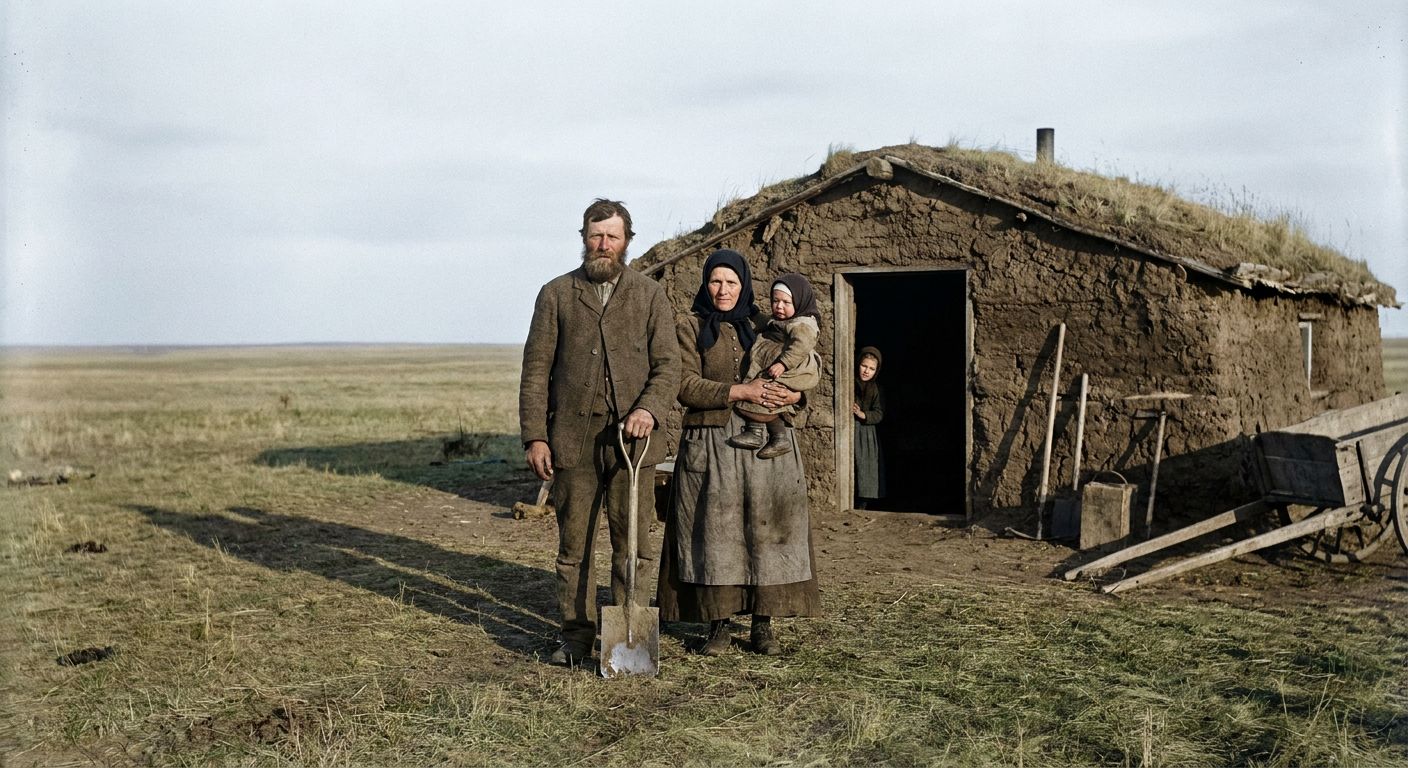
The arrival of the Northern Pacific Railroad in the 1870s re-engineered the landscape almost overnight. The government and the railroads launched massive propaganda campaigns in Europe, promising "free land" to anyone brave enough to claim it. They lured Norwegians, Germans, and Germans from Russia with the dream of the 160-acre homestead. These settlers arrived to find a land with no trees for lumber, leading them to cut the very sod from the earth to build their first homes.
This was the era of the "Bonanza Farms"—massive corporate wheat operations that spanned thousands of acres. North Dakota became a monoculture factory, fueled by the rich, black soil of the Red River Valley. However, the isolation was profound. The "lonesome prairie" wasn't just a poetic phrase; it was a psychological reality for immigrant women and men living miles from their nearest neighbors, enduring blizzards that could bury a house in a single night. This shared hardship forged a unique political identity: a fierce, populist streak that eventually led to the creation of the only state-owned bank and flour mill in America, designed to protect farmers from out-of-state monopolies.
The Badlands and the Rough Rider
While the east was defined by the plow, the west was defined by the scoria and silt of the Badlands. In 1883, a young, grieving New Yorker named Theodore Roosevelt arrived in the town of Medora to hunt bison. The jagged, multicolored buttes and the raw, violent beauty of the Little Missouri River valley captivated him. He invested in cattle ranching, losing a fortune in the "Great Die-Up" winter of 1886-1887, but gaining a rugged philosophy that would define his presidency.
Roosevelt famously remarked that he would never have been president had it not been for his time in North Dakota. The Badlands served as a laboratory for the American conservation movement, a place where the fragility of the natural world became apparent even in its most rugged form. Today, the national park that bears his name preserves the silence of the wilderness, where wild horses still roam and the stars shine with a clarity found in few other places on the continent.
The Modern Frontier
The 21st century has brought a new kind of boom to the state. The Bakken oil formation, unlocked by hydraulic fracturing, turned quiet ranching towns like Williston into "Man Camps" and overnight cities. The landscape is now dotted with the rhythmic bobbing of pumpjacks and the flares of natural gas, creating a surreal juxtaposition of ancient prairie and industrial frontier. North Dakota has become a place where billion-dollar energy deals are struck in the same diners where farmers still debate the price of winter wheat.
Yet, despite the industrialization, the fundamental character of the state remains tied to its openness. It is a place that demands a certain kind of toughness—a willingness to face the wind and the horizon without blinking. Whether it is the descendants of Norwegian sod-busters or the modern workers on an oil rig, the people of North Dakota continue to navigate a land that is as unforgiving as it is beautiful. To stand in the middle of a North Dakota field today is to realize that while the technology changes, the vastness of the sky remains the same, an eternal reminder of the human scale against the infinite plains.
This story travelled through
Where does this story take you next?
Every story opens a door somewhere else. Pick a thread and we'll tell you that story too.
Curious about something else?
Discover another exploration