The Mountain of Silver and the Ghost of a Global Empire
A single Andean peak once pumped the lifeblood of the global economy, minting the world's first currency while devouring the lives of those who dug it.
This story began with a question: “A story from Americas”
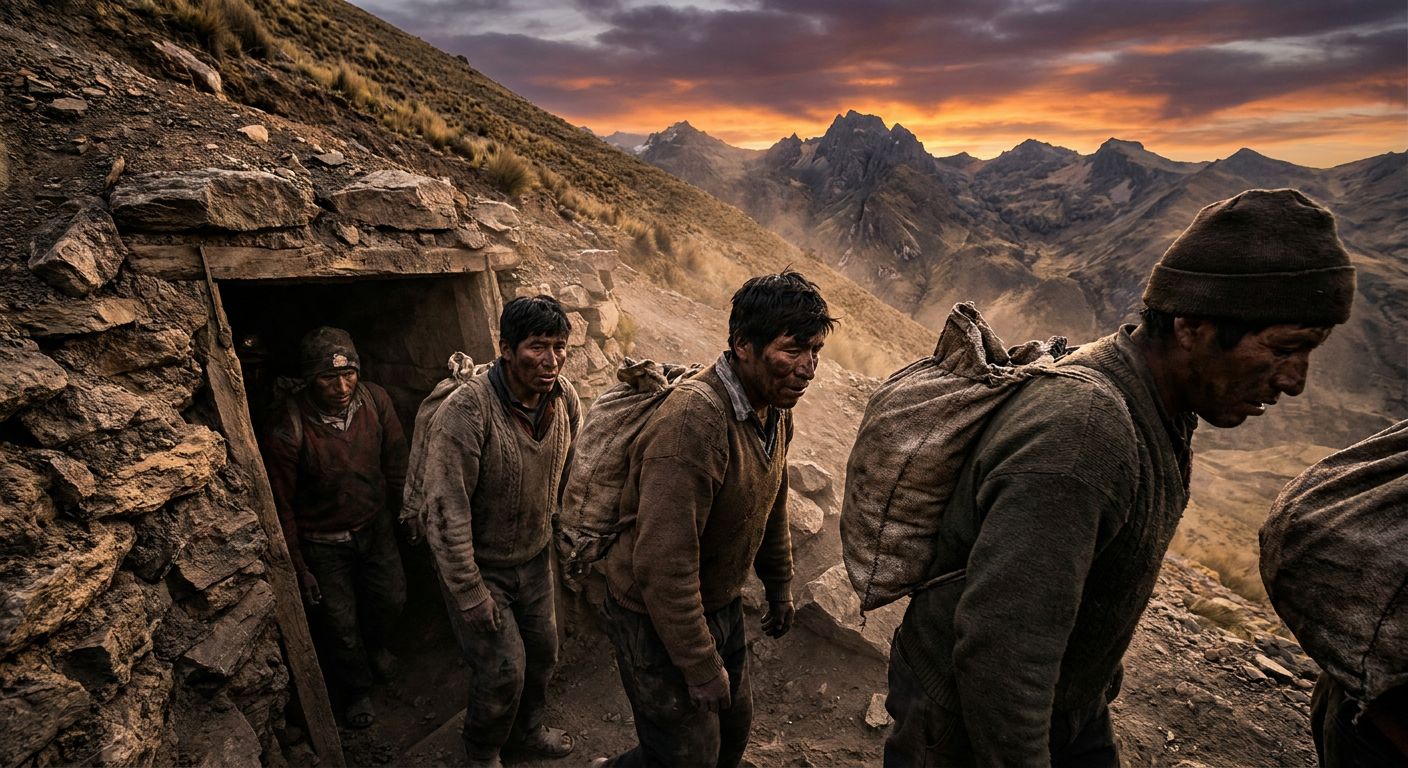
If you stand on the high, windswept plains of the Bolivian Andes, the air is thin enough to feel brittle, and the silence carries the weight of five centuries. Below you, the earth is scarred by a landform that fundamentally altered the trajectory of human commerce: Cerro Rico, the "Rich Hill" of Potosí. In the mid-16th century, this single peak held a concentration of silver so vast it did more than just enrich the Spanish Empire; it acted as the primary engine for a nascent global economy. Here, the modern world was not so much designed as it was forged through a collision of geography, imperial logistics, and labor.
Before the arrival of the Spanish, the mountain was known to the Quechua people, though historical accounts suggest they avoided large-scale extraction. In 1545, a man from Chumbivilcas named Diego Gualpa reported finding rich veins of ore on the slopes, sparking a migration that would transform a remote mining camp into one of the largest and most affluent cities in the world. By 1610, Potosí’s population rivaled London and Paris, a feat of urbanization occurring at over 13,000 feet above sea level.
The Mita: Engineering a Labor Colony
The logistical success of Potosí was contingent upon the mita, a pre-Columbian Incan labor system that the Spanish Empire adapted for colonial extraction. Originally, the mita was a form of communal public service, where citizens contributed time to state projects like road networks or terraced agriculture. Under Spanish rule, it was transformed into a mandatory draft that funneled thousands of Indigenous men into the lightless tunnels of Cerro Rico.
Under Spanish rule, it became a mandatory draft that funneled thousands of Indigenous men into the dark, suffocating bowels of Cerro Rico. [n] Inside the mountain, the conditions were defined by stark physical extremes. Miners often spent a full week underground, navigating narrow, oxygen-depleted shafts that descended deep into the rock. The transition from the freezing Andean air at the surface to the sweltering heat of the lower depths led to high rates of respiratory illness, while the dust produced by constant hammering resulted in silicosis. As the silver flowed toward the coast to fill the holds of Atlantic-bound galleons, the human cost was registered in the mass displacement of families from across the Andes to meet the relentless demand for labor.
Potosí Silver and the Ming Dynasty
The silver from Potosí did not merely stay within the treasury of Madrid. Minted into the real de a ocho—the famous Spanish dollar—the metal became the world’s first truly global currency. Its stability and high silver content allowed it to be accepted in the ports of Manila, the markets of Amsterdam, and the coastal trading hubs of India.
The Spanish dollar was so stable and widely recognized that it later served as the primary model for the United States dollar. [n] However, the ultimate destination for much of this Andean silver was China. During the 16th century, the Ming Dynasty implemented the "Single Whip Reform," a fiscal policy that collapsed various taxes into a single payment to be made exclusively in silver. This move created an insatiable demand for the metal in the East. The resulting trade loop saw Potosí silver travel through Acapulco and across the Pacific in the Manila Galleons, where it was traded for Chinese silks, porcelain, and tea. This flow of metal essentially linked every inhabited continent, though it also triggered "the Great Inflation" in Europe, as the sudden influx of silver devalued currencies across the Mediterranean.
The Chemistry of the Casa de la Moneda
In the center of the city stands the Casa de la Moneda de Bolivia, the Royal Mint. This fortress-like structure served as the industrial heart of the operation, where raw ore was transformed into standardized wealth. Within its stone walls, one can still find massive wooden gears and rolling mills that were once powered by teams of mules and enslaved Africans, who were brought to the high altitudes to supplement the Indigenous labor force.
The refinement of the ore relied on the "patio process," a chemical innovation that used mercury to separate silver from crushed rock. While highly effective at extracting silver from lower-quality ores, the process was ecologically devastating. Mercury vapors were released into the atmosphere, and toxic runoff frequently turned local water sources a deep, opaque red. This environmental legacy persists today, with high levels of heavy metal contamination still detectable in the soil and sediment surrounding the city.
The Lord of the Underworld
By the 18th century, the most accessible veins of silver had been exhausted, and Potosí began a slow transition from a global metropolis to a quiet highland town. Yet the culture of the mines remains remarkably intact. Modern miners, now primarily seeking tin and zinc, continue to navigate the precarious shafts of Cerro Rico.
Before entering, many still pause to offer coca leaves, alcohol, and tobacco to El Tío, a deity who rules the subterranean world. Represented by clay statues with horns and glowing eyes, El Tío is a syncretic figure—a blend of the pre-Columbian mountain spirits (huacas) and the Spanish concept of the devil. To the miners, he is not a figure of evil in the Western sense, but a capricious guardian who must be appeased to ensure safety and a successful strike.
Potosí today is a landscape of memory, where baroque church facades stand against the backdrop of a hollowed mountain. The story of Cerro Rico is the story of the birth of global trade, demonstrating how the geological wealth of a single Andean peak could simultaneously bankrupt European kings, stabilize Chinese dynasties, and redraw the map of the human world.
This story travelled through
Where does this story take you next?
Every story opens a door somewhere else. Pick a thread and we'll tell you that story too.
Curious about something else?
Discover another exploration