The Mountain Built of Broken Jars
Trace the massive logistics of the ancient world through the shards of millions of discarded jars in the heart of Rome.
This story began with a question: “The journey of olive oil to Rome”
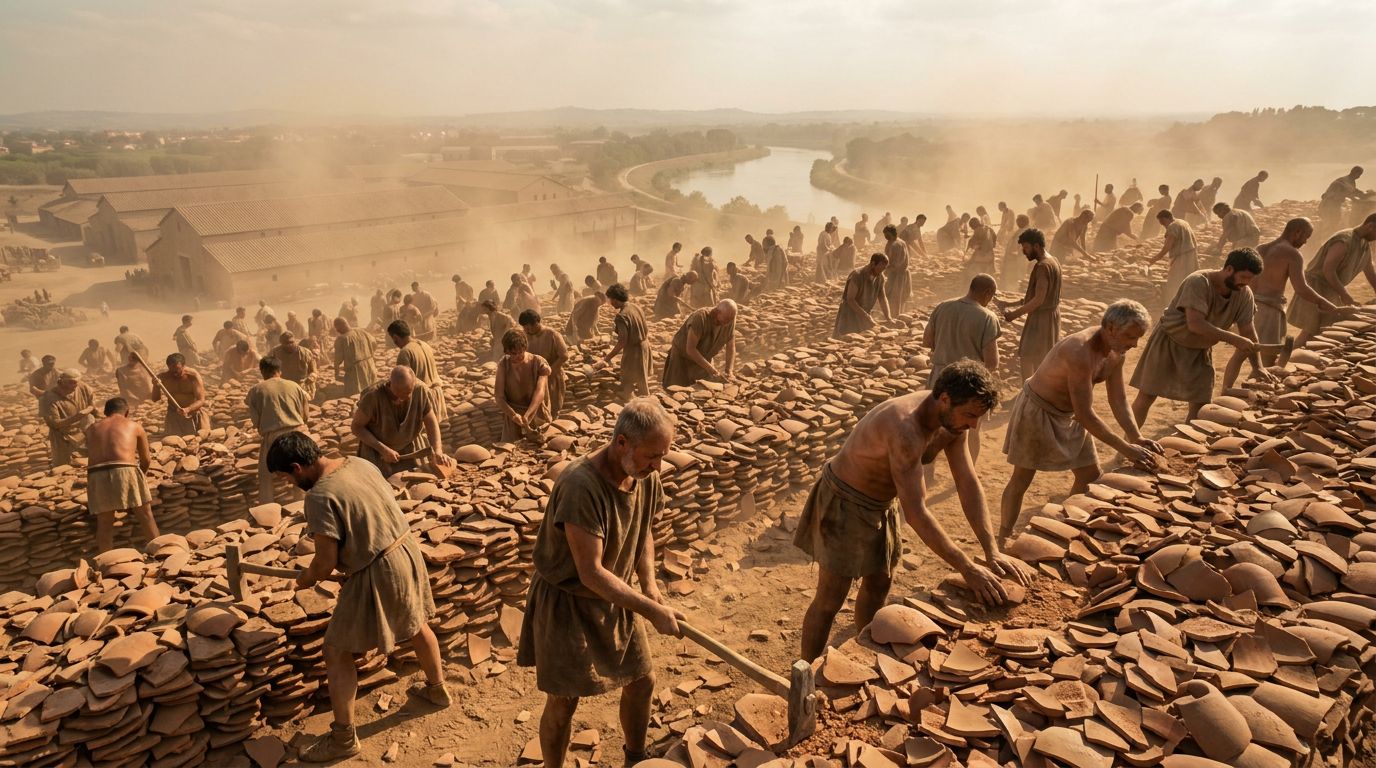
To walk the base of Monte Testaccio in modern-day Rome is to stand upon the literal discarded fragments of an empire. At first glance, it appears to be a grassy, tree-covered hill like any other in the city’s southern skyline. But a closer look at the exposed slopes reveals a different reality: the hill is composed of millions of broken pottery shards, known as testae. These are the remains of Dressel 20 amphorae—the heavy-duty shipping containers of the ancient world. For three centuries, this was the final resting place for the vessels that fueled Rome, providing the city with the golden liquid that powered its lamps, cleansed its bodies, and flavored its bread: olive oil.
In the second century AD, Rome was a sprawling metropolis of over a million people, and its appetite for olive oil was insatiable. Historians estimate the city required roughly 25 million liters of oil every year. Meeting this demand required a logistical operation of staggering scale, transforming the landscape of the Roman provinces and creating the world’s first truly globalized food commodity market.
The Groves of Baetica
The journey did not begin in Italy, but over a thousand miles to the west, in the Roman province of Baetica—modern-day Andalusia, Spain. While the Romans loved their native Italian oil, the sheer scale of the imperial capital's needs meant they had to look toward the sun-drenched valley of the Guadalquivir River. Here, the landscape was transformed into a monoculture of silver-leafed trees.
The production was industrial in its efficiency. In large rural estates called villae, massive stone presses squeezed the juice from harvested olives. The oil was then decanted into ceramic amphorae, each capable of holding about 70 liters. These were not just jugs; they were masterpieces of functional design. The Dressel 20, the most common type found at Monte Testaccio, featured thick walls and heavy handles to survive the rigors of maritime travel. Before the oil left the estate, the vessels were marked with tituli picti—painted inscriptions that acted as a sophisticated tracking system. These marks recorded the weight of the empty jar, the weight of the oil, the name of the producer, and the official who verified the contents.
The River Road to Gades
Once filled and sealed, the amphorae began their long journey. They were loaded onto flat-bottomed river barges that navigated the Guadalquivir River. This waterway was the artery of the province, connecting the inland groves to the great Atlantic port of Gades (modern-day Cádiz) and the river port of Hispalis (Seville).
The logistics were overseen by a class of wealthy merchants known as navicularii. These shipowners were essential to the empire’s survival, often receiving tax exemptions and special legal status because they ensured the capital did not starve. At the ports, the heavy jars—each weighing over 100 kilograms when full—were transferred from the river boats to massive seagoing merchant vessels. These ships were the giants of the Mediterranean, some capable of carrying up to 10,000 amphorae in their holds, packed tightly in layers of sand to prevent breakage during the rough autumn seas.
The voyage from the Iberian Peninsula to Italy was a treacherous one. The ships had to navigate the Strait of Gibraltar and cross the open Mediterranean, hugging the coastlines of North Africa or the Balearic Islands depending on the winds. A single storm could send a fortune in oil to the bottom of the sea, a fact evidenced today by the hundreds of Roman shipwrecks discovered by underwater archaeologists, their holds still neatly stacked with Spanish oil jars.
The Grand Entrance at Ostia
After two to three weeks at sea, the merchant ships would sight the lighthouse of Portus, the massive artificial harbor complex commissioned by the emperors Claudius and Trajan near the mouth of the Tiber. This was the throat of Rome. The arrival of an oil fleet was a moment of intense activity. Laborers known as saccarii swarmed the decks, using cranes and pulleys to hoist the heavy amphorae from the deep holds.
Because the Tiber River was too shallow and narrow for the deep-drafted merchant ships, the oil had to be transferred one last time. It was loaded onto smaller caudicariae, tow-boats that were pulled upstream by teams of oxen walking along the riverbanks. This final 20-mile stretch was the final leg of a journey that had spanned half the known world. The oil finally arrived at the Emporium, the great riverside district of Rome, where massive warehouses called horrea awaited.
The Mountain of Memory
When the oil reached the warehouses, it was decanted into smaller containers or large permanent vats for distribution to the city's shops and public baths. This created a unique problem: what to do with the empty amphorae? Unlike wine jars, which were often lined with resin and could be reused, olive oil jars were porous. Over time, the oil would soak into the ceramic and turn rancid, making the vessel unfit for a second shipment.
The Roman solution was a masterpiece of civil engineering. They created a designated dump site that eventually grew into Monte Testaccio. To manage the smell of the rotting oil residue, the workers carefully stacked the broken shards and covered them with lime to neutralize the odor. They didn't just throw the jars in a pile; they engineered a hill, complete with internal retaining walls of intact jars filled with rubble to maintain stability.
Standing atop the hill today, you are standing on the ghosts of nearly 53 million amphorae. Each fragment represents a tree in Spain, a merchant in Gades, a sailor on the Mediterranean, and a citizen in Rome. The journey of the oil was more than just a trade route; it was the physical manifestation of the Roman peace, a system that managed to link the distant edges of the continent into a single, hungry heart. Even as the empire fell, the hill remained—a silent, ceramic testament to a civilization that conquered the world one jar at a time.
This story travelled through
Where does this story take you next?
Every story opens a door somewhere else. Pick a thread and we'll tell you that story too.
Curious about something else?
Discover another exploration