The Mirror on the Roof of the Andes
When the summer rains fall on the world’s largest salt flat, the Bolivian Altiplano becomes a seamless, high-altitude reflection of the sky.
This story began with a question: “Why do the salt flats of Uyuni turn into a mirror after rain?”
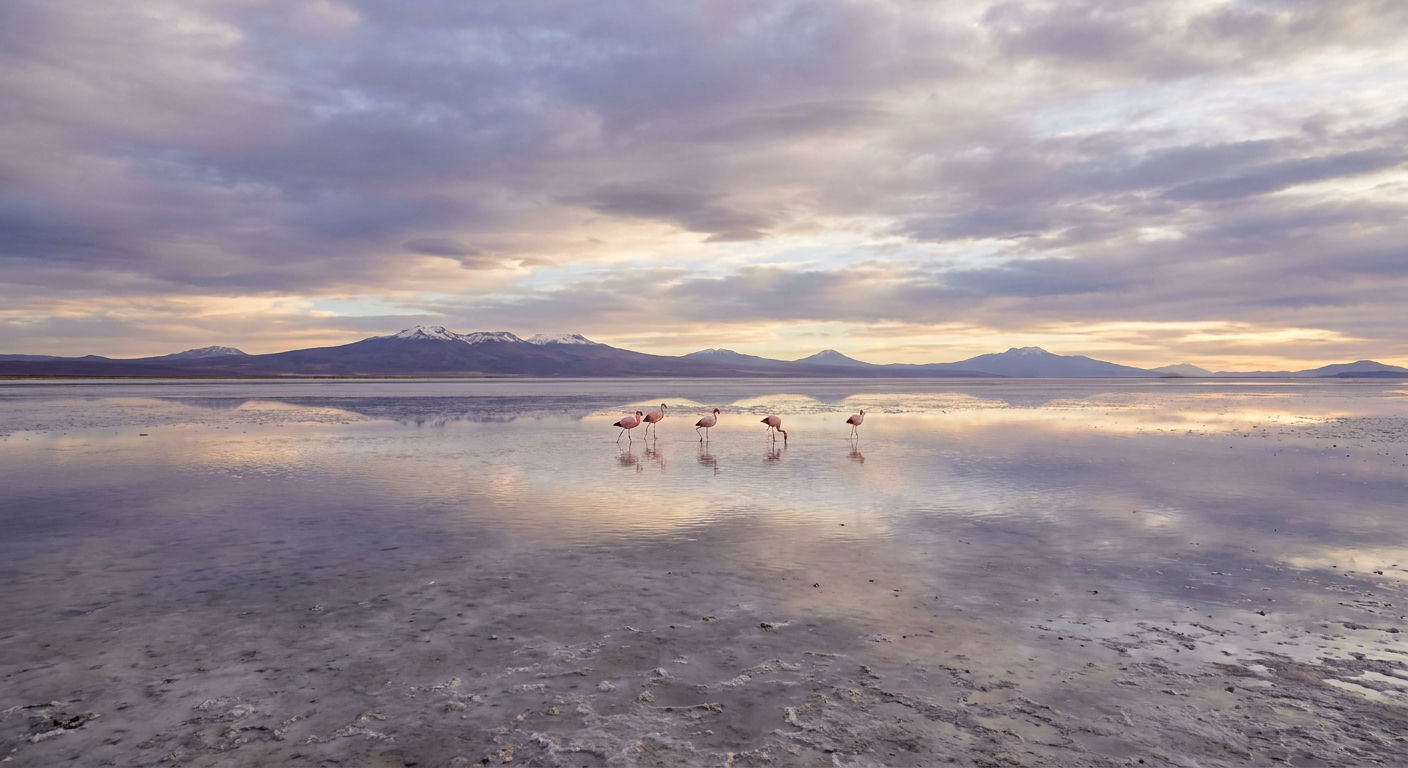
In the southwestern highlands of Bolivia, the transition between earth and sky is often a matter of debate. Most of the year, the Salar de Uyuni exists as a stark, blinding geometry—a crust of white salt hardened into millions of interlocking hexagons. Sitting at an elevation of 11,995 feet, the plateau is so massive and so perfectly level that it behaves less like a landscape and more like a frozen sea. But when the summer rains arrive between December and March, the desert undergoes a physical transformation that effectively erases the horizon.
This isn't just a wet desert; it is a specular reflection occurring on a planetary scale. A few inches of water gather on a surface that has no natural drainage, creating a liquid film that reflects light with the precision of silvered glass. For those standing in the center of the Salar during the rains, the clouds appear underfoot and the stars reflect with such clarity that pilots and drivers frequently suffer from spatial disorientation, unable to distinguish the ground from the void.
The Seal of Lake Minchin
The mirror is a ghost of a much deeper history. Roughly 30,000 to 42,000 years ago, this entire basin was filled by Lake Minchin, a prehistoric inland sea. As the climate warmed and the water evaporated, it left behind a thick, layered sediment of salt and minerals. While the surface appears to be a solid floor, it is actually a porous crust roughly 10 meters thick, floating atop a massive reservoir of liquid brine.
This brine is a chemical soup rich in potassium, magnesium, and lithium chloride. However, the topmost layer has been sun-baked into a dense, impermeable shield of sodium chloride. When the summer rains fall, the water cannot seep through this crystalline floor, nor can it drain away, as the Altiplano is a closed basin surrounded by the Andes. The water simply rests there, smoothed by the wind into a perfectly flat liquid lens only a few centimeters deep. While modern science explains this through hydrology, the local Aymara people have long held that the salt is the milk of the Tunupa volcano, who wept for her lost child until her tears and milk flooded the plains.
A Level Beyond Human Engineering
To the satellites orbiting overhead, the Salar de Uyuni is the most reliable coordinate on Earth. It is arguably the flattest place on the planet, with an average altitude variation of less than one meter over its entire 4,000-square-mile expanse. This lack of vertical relief is so consistent that NASA and ESA use the Salar to calibrate their radar altimeters. By bouncing signals off the flat salt and the seasonal water layer, scientists can fine-tune the precision of instruments used to measure sea-level rise and ice-sheet thickness.
The perfection of the reflection relies on this lack of topography. In a typical landscape, water pools in valleys and flows off hills, breaking the surface tension. Here, the water distributes itself with the precision of a spirit level. Because the air at this altitude is thin and remarkably free of dust, the light waves are not scattered. Instead, they bounce back at the same angle they hit the water, preserving the total vibrancy of the Andean sky. The result is a landscape that functions as a single, continuous optical instrument.
The Pink Nomads of the Brine
Despite the caustic, high-salinity environment, the mirror is not a wasteland. The arrival of the rain triggers a biological cycle that brings thousands of visitors to the brine. The Salar is a primary breeding ground for three species of South American flamingos, including the rare, yellow-billed James's flamingo. These birds have evolved specialized filters in their beaks to sift through the salty water for microscopic algae and brine shrimp that thrive in the mineral-rich pools.
Seeing a colony of pink birds standing in a reflected sunset is one of the world's most surreal spectacles, yet their presence is a reminder of the Salar's underlying volatility. The very minerals that support the algae—specifically the lithium reserves estimated to be the largest on Earth—are the focus of intense global interest. Extracting these minerals requires pumping the brine into massive evaporation ponds, a process that is often hindered by the rainy season. When the mirror forms, the industrial infrastructure of the town of Uyuni and the village of Colchani must pause, as the heavy trucks cannot safely navigate a world where the road has vanished into the sky.
The Vanishing Glass
As the fierce Andean sun intensifies toward the end of March, the mirror begins its slow retreat. The water does not soak into the earth; it evaporates into the thin air, leaving behind a fresh layer of recrystallized salt. This process is what maintains the Salar’s incredible flatness year after year, as the new salt fills in any minor depressions that may have formed.
The hexagons return, and the "mirror on the roof of the world" fades back into a cracked, white desert. But the hydrostatic equilibrium of the basin remains. The next time the clouds break over the mountains, the impermeable crust will again hold the water in place, turning the floor of the Andes back into a window looking into the sky. The lithium-rich brine continues to churn beneath the surface, a hidden ocean waiting for the next cycle of the sun.
This story travelled through
Where does this story take you next?
Every story opens a door somewhere else. Pick a thread and we'll tell you that story too.
Curious about something else?
Discover another exploration