The Marble Magnet: How Ephesus Banked the Ancient World
From a sheltered harbor to the world's first international bank, Ephesus transformed its geography into a marble empire.
This story began with a question: “How did Efeze become wealthy?”
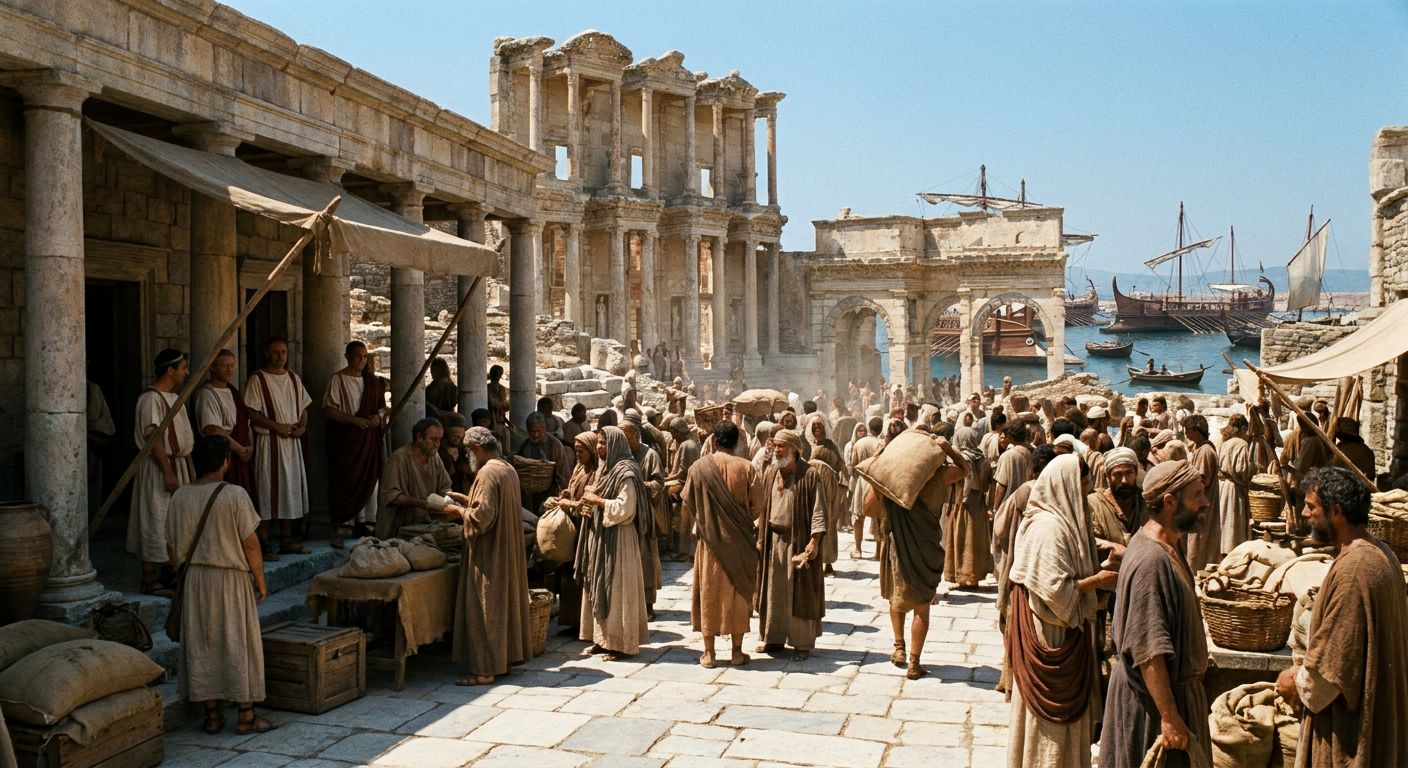
If you stand today in the Great Theatre of Ephesus, looking down a wide marble-paved road that once led straight to the sea, you are looking at a phantom of immense prosperity. The Mediterranean breeze still rolls in from the west, carrying the scent of salt and wild thyme, but the harbor is gone, replaced by miles of silty marshland and scrub. In its heyday, however, this was the glittering gateway to Asia, a city that functioned as a giant magnet for the wealth of two continents.
The rise of Ephesus was a lesson in the intersection of geography, religion, and the shrewd manipulation of imperial politics. To understand how a single city could afford a temple four times the size of the Parthenon and streets paved in solid white Proconnesian marble, one must look at how the Ephesians turned their sanctuary into the central bank of the ancient world.
The Gate Between Two Worlds
Long before the Romans arrived, Ephesus held a unique geographic advantage. Situated at the mouth of the Kaystros River—known today as the Küçük Menderes—on the western coast of Anatolia, it sat at the precise meeting point of the Aegean maritime routes and the Royal Road of the Persian Empire. It was the natural funnel through which the luxury goods of the East—spices, silk, and precious metals—flowed toward the markets of Greece and Rome.
The city’s harbor was its lifeblood. While other ports along the coast were battered by winter storms, the sheltered position of Ephesus offered a year-round haven for merchant galleys. The Ephesians were obsessive about this advantage. As the river naturally deposited silt that threatened to choke the harbor, the city invested staggering sums in dredging and canal building, fighting a centuries-long war against the encroaching earth to keep the money flowing.
Every ship that docked paid a harbor tax. Every merchant who set up a stall in the sprawling Tetragonos Agora—the commercial market—paid for the privilege. By the 2nd century BCE, Ephesus had surpassed its rivals to become the largest emporium in Asia Minor. It was a place where a merchant could arrive with a cargo of grain from Egypt and leave with a hold full of local wool, silver, and wine.
The Goddess and the Gold
However, trade was only half the story. The true engine of Ephesian wealth was the Artemision—the Temple of Artemis. This was not just a place of worship; it was one of the Seven Wonders of the Ancient World and, perhaps more importantly, the most trusted financial institution in the Mediterranean.
The temple operated as a sovereign bank. Because the sanctuary was considered inviolable—a sacred space where even the most ruthless generals dared not shed blood—it became the safest place on earth to store wealth. Kings, emperors, and wealthy merchants from across the Greek and Persian worlds deposited their fortunes within its massive columns for safekeeping.
The priests of Artemis were effectively the world's first international bankers. They managed these vast deposits, lending money out at interest to fund wars, public works, and private ventures. The temple owned vast tracts of land, fisheries, and salt works, all of which funneled a constant stream of revenue back into the city’s coffers. This religious prestige created a pilgrim economy that drew thousands to the city for the great festivals. Visitors spent fortunes on food, lodging, and the famous silver miniature shrines of the goddess, which local silversmiths produced by the thousands.
The Roman Tax Harvest
When the Roman Republic took control of the region in 133 BCE, the wealth of Ephesus shifted into a higher gear. The Romans designated Ephesus as the capital of the province of Asia, their richest territory. This made the city the administrative hub for tax collection across the entire region.
Ephesus became the base for the publicani, the Roman tax farmers. These private contractors would bid for the right to collect taxes in the province, paying the Roman state upfront and then extracting the sum from the local population. Much of this administrative machinery was centered in Ephesus, drawing in lawyers, bureaucrats, and financiers who all required grand villas and expensive entertainment.
The city’s elite learned to navigate the Roman system with precision. They funded lavish monuments to the Emperors, ensuring that Ephesus remained the "First and Greatest Metropolis of Asia." In return, the city was granted neokoros status—the prestigious right to host the imperial cult. This was a heavy responsibility that required building and maintaining massive temples to the Emperors, but it was also a lucrative distinction that ensured Ephesus remained the primary destination for all official Roman business and judicial proceedings in the East.
A Marble Legacy
The physical evidence of this wealth was designed to intimidate. The Library of Celsus, which still stands as a stunning facade today, was not just a house of books but a monumental tomb for a Roman senator, built with a private fortune that could have funded a small army for a decade. The city’s main thoroughfares were lined with stoas—shaded porticos—where bankers sat at tables changing the currencies of a dozen different nations, the air ringing with the clink of silver drachmae and gold aurei.
Even the common comforts of Ephesus were revolutionary. The city boasted sophisticated sewer systems and public toilets with running water, luxuries funded by the "voluntary" contributions of wealthy citizens looking to buy political influence. Walking the Curetes Way, the sound of water rushing through lead and clay pipes beneath the pavement was a constant reminder of the city's technical mastery. The Great Theatre, which could seat 25,000 people, was a testament to a city that had so much surplus capital it could afford to entertain a tenth of its population at once.
Eventually, the very geography that made Ephesus rich became its undoing. The Kaystros River, which had carried the trade ships, finally won its war. Despite desperate Roman efforts to dredge the channel, the harbor silted up completely, pushing the coastline miles away. Without its port, the "Bank of Asia" lost its reason for being. The merchants moved on, the temple fell into ruin, and the marble city was left to the silence of the silt.
Today, the ruins stand as a reminder that wealth is often a guest of the land, staying only as long as the gates remain open to the sea.
This story travelled through
Where does this story take you next?
Every story opens a door somewhere else. Pick a thread and we'll tell you that story too.
Curious about something else?
Discover another exploration