The Longest Walk Home: Karl Bushby’s Goliath Expedition
Former paratrooper Karl Bushby’s decades-long attempt to walk an unbroken path from Chile to England.
This story began with a question: “Karl Bushby which route did he walk”
In the autumn of 1998, a former British paratrooper named Karl Bushby stood at the southern tip of South America, looking north toward a horizon that didn't end. He had a backpack, a pair of sturdy boots, and a premise that sounded like a fever dream: he intended to walk back to his home in Hull, England, without using any form of transport other than his own feet. He estimated the journey would take him twelve years. He did not know then that he was beginning a quest that would span decades and turn a simple hike into a high-stakes struggle against international borders.
The project, which he dubbed the Goliath Expedition, was not a straight line. To reach Europe from Punta Arenas, Chile, he had to navigate the entire spine of the Western Hemisphere. The geography dictated the path: through the freezing winds of Patagonia, across the high-altitude deserts of the Andes, and through the humid, dense greenery of the Amazon basin. He walked alone, pushing a custom-built cart he called The Beast, which carried his tent, food, and supplies across thousands of miles of paved and unpaved road.
The Gap and the Wall
By the time he reached the border between Colombia and Panama, Bushby faced his first truly impassable obstacle: the Darien Gap. This is a sixty-mile stretch of roadless jungle, swamp, and mountains that serves as a natural barrier between North and South America. It is a place where the Pan-American Highway simply ceases to exist. He had to cross it on foot, hacking through some of the densest rainforest on the planet, navigating territories held by paramilitaries and drug traffickers. While most travelers take a boat or a plane to bypass this lawless region, Bushby’s rules forbade it; he emerged from the canopy after months, thin and scarred, but still on his feet.
His success in the jungle only brought him to the vast, arid stretches of Central America and Mexico. As he moved north, the challenge shifted from survival against nature to the endurance of the psyche. He crossed the border into the United States at Laredo, Texas, in 2002. For the next several years, he trekked across the American heartland, moving from the searing heat of the Mojave Desert to the Great Plains, eventually turning toward the rugged coastlines of the Pacific Northwest. The goal was the top of the world, where the land finally runs out.
Into the Frozen Corridor
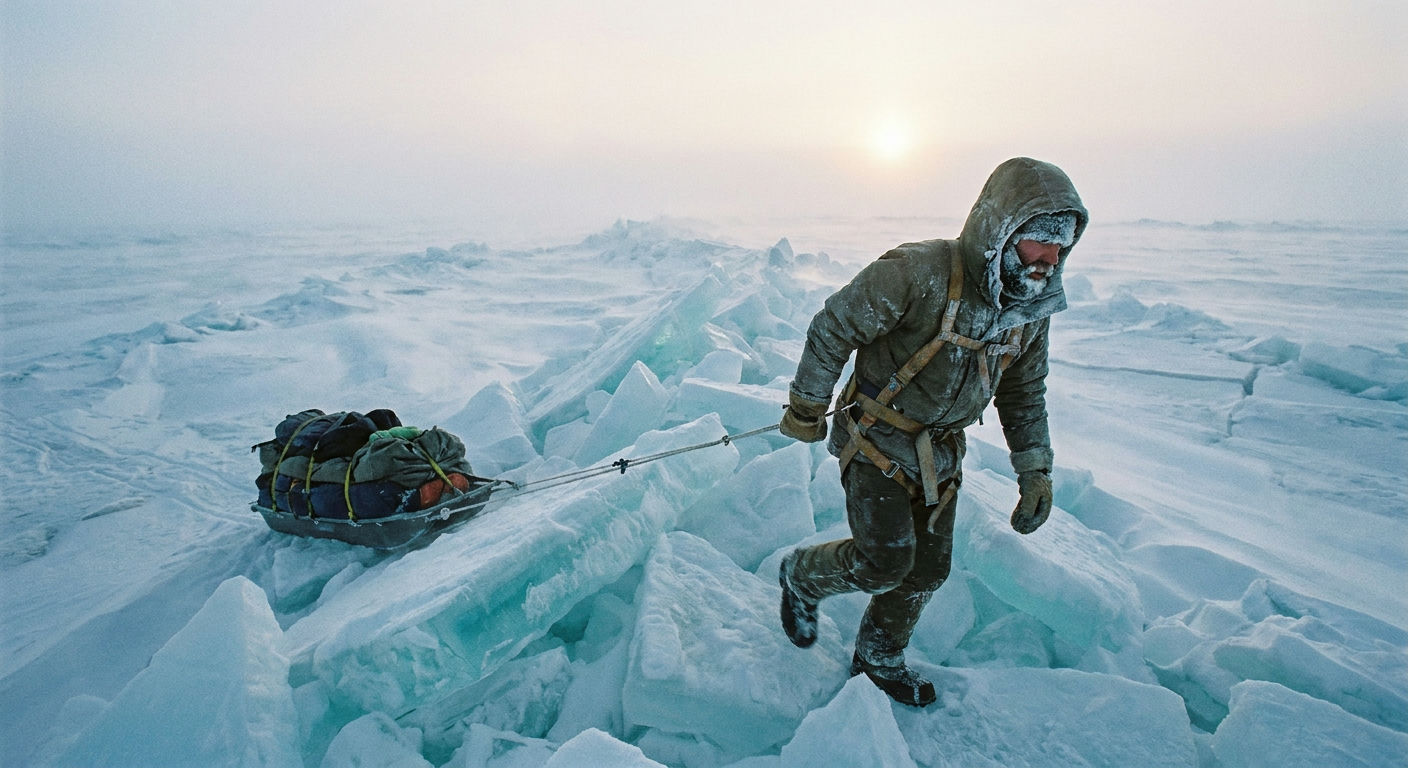
In 2006, Bushby reached the edge of the Seward Peninsula in Alaska. Ahead lay the Bering Strait, a fifty-six-mile stretch of churning, ice-choked water separating the Americas from Asia. This was the pivotal moment of the entire expedition. Because he refused to use a boat, he waited for winter, intending to walk across the frozen sea ice. Along with French adventurer Dimitri Kieffer, he stepped onto the shifting floes, navigating a chaotic landscape of pressure ridges—walls of ice forced upward by the colliding currents of the Pacific and Arctic oceans.
The crossing was a harrowing fourteen-day ordeal. The ice was not a solid bridge; it was a treadmill of giant white rafts constantly moving north with the current. To make any progress toward the west, the men had to walk diagonally against the drift, often retreating miles backward while they slept. When they finally scrambled onto the shore of the Chukotka Peninsula, they were exhausted and frostbitten, having achieved what few humans had ever attempted. But instead of a hero's welcome, they were met by the Russian Border Guard and detained for entering the country at a closed port of entry, sparking a legal battle that would shadow the next decade.
The Long Siberian Stall
The journey that was supposed to take twelve years began to stretch into a lifetime. For years, Bushby became entangled in the complexities of Russian law. In 2012, his progress was halted by a five-year ban from the country, a catastrophic delay that forced him to wait for political tides to turn. Each time he was allowed back, he returned to the exact spot where he had left his footprints in the Siberian snow. He pushed through the Russian Far East, one of the most sparsely populated and climatically hostile regions on Earth, where temperatures regularly dropped to minus 40 degrees.
As he moved deeper into the Eurasian landmass, the route took him through the Gobi Desert and into the vast steppes of Central Asia. He traveled through Mongolia and into Kazakhstan, following the ancient paths that had connected East and West for millennia. The sheer scale of the landscape meant that years passed between major milestones. He was no longer the young paratrooper who had left Chile; he was a man in middle age, his face weathered by the sun of the tropics and the winds of the tundra, still chasing a home that remained thousands of miles away.
The Edge of the Caspian
In recent years, the expedition faced a new geographical puzzle: the Caspian Sea. To keep his "unbroken path" intact while moving toward Europe and avoiding modern conflict zones to the north, Bushby had to find a way around or across this massive inland body of water. In 2024, he undertook a 300-kilometer swim across the Caspian, moving from Kazakhstan toward Baku, Azerbaijan. Supported by a team but powered by his own limbs, he became the first person to cross the sea from east to west in this manner.
The map of his life is now a line that stretches over 20,000 miles. A final, daunting obstacle remains: the English Channel. Because walking through the Channel Tunnel is strictly prohibited for pedestrians, Bushby must find a way across the water that satisfies his code of self-propulsion, perhaps by swimming or utilizing a human-powered craft. The story of Karl Bushby is no longer just a feat of athleticism; it is a study in what happens when a human being refuses to break a promise made to himself. He continues to move westward, a man who has spent more than half his adult life walking toward a front door he hasn't seen since the end of the twentieth century.
This story travelled through
Where does this story take you next?
Every story opens a door somewhere else. Pick a thread and we'll tell you that story too.
Curious about something else?
Discover another exploration