The Long Winter of the Sea Parrot
Every autumn, millions of Atlantic Puffins vanish from their clifftop colonies, embarking on a solitary, six-month survival marathon across a frozen ocean.
This story began with a question: “Where do puffins go in the winter?”
If you stand on a jagged cliffside in Iceland or the Shetland Islands during the height of summer, the Atlantic Puffin is impossible to miss. They are the "clowns of the sea," bustling about with their neon-orange beaks full of silver sand eels, crashing into their burrows with a charming lack of grace. But as August wanes, a strange silence falls over the colonies. Almost overnight, the millions of birds that carpeted the rocks vanish. For centuries, this disappearance was a genuine mystery to the coastal people who lived alongside them. They didn't fly south to palm-fringed beaches or tropical lagoons. They simply walked to the edge of the rock, cast themselves into the wind, and disappeared into the grey expanse of the North Atlantic.
For a long time, we only knew where they weren't. They weren't on land. They weren't in the sightlines of coastal fishers. It was as if they had been swallowed by the horizon. Only recently, with the advent of tiny geolocator tags no heavier than a penny, have we begun to track their lonely, six-month odyssey across one of the most hostile environments on Earth.
The Transformation of the Sea Parrot
The bird that survives the winter is not the same bird we see in the summer. As the breeding season ends, the puffin undergoes a radical physical transformation known as a partial molt. The most striking change is the beak. That iconic, glowing orange sheath—actually a series of horny plates—flakes off, revealing a smaller, duller, dusky-grey beak underneath. Their vibrant eye ornaments disappear, and their crisp white faces fade to a dirty charcoal.
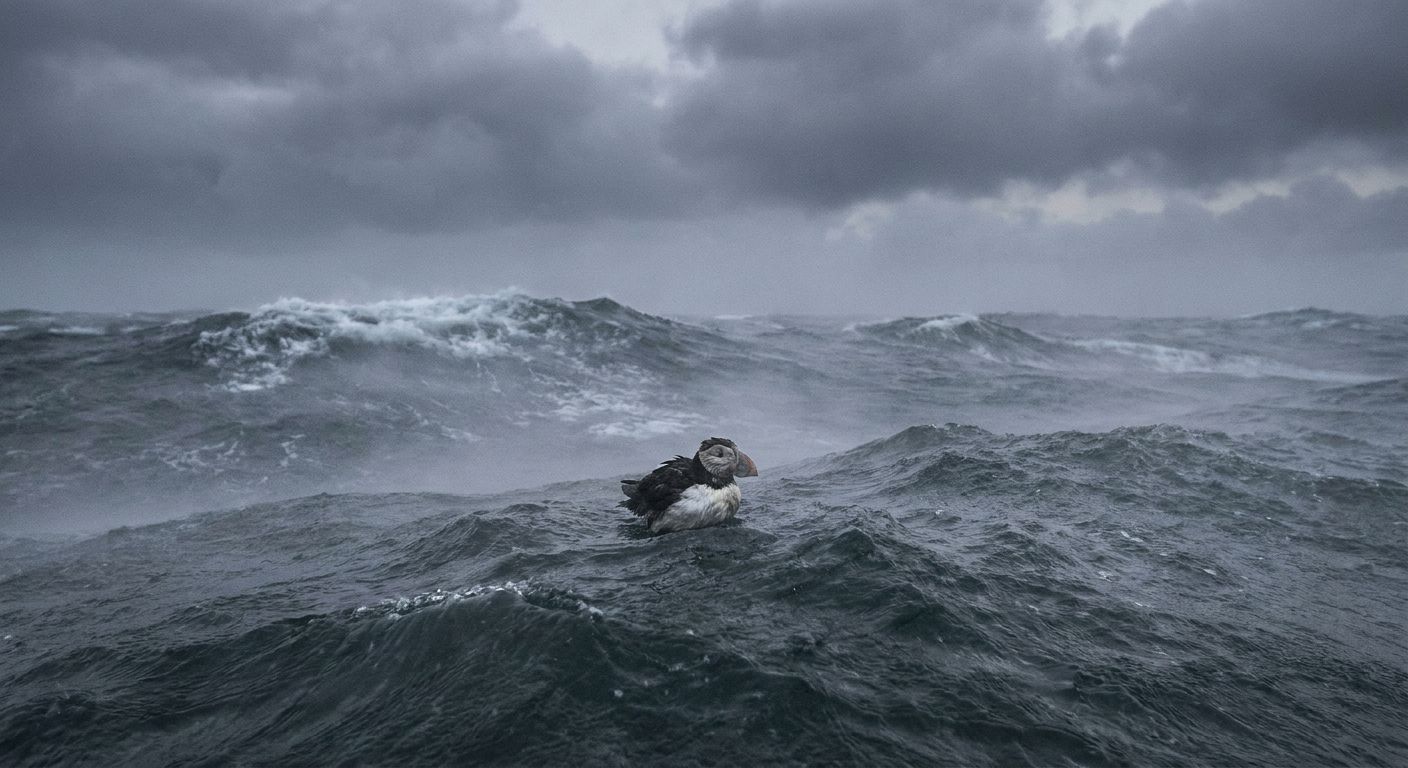
This is more than just a wardrobe change; it is a survival strategy. In the middle of the ocean, a bright orange beacon on your face is an invitation to predators. By shedding their summer finery, puffins become ghosts. They blend into the whitecaps and the leaden skies, becoming nearly invisible to the gulls and skuas that patrol the open water. They also shed their flight feathers all at once, rendering them flightless for several weeks. During this vulnerable period, they are completely beholden to the currents, bobbing on the surface of the swells like corks, waiting for their new feathers to harden so they can take to the sky again.
Solitude in the Vast Blue
Once their new plumage is ready, the puffins begin a journey of staggering scale. Unlike many seabirds that migrate in massive, coordinated V-formations, puffins are solitary winterers. They scatter. A single colony from Wales might see individuals head in completely opposite directions: some toward the icy waters off Greenland, others toward the relatively warmer currents near the Azores or even entering the Mediterranean through the Strait of Gibraltar.
They spend these months almost entirely on the wing or on the water. A puffin in winter rarely, if ever, touches solid ground. They sleep on the waves, tucking their heads under a wing while their waterproof feathers—maintained by constant preening with oil from a gland near their tail—keep them buoyant and dry. They are enduring a world of constant motion, where the "ground" beneath them is a moving liquid mountain and the temperature is often near freezing.
The North Atlantic winter is a gauntlet of storms. When the wind howls at hurricane force and the waves rise to the height of office buildings, the puffin does not seek shelter. It cannot. Instead, it uses its powerful wings—designed for "flying" underwater to hunt fish—to dive deep beneath the churning surface, finding a moment of relative calm in the dark, silent depths before surfacing again to breathe.
The Great Return to the Burrows
The most incredible part of the puffin’s winter journey isn't just the survival; it's the homecoming. In March and April, the biological clock strikes a chord that resonates across thousands of miles of ocean. Despite having spent months alone, navigating a featureless seascape without landmarks, the puffins begin to trek back toward the very same cliffside where they were born.
They don't just return to the same island; they often return to the exact same hole in the ground. Because puffins usually mate for life, the winter is a period of long-distance separation. The reunion at the burrow is a frantic, celebratory affair. As they arrive, their beaks begin to regrow the orange plates, glowing brighter as their hormone levels rise. They engage in "billing," a ritual where they tap their beaks together like a pair of wooden castanets, re-establishing the bond that was paused by the winter's isolation.
The mystery of how they navigate back remains one of biology's great questions. Evidence suggests they use a combination of celestial navigation, sensing the Earth’s magnetic field, and perhaps even a keen sense of smell to find their way home through the mist. They return weary, having survived half a year in a wilderness that would kill a human in minutes, ready to start the cycle of life all over again on the safety of the rocks.
The Fragile Bridge of Ice and Fish
The winter journey is becoming increasingly perilous, not because of the storms, but because of the shifting patterns of the ocean itself. Puffins rely on "cold-water" fish like sand eels and capelin. As ocean temperatures rise, these fish schools are moving further north or diving deeper than the puffins can reach. A puffin that has spent five months battling Atlantic gales arrives at its summer home with very little energy to spare; if the fish aren't there when they arrive, the colony fails.
We are beginning to see the effects of this in the "pufflings"—the chicks. In some years, the parents return from their winter haunts only to find a sea empty of the high-calorie snacks their young need. Understanding where puffins go in the winter is no longer just a matter of scientific curiosity; it is a race to understand which parts of the ocean we must protect to ensure that, every spring, the grey ghosts of the Atlantic can turn back into the colorful clowns of the cliffs.
This story travelled through
Where does this story take you next?
Every story opens a door somewhere else. Pick a thread and we'll tell you that story too.
Curious about something else?
Discover another exploration