The Lone Star Horizon: A History of Texas
From a contested Spanish buffer zone to a sovereign republic and a modern industrial titan, the story of the Lone Star State is one of constant reinvention.
This story began with a question: “What is the story of Texas?”
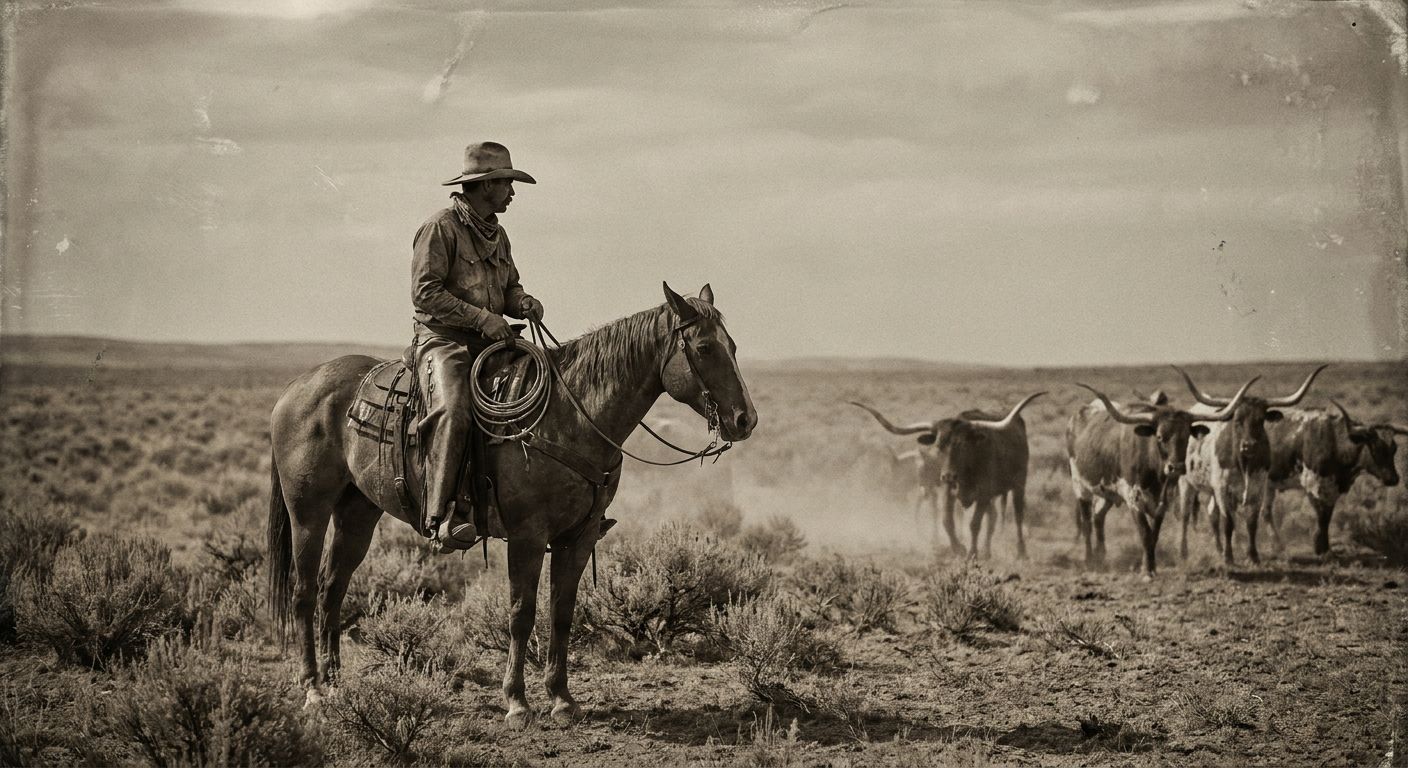
On the high, wind-scoured plains of the Llano Estacado, the horizon is so flat that you can see the curvature of the earth. It is a landscape that feels infinite, a place where the sky doesn't just meet the land but swallows it whole. For centuries, this vastness was not a borderland, but a heartland—the center of Comancheria, a powerful empire of horse-mounted warriors who dictated the terms of life across the Great Plains. To understand Texas is to understand that it has never been just one thing; it is a collision of worlds, a place where geography and ambition have repeatedly rewritten the rules of survival.
The story of Texas is often told as a linear progression toward independence, but it began as a desperate struggle for a foothold. In the early 1700s, the Spanish Empire looked north from Mexico and saw a terrifying void. They didn't see oil or cattle; they saw a buffer zone needed to protect their silver mines from the encroaching French and the devastating raids of the Apache and Comanche. They built missions like San Antonio de Valero—later known as the Alamo—not just to convert the indigenous population, but to anchor the land to the Spanish crown. Yet, the missions often failed to thrive, caught between the crushing weight of a distant bureaucracy and the sheer physical power of the indigenous nations who already owned the grass.
The Invitation and the Fracture
By the 1820s, a newly independent Mexico found itself facing the same problem Spain had: a massive, underpopulated territory that was difficult to defend. Their solution was a gamble that would change the map of North America. They invited American settlers, led by empresarios like Stephen F. Austin, to colonize the region. The deal was simple: the settlers would receive massive land grants in exchange for becoming Mexican citizens, practicing Catholicism, and—crucially—abstaining from the practice of slavery, which Mexico had abolished.
The settlers arrived in droves, bringing with them a hunger for cotton land and a fierce sense of individual liberty that frequently bucked against Mexican law. The cultural and political friction grew heat by the year. When General Antonio López de Santa Anna seized power in Mexico City and revoked the federalist constitution, the friction turned into a firestorm. The resulting Texas Revolution was not a simple tale of "Americans vs. Mexicans"; it was a messy, multilingual civil war involving Tejanos—Texans of Mexican descent—who fought alongside the American settlers for the right to self-governance.
A Republic Born of Blood and Debt
The revolution reached its bloody crescendo in 1836. At the Alamo, a small force was wiped out by Santa Anna’s army, a defeat that became a powerful rallying cry. Just weeks later, at San Jacinto, the Texian army under Sam Houston caught the Mexican forces by surprise during a siesta. In an eighteen-minute battle, the Republic of Texas was born.
For nine years, Texas existed as a sovereign nation, a period marked by profound instability. The Republic was broke, unrecognized by Mexico, and constantly at war with the Comanche to the west. Its leaders were divided: Sam Houston favored annexation by the United States to ensure security, while Mirabeau B. Lamar dreamed of a Texas empire stretching all the way to the Pacific. This decade of independence forged the "Lone Star" identity—a lingering sense of exceptionalism that suggests Texas is not just a state, but a distinct entity that once stood alone against the world.
The Long Shadow of the Frontier
When Texas finally joined the United States in 1845, it did so with a unique provision: it kept its public lands to pay off its massive debts, a move that would later make the state incredibly wealthy when oil was discovered. But first, the land had to be settled. The mid-to-late 19th century was the era of the great cattle drives, where millions of longhorns were driven from the brush country to railheads in Kansas. This was the birth of the American cowboy, an icon built on the reality of grueling labor, diverse crews of Black, Mexican, and white vaqueros, and the final, violent displacement of the indigenous tribes.
The transition from a frontier society to a modern powerhouse happened almost overnight at a place called Spindletop. In 1901, a geyser of black crude erupted near Beaumont, shooting 150 feet into the air. The oil boom transformed Texas from a rural, agrarian society into an industrial titan. It funded the rise of cities like Houston and Dallas, fueled the global machinery of two World Wars, and created a new kind of Texan—the oil tycoon.
The Modern Crossroads
Today, the image of Texas is shifting again. The rugged cattle trails have been replaced by the "Silicon Hills" of Austin and the massive shipping lanes of the Gulf Coast. It is one of the most urbanized and diverse states in the U.S., a place where the cowboy hat is just as likely to be worn by a software engineer as a rancher. Yet, the echoes of the past remain. The state's political identity is still defined by the tension between individual liberty and collective infrastructure, a debate that has been running since the first empresarios crossed the Sabine River.
The story of Texas is ultimately a story of scale. Everything here—the storms, the fortunes, the conflicts, and the ambitions—feels outsized. It is a place that was won, lost, and reinvented so many times that the reinvention itself has become the primary tradition. From the Comanche riders to the NASA engineers directing voyages to the moon, Texas remains a frontier, forever looking toward the next horizon.
This story travelled through
Where does this story take you next?
Every story opens a door somewhere else. Pick a thread and we'll tell you that story too.
Curious about something else?
Discover another exploration