The Lion of the Transvaal: Paul Kruger’s Unyielding Legacy
A frontiersman who became President, Kruger led the Boer struggle against the British Empire and left a legacy of both political division and conservation.
This story began with a question: “Who was Paul Kruger and what was his role in the history of South Africa?”
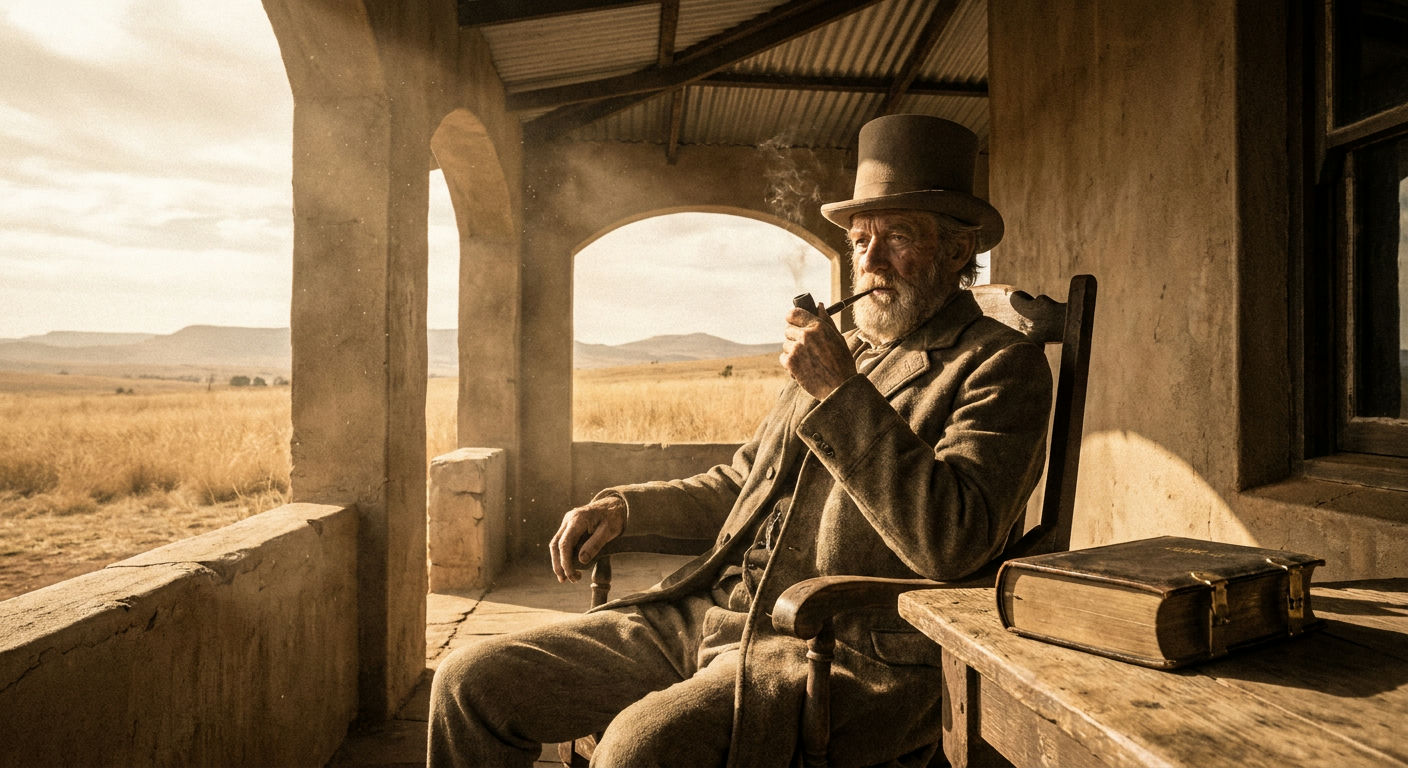
In the rugged history of the South African interior, few images are as incongruous as a man wearing a formal black silk top hat while standing in the middle of a dusty, lion-haunted scrubland. This was Stephanus Johannes Paulus Kruger, the man known to the world as the \"Lion of the Transvaal.\" He was a figure carved from the hard edges of the frontier, a leader who reportedly once used a pocketknife to amputate his own thumb after a hunting accident and whose physical toughness was matched only by a stubborn, unyielding faith.
For a young boy named Stephanus Johannes Paulus Kruger, the horizon was something that moved. He was only ten years old when his family joined the Great Trek, a massive migration of Dutch-descended farmers, or Boers, who loaded their lives into ox-wagons to escape British colonial rule in the Cape Colony. This 1,000-mile journey through the vast, semi-arid Karoo and over the Drakensberg mountains shaped a world of gunpowder and prayer books. By the age of fourteen, Kruger was considered a full burgher, entitled to his own farm in the South African Republic—a territory more commonly known as the Transvaal. He didn't just live in this land; he became its embodiment, eventually rising to become its president in 1883.
Gold, Greed, and the Witwatersrand Reef
For decades, the South African Republic was a poor, isolated pastoral state, but the earth beneath Kruger’s feet held a secret that would destabilize the global economy. In 1886, a massive gold reef was discovered on the Witwatersrand, a ridge of white water that would soon become the site of Johannesburg. This discovery turned the bankrupt republic into the richest gold-producing region on Earth.
Kruger viewed this sudden wealth with profound suspicion. He famously remarked that the gold would bring \"more blood than joy,\" fearing that the influx of thousands of foreigners—the Uitlanders—would overwhelm Boer culture and invite the British Empire back to his doorstep. By denying these newcomers the right to vote, Kruger created a political pressure cooker. The struggle soon focused on a clash of ideologies between Kruger and the British diamond magnate Cecil John Rhodes. While Rhodes dreamed of a British Africa stretching \"from Cape to Cairo,\" Kruger was determined to keep his republic an independent island in a British sea. The conflict was no longer just about pastoral land; it was a battle over who would control the mineral heart of the continent.
The Commando and the Imperial Machine
The diplomatic friction finally ignited in 1899, marking the start of the Second Boer War. Kruger, now an elderly man with a thick, iconic spade beard, found himself leading a collection of farmers against the professional might of the British Empire. This was the conflict that introduced the world to the concept of guerrilla warfare on a massive scale. Kruger’s commandos were expert marksmen who knew every fold of the landscape, using highly mobile tactics to frustrate the slow-moving British columns.
However, the Boers could not hold back the sheer numbers and industrial resources of the Imperial forces. As the British captured the capitals of the Boer republics, Kruger was forced into a heartbreaking exile. He boarded a Dutch cruiser, the Gelderland, and sailed for Europe, hoping to find international support for his cause. He traveled through France, Germany, and the Netherlands, greeted by sympathetic crowds who saw him as a David fighting a Goliath. Yet, the governments of Europe offered only cheers, not soldiers. The old president never saw his homeland again, dying in Clarens, Switzerland, in 1904, two years after his republics had been absorbed into the British Empire.
The Accidental Conservationist
Today, Kruger remains one of the most polarizing figures in the history of the region. To some, he was the \"Father of the Nation\" who stood against imperialism; to others, he was a stubborn reactionary whose policies of exclusion laid the early, shaky foundations for the system of racial segregation that would later be known as Apartheid.
However, his most enduring physical legacy is not a monument of stone, but a sanctuary of soil. In 1898, despite the brewing war, he signed the proclamation that established a government wildlife reserve to protect the animals of the Lowveld from overhunting. This area would eventually become the Kruger National Park, one of the most famous conservation areas in the world.
There is a strange irony in the fact that the man who spent his life fighting to keep people out of his land is now remembered most through a park that invites the whole world in. His bronze statue still stands in the center of Pretoria, watching a city and a country that has transformed into something he would scarcely recognize, yet his name is whispered every time a lion moves through the tall grass of the east. Does the preservation of the land he loved justify the divisions he helped create, or is the park simply the final, wild vestige of a republic that refused to be tamed?",change_summary:[
This story travelled through
Where does this story take you next?
Every story opens a door somewhere else. Pick a thread and we'll tell you that story too.
Curious about something else?
Discover another exploration