The Legacy of the Burning Stone: Estonia’s Oil Shale Saga
From shepherd's hearths to Soviet mega-plants, discover how a rare 'burning stone' gave a small Baltic nation its power and its most enduring environmental challenge.
This story began with a question: “What is the history of Estonia's oil shale industry?”
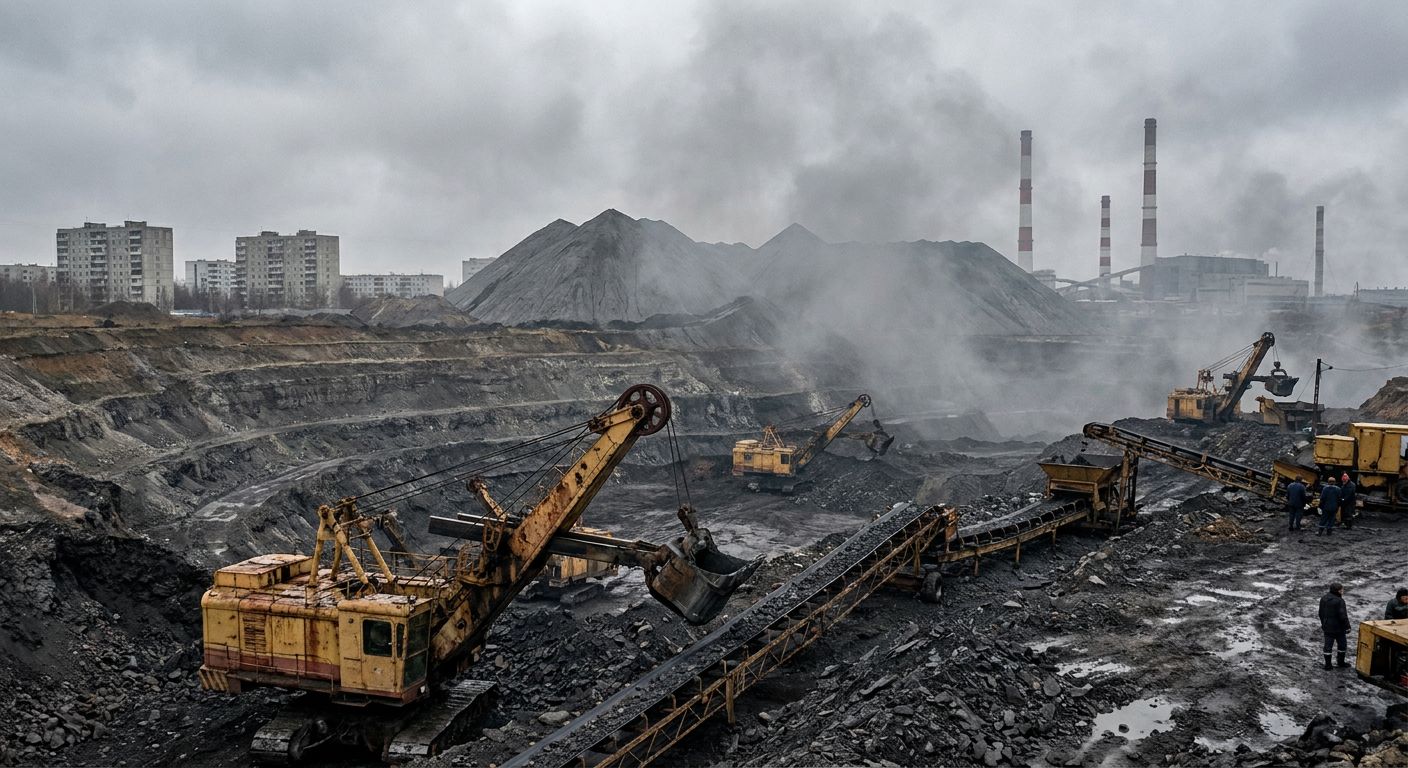
High in the northeastern corner of Estonia, the landscape takes on a shape unlike anywhere else in the Baltic. Amidst the birch forests and wetlands, massive, flat-topped hills rise from the earth—man-made plateaus of grey ash and spent rock that tower over the town of Kohtla-Järve. For over a century, this region has been the engine room of a nation. While other countries built their empires on coal or liquid petroleum, Estonia looked at the dull, brownish stone beneath its feet and saw fire. This is the story of põlevkivi, the "burning stone," a resource that provided Estonia with a fierce energy independence but left a heavy footprint on its land and soul.
The Discovery of the Burning Stone
The story begins not in a laboratory, but in a shepherd’s fire. Local legends tell of peasants building hearths out of the strange, layered rocks found in the fields, only to find the hearth itself catching fire and glowing with an intense, oily heat. Geologists call it oil shale—a sedimentary rock packed with organic matter called kerogen. While it had been scientifically identified as early as the late 18th century, it remained a curiosity until the pressures of the First World War forced a desperate search for local fuel.
As the Russian Empire crumbled and the young Republic of Estonia fought for its independence in 1918, the "burning stone" became a matter of national survival. Wood was scarce and coal imports were cut off by conflict. The Estonian government realized that if they could unlock the energy trapped in these rocks, they could power their own destiny. In 1922, the state-owned enterprise Riigi Põlevkivitööstus was established, and the sleepy villages of the northeast were transformed into a frontier of industrial experimentation.
A Soviet Industrial Fortress
The true explosion of the industry came after the Second World War, during the decades of Soviet occupation. The Kremlin viewed Estonia’s oil shale as a vital strategic asset for the entire northwestern USSR. They didn't just want the rock for heat; they wanted the oil that could be chemically cooked out of it. Massive open-pit mines and deep underground shafts began to spiderweb across the Ida-Viru County.
This era saw the construction of the world’s largest oil-shale-fired power plants near the city of Narva. These gargantuan facilities, with their iconic striped chimneys, eventually provided over 90 percent of Estonia’s electricity. The scale of the operation was staggering. To keep the furnaces roaring, tens of thousands of workers were brought in, primarily from other parts of the Soviet Union. This migration fundamentally altered the demographic and linguistic map of the region, creating a Russian-speaking industrial heartland that felt distinct from the rest of the Estonian-speaking nation.
The Alchemy of Shale Oil
Extracting energy from shale is a brutal, complicated process. Unlike liquid oil that gushes from a well, shale must be mined, crushed, and then heated to roughly 500 degrees Celsius in a vacuum to release its vapors. This process, known as retorting, turns the solid kerogen into a thick, pungent synthetic crude. For the Soviet military, this oil was precious; for the Estonian locals, it meant a landscape of "ash mountains"—the piles of semi-coke residue left over after the oil was extracted.
By the 1980s, the industry reached its zenith, but the environmental cost was becoming impossible to ignore. The groundwater was turning acidic, and the air in the industrial towns was thick with the scent of sulfur and bitumen. Yet, even as the Singing Revolution took hold and Estonia pushed for independence from the USSR in the late 1980s, the oil shale workers remained a powerful, if complicated, political force. They were the men who kept the lights on, and their labor was the only thing standing between the country and total energy dependence on its giant neighbor to the east.
A Nation in Transition
When Estonia regained its independence in 1991, it inherited a double-edged sword. It was the only country in the world that relied almost entirely on oil shale for its electricity, giving it a level of energy security that its Baltic neighbors envied. However, as Estonia moved toward the European Union, the "burning stone" became a liability. Oil shale is one of the most carbon-intensive ways to produce energy, and the environmental standards of the 21st century began to clash with the industrial legacy of the 20th.
Today, the ash mountains are being landscaped and turned into centers for adventure sports and wind farms. The giant power plants are being retrofitted to burn wood chips alongside shale, or are being decommissioned entirely. The industry is pivoting from burning the rock for electricity to refining it into high-value chemicals and fuels, trying to find a cleaner future for a stone that has defined the region for a century. The miners who once worked in the dark shafts now look out over a landscape that is slowly turning green again, a testament to a nation’s ability to reinvent itself even when its history is carved in stone.
The era of the burning stone is not over, but it has changed. It remains a symbol of Estonian grit—the ability to take a cold, grey rock and find within it the warmth to build a modern state. In the quiet forests of Ida-Virumaa, the scars of the mines are still visible, reminding travelers that independence often comes with a heavy, dusty price.
This story travelled through
Where does this story take you next?
Every story opens a door somewhere else. Pick a thread and we'll tell you that story too.
Curious about something else?
Discover another exploration