The King Who Bought a Kingdom: Valdemar IV’s Feudal Finance
When the Danish throne went vacant in 1332, the kingdom was a bankrupt collection of mortgages held by foreign counts.
This story began with a question: “How did Valdemar IV systematically buy back a country that had been pawned to German counts?”
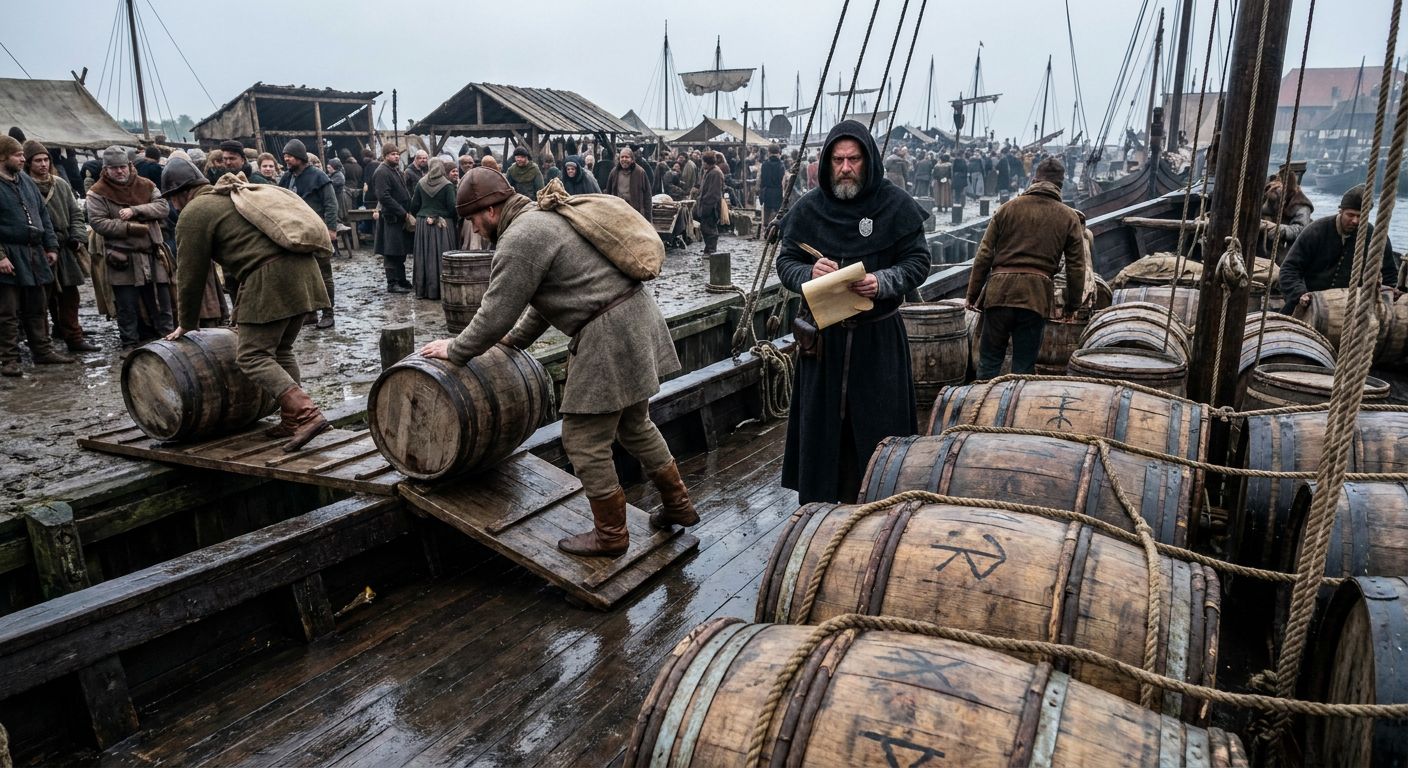
If you had stood on the shores of the Danish Belts in the year 1332, you would have looked upon a kingdom that was little more than a ledger of liabilities. Denmark was a ghost, a collection of islands and peninsulas that had been carved up, mortgaged, and handed over to German counts as collateral for royal debts. There was no king on the throne, the crown jewels were likely sitting in a counting house in Lübeck, and the peasants were being bled dry by foreign tax collectors who had no interest in the land beyond the silver that could be squeezed from its soil.
This period, known as the "Great Pawnship," represented a total national insolvency. When Valdemar IV Atterdag returned from exile in the Bavarian court in 1340, he didn't inherit a throne; he inherited a series of legal contracts and a debt so deep it threatened to erase his dynasty. His reign was not just a military campaign, but one of the most ruthless and brilliant exercises in feudal financial engineering in European history.
The Kingdom Under the Hammer
The crisis had begun decades earlier under Valdemar’s father, Christopher II of Denmark. Desperate for funds to fight internal rivals and external enemies, Christopher had pawned entire provinces to foreign creditors, most notably Gerhard III, Count of Holstein-Rendsburg. By the time Valdemar was elected king, the realm was a patchwork of "mortgaged" territories. Under this system, a count would hold a region, collect all its taxes and rents as interest on the loan, and only return the land if the principal was paid back in full—a nearly impossible task for a bankrupt crown.
Valdemar’s genius lay in recognizing that he could not fight every creditor at once. He began a cold, systematic process of "buying back" Denmark, one district at a time. He started in North Jutland, using a mixture of small-scale military pressure and complex diplomacy. He leveraged the chaos following the assassination of Gerhard III to re-establish a foothold, but he knew that swords alone wouldn't win back the title deeds. To clear the books, he needed a massive, sustained influx of liquid capital.
The Duchy for a Kingdom
To fund his reclamation project, Valdemar IV Atterdag transformed the Danish monarchy into a high-pressure taxation machine. He revived and strictly enforced the scutage system—a tax paid in lieu of military service—and introduced the snapskat, a sudden, heavy tax on all households. He traveled the country relentlessly, holding court sessions to reclaim "alienated" crown lands—farms and estates that had been illegally seized by local nobles during the interregnum.
Valdemar’s reputation for being "always in motion" earned him his nickname Atterdag. While some interpret it as "another day," others suggest it came from the Low German ter tage, meaning "these days," referring to his constant presence as a royal bailiff. To secure the heartlands, he made the difficult decision to liquidate peripheral assets. In 1346, he sold the Duchy of Estonia (1219–1346) to the Teutonic Knights for 19,000 marks of silver. This was no mere bag of coins; 19,000 marks represented roughly four tons of silver, a staggering amount of liquidity that allowed him to pay off the Holsteiners and retire the mortgages on the Danish islands.
The Scanian Revenue
By the 1360s, Valdemar had secured Jutland and the islands, but the crown’s most valuable economic engine remained in Swedish hands: Scania. Located at the southern tip of the Scandinavian peninsula, Scania was home to the towns of Skanör and Falsterbo, the site of the Great Herring Fair. This was a seasonal economic explosion where millions of fish were salted and shipped across Europe, generating immense tax revenue through harbor fees and trade duties.
Valdemar did not just want Scania for pride; he wanted the herring gold to finalize the stabilization of the Danish economy. In 1360, he launched a surprise invasion, reclaiming the province and its vital fortresses. This move signaled that Denmark was no longer a pawn on the Baltic board, but a player. However, this sudden surge in Danish power deeply unsettled the merchant lords of the North.
The reconquest of Scania brought Valdemar into direct conflict with the powerful Hanseatic League. The merchants feared his control over the herring trade and his ability to tax their ships. In 1361, Valdemar struck Visby, the wealthy Hanseatic hub on the island of Gotland. By sacking the city, he aimed to break the League’s regional monopoly and ensure that the profits of Baltic trade flowed into the Danish treasury rather than the pockets of German burghers.
The Architecture of Sovereignty
Valdemar IV Atterdag’s legacy was not just the borders he restored, but the administrative framework he left behind. He replaced the chaotic feudal levies with a centralized bureaucracy and a series of royal castles that served as both military strongpoints and tax collection centers. These stone fortresses were the physical manifestation of a debt-free state, ensuring that the crown would never again be forced to pawn its own soil.
By the end of his reign in 1375, the "pawned kingdom" was a unified, solvent state. He had turned a bankrupt family estate into a European power, laying the foundation for his daughter, Margaret I of Denmark, to eventually unite all of Scandinavia under the Kalmar Union. Valdemar proved that a kingdom is more than just land and people; it is a legal and financial entity that must be managed with the precision of a merchant. He remains the king who bought his way back into history, proving that in the game of medieval power, the ledger could be as powerful as the lance.
This story travelled through
Where does this story take you next?
Every story opens a door somewhere else. Pick a thread and we'll tell you that story too.
Curious about something else?
Discover another exploration