The Fortress of Mud: Why Venice Rose from the Lagoon
Born of desperation and built upon a subterranean forest, Venice was a fortress of mud that became a masterpiece of stone.
This story began with a question: “Why was Venice built on water?”
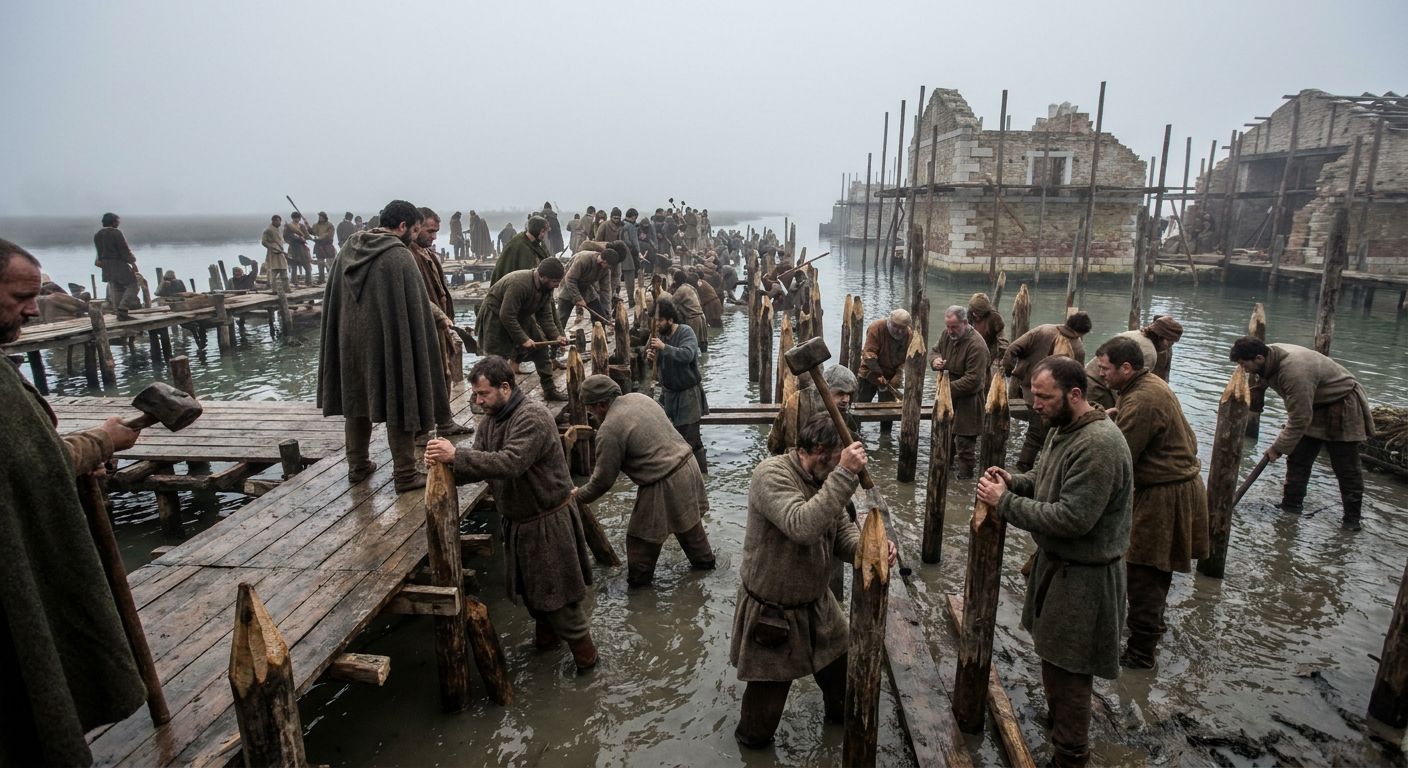
To the modern traveler standing on the Rialto Bridge, Venice feels like a beautiful impossibility, a city of marble and gold floating effortlessly atop a shimmering lagoon. But if you were to drain the water from the Grand Canal, you wouldn't find solid earth or bedrock. Instead, you would find a forest of millions of petrified wooden stakes, driven deep into the thick mud. Venice was not built on water because its founders were visionaries or poets; it was built on water because they were terrified.
The story begins in the 5th century AD, as the Roman Empire was crumbling under its own weight. From the north and east came waves of Germanic and Hunnic invaders—most famously Attila the Hun—who swept across the fertile plains of northern Italy. The inhabitants of Roman cities like Aquileia and Padua watched their villas burn and realized that their walls were no longer enough to keep the chaos at bay. They looked toward the Adriatic Sea, specifically to a desolate, marshy archipelago of 118 small islands protected by a shallow lagoon.
A Sanctuary of Mud and Mist
The lagoon was a treacherous labyrinth of shifting sandbanks and shallow channels. To a local fisherman, these waters were a familiar backyard; to a mounted barbarian warrior or a heavy infantry unit, they were a death trap. The early refugees realized that the water was their greatest wall. By retreating to these muddy outcrops, they put a barrier of salt and silt between themselves and the crumbling world.
Life in the early centuries was grueling. There was no fresh water, little arable land, and the air was thick with the scent of brine and decay. These early Venetians were forced to become masters of their environment. They learned to navigate the "barene"—the salt marshes—and began to realize that their isolation was actually a strategic masterpiece. They were unreachable by land, yet they sat at the mouth of the great rivers of northern Italy, perfectly positioned to control the trade between the dying Western Empire and the rising power of Byzantium in the East.
The Forest Beneath the Stone
As the population grew, the small islands could no longer support the weight of a growing city. The Venetians faced a daunting engineering crisis: how do you build a city of stone on a foundation of mud? Their solution remains one of the greatest architectural feats in human history. They turned to the vast forests of Slovenia and Croatia, transporting millions of logs across the sea.
These logs, mostly larch and oak, were sharpened and driven vertically through the soft mud until they hit a harder layer of compressed clay known as "caranto." Because the wood was submerged in oxygen-poor silt, it did not rot. Instead, the salt and minerals in the water petrified the wood over centuries, turning it into a foundation as hard as stone. On top of these millions of pilings, they laid horizontal planks of larch, and upon those, they began to lay the Istrian stone that would support the city's iconic palazzos.
The geography of the lagoon also dictated the city's unique layout. The Grand Canal follows the natural path of an ancient riverbed that once flowed through the marsh. The smaller canals are the veins that allowed for the movement of goods and people in a world where horses and carriages were useless. Every bridge, every fondamenta, and every water-gate was a deliberate adaptation to a landscape that was never meant for human habitation.
The Bride of the Sea
By the middle ages, what began as a desperate refuge had transformed into the "Serenissima"—the Most Serene Republic. The very water that once provided safety now provided wealth. Venice became a maritime empire, a thalassocracy that dominated the Mediterranean. Their relationship with the water was so central to their identity that the Doge, the city's leader, performed an annual ceremony known as the "Marriage to the Sea," dropping a gold ring into the Adriatic to symbolize the city's eternal dominion over the waves.
However, the water that saved Venice is now the very thing that threatens it. The "Acqua Alta," or high water, has become more frequent as the city slowly sinks and sea levels rise. The ancient wooden pilings still hold firm, but the porous brick and stone of the buildings are being eaten away by salt. The city remains a fragile miracle, a testament to the moment when a group of fleeing Romans decided that the safest place on Earth was a patch of mud in the middle of a lagoon. The water was their shield, then their highway, and now, it is their greatest challenge.
Venice stands as a reminder that the most spectacular achievements often grow out of the most desperate circumstances. It is a city that refused to be built on land, choosing instead to stand on the sea, anchored by a forest hidden beneath the waves.
This story travelled through
Where does this story take you next?
Every story opens a door somewhere else. Pick a thread and we'll tell you that story too.
Curious about something else?
Discover another exploration