The Floating Republic: A Biography of Venice
Born from the mud of a lagoon to escape the Huns, Venice rose to become a glittering maritime empire before settling into a long, beautiful twilight.
This story began with a question: “What is the story of Venice?”
If you stand at the edge of the Riva degli Schiavoni as the dawn light hits the lagoon, the city of Venice appears less like a feat of engineering and more like a shimmering hallucination. Domes and bell towers rise directly from the silver water, seemingly untethered to the earth. There are no cars, no rumbling trucks, only the rhythmic slap of waves against ancient Istrian stone. It is a place that shouldn't exist—a city built on mud, salt, and the sheer, stubborn refusal of a people to be conquered.
To understand Venice, you have to look beneath the ripples of the Grand Canal. The city does not rest on solid ground, but on a forest of upside-down trees. Millions of wooden piles, mostly larch and oak, were driven deep into the soft silt of the lagoon centuries ago. Deprived of oxygen by the surrounding mud, the wood petrified rather than rotted, creating a stone-like foundation for the heavy marble palaces above. This improbable beginning was born of desperation; in the 5th century, the inhabitants of the nearby Roman mainland fled to these marshy islands to escape the terrifying raids of Attila the Hun and later the Lombards. They chose the swamp because the cavalry of their enemies could not follow them into the treacherous, shifting shallows.
The Arsenal and the Birth of Empire
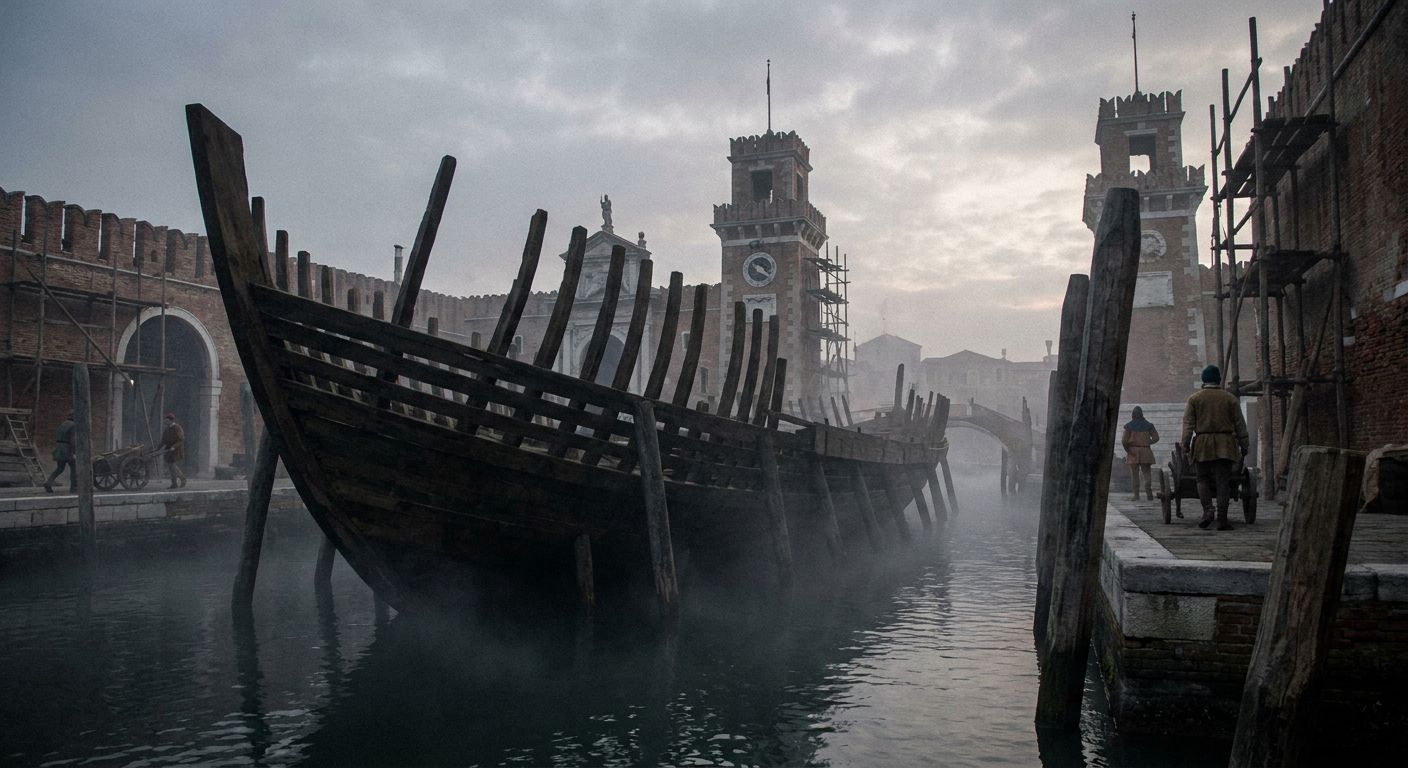
By the Middle Ages, Venice had transformed from a refuge for fugitives into the most sophisticated maritime power in the world. At the heart of this transformation was the Venetian Arsenal. This was perhaps the world’s first true industrial complex, a massive shipyard protected by high walls where the Republic could churn out a fully armed galley in a single day using a pre-industrial assembly line. This naval might allowed Venice to dominate the Adriatic and Mediterranean, positioning itself as the essential middleman between the silk and spice markets of the East and the hungry kingdoms of Western Europe.
The city became a vibrant, crowded bazaar where German merchants traded silver for Byzantine silks and Arab spices. Unlike the feudal kingdoms of the mainland, Venice was a merchant republic. Its leader, the Doge, was not a king but a high-ranking official elected for life, overseen by a complex web of councils designed to prevent any single man from seizing absolute power. This political stability allowed the "Serenissima"—the Most Serene Republic—to endure for over a thousand years.
The Pigment of Power and the Golden Age
As wealth flooded in, Venice became obsessed with spectacle. Because the city lacked the sprawling gardens or hunting forests of mainland aristocrats, the Venetians spent their fortunes on their facades. They draped their palaces in pink Veronese marble and intricate Gothic carvings, creating a style known as Venetian Gothic that looked as delicate as lace. Inside, the Great Council Chamber grew into one of the largest rooms in Europe, its walls covered in the stormy, light-filled canvases of Tintoretto and Veronese.
Venice’s unique environment even changed the history of art. In Florence, artists painted in fresco on dry plaster, but the salty, humid air of the lagoon caused frescoes to peel and crumble within years. Consequently, Venetian artists pioneered the use of oil on canvas, which could withstand the dampness. The city’s light—constantly refracted off the water and bouncing between narrow stone alleys—inspired a school of painting focused on colore (color) rather than the rigid disegno (drawing) of the Romans. The deep crimsons and luminous blues of Titian were the visual language of a city that was, for a time, the wealthiest place on the planet.
The Long Sunset of the Republic
The decline of Venice was not a sudden collapse, but a slow, elegant retreat that lasted three centuries. It began in 1498, when Vasco da Gama rounded the Cape of Good Hope, opening a direct sea route to the Indies. Suddenly, the Mediterranean was no longer the center of the world, and Venice's monopoly on the spice trade evaporated. As their naval power waned, the Venetian nobility turned their attention inland, building magnificent villas along the Brenta Canal and reinventing themselves as landed gentry.
During this long twilight, Venice pivoted from a center of trade to a center of pleasure. The 18th century saw the city become the playground of Europe, famous for its months-long Carnival, its gambling dens, and the exploits of figures like Giacomo Casanova. It was a city of masks, where social hierarchies were temporarily suspended in a blur of silk and harlequin patterns. This era of decadence came to a crashing halt in 1797 when Napoleon Bonaparte arrived at the edge of the lagoon. He famously declared he would be an "Attila for the Venetian State," and he successfully forced the last Doge to abdicate, ending 1,100 years of independence.
A City Against the Tide
Today, Venice faces a challenge more relentless than any invading army: the sea itself. The city is sinking, a phenomenon known as subsidenza, while global sea levels are rising. Every winter, the acqua alta (high water) floods St. Mark’s Square, turning the city’s drawing room into a shallow lake. Massive yellow barriers, part of the MOSE project, now rise from the seabed during storms to hold back the Adriatic, a modern echo of the engineering ingenuity that first drove wooden piles into the mud 1,500 years ago.
Yet, despite the crowds of tourists and the threat of the tides, Venice remains a place of profound silence. Late at night, when the day-trippers have departed, you can hear the footsteps of a single person echoing three canals away. The city endures not just as a museum, but as a testament to the human ability to build something beautiful in the most inhospitable of places. It is a reminder that even the most solid-looking empires are, at their heart, built on water and dreams.
This story travelled through
Where does this story take you next?
Every story opens a door somewhere else. Pick a thread and we'll tell you that story too.
Curious about something else?
Discover another exploration