The Emerald Spine: A Biography of Java
From the smoke of sacred volcanoes to the world’s largest Buddhist temple, explore the island that serves as the heartbeat of the Indonesian archipelago.
This story began with a question: “What is the story of Java?”
If you were to look down from space at the Indonesian archipelago, Java appears as a long, emerald spine resting between the Indian Ocean and the Java Sea. It is not the largest island in the chain—that honor goes to Sumatra or Kalimantan—but it is the undisputed heartbeat of the region. Home to over 150 million people, it is the most populous island on Earth, a place where the air smells of clove cigarettes, damp earth, and the sulfurous breath of the volcanoes that both create and destroy life here.
To understand Java, one must first understand its fire. The island is part of the Ring of Fire, a volcanic arc where the Indo-Australian plate slides beneath the Eurasian plate. This geological violence has blessed Java with some of the most fertile soil on the planet. For millennia, Javanese farmers have harvested three crops of rice a year from the volcanic slopes, a surplus of food that allowed for the rise of sophisticated civilizations, grand temples, and a culture that is as dense and layered as the tropical jungle.
The Age of God-Kings
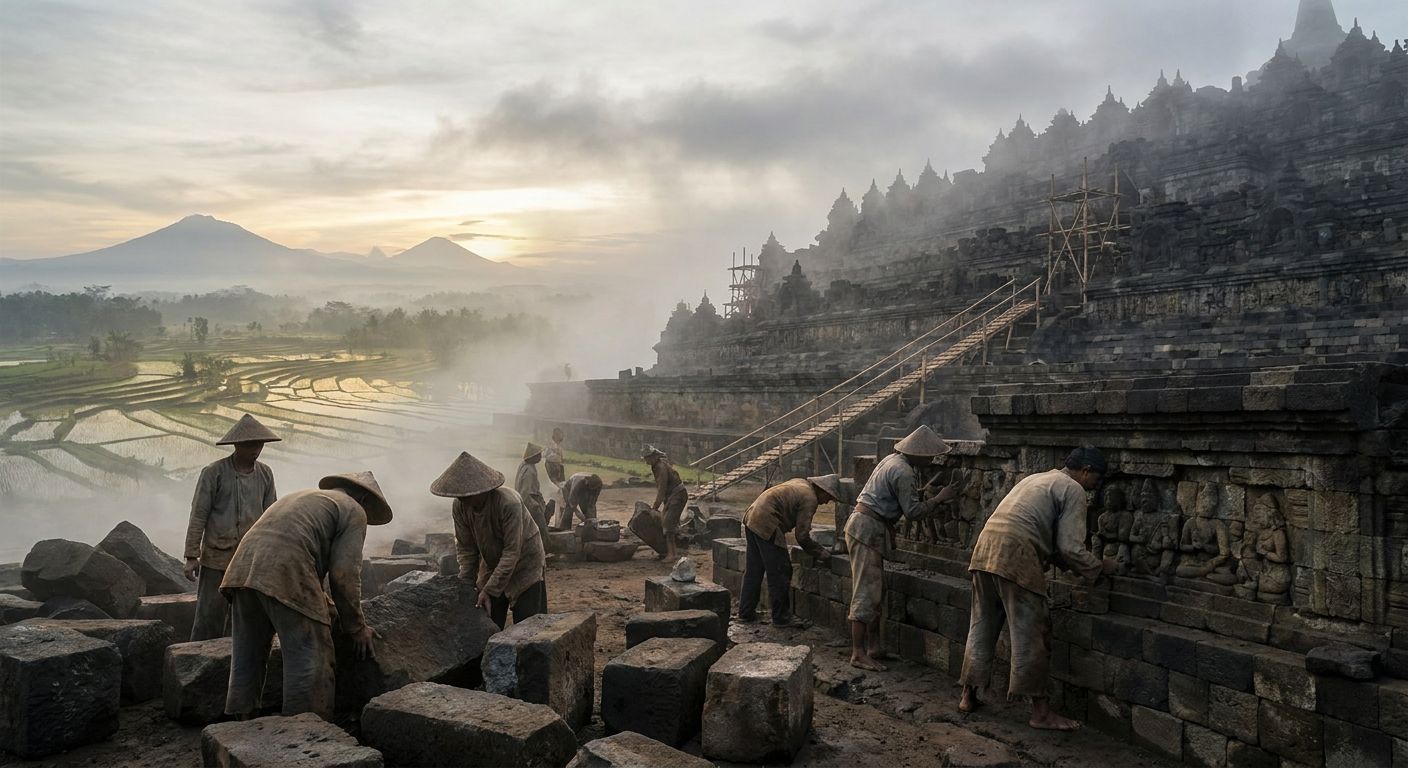
Long before the arrival of Europeans, Java was a land of powerful maritime and agrarian empires. By the 8th century, the island was the center of a flourishing Buddhist and Hindu Renaissance. On the Kedu Plain, the Shailendra dynasty raised Borobudur, a massive stone mountain of a temple adorned with over 2,500 relief panels and 504 Buddha statues. It remains the largest Buddhist temple in the world, designed as a physical map of the cosmos where pilgrims could climb from the world of desire to the realm of enlightenment.
Not far away, the Sanjaya dynasty built Prambanan, a soaring Hindu complex dedicated to Shiva. These monuments were not just religious sites; they were statements of immense wealth and organizational power. The labor required to carve and transport these millions of volcanic stones speaks to a highly structured society where kings were seen as intermediaries between the divine and the earthly. This era of "Indianized" kingdoms established the Javanese aesthetic—a love for shadow puppetry (wayang kulit), the hypnotic metallic clang of the gamelan orchestra, and a courtly etiquette that survives in the royal cities of Yogyakarta and Surakarta today.
The Spice Hub and the Crescent
As the first millennium closed, Java’s influence expanded through trade. The Majapahit Empire, which rose in the 13th century, is still remembered as the "Golden Age" of Indonesia. From their capital in East Java, the Majapahit controlled the maritime routes through which the world’s spices—nutmeg, mace, and cloves from the eastern islands—flowed toward China, India, and the Middle East. It was during this time that Islam began to take root in Java’s coastal trading ports.
Unlike the rapid conquests seen elsewhere, Islam’s spread in Java was a slow, syncretic process. It was carried by Sufi mystics and merchants who blended the new faith with existing Hindu-Buddhist traditions and local animism. The result was a unique "Javanese Islam," where ancient rituals remained woven into the fabric of daily prayer. By the 16th century, the great sultanates like Mataram rose to power, and the old Hindu elites retreated to the neighboring island of Bali, leaving Java to transform into the Islamic powerhouse it remains today.
The Dutch Shadow and the Cultivation System
The arrival of the Dutch East India Company (VOC) in the early 1600s changed the island’s trajectory forever. Seeking a monopoly on the spice trade, the Dutch established their headquarters at Batavia (modern-day Jakarta). What began as a series of trading posts eventually turned into a brutal colonial administration. The Dutch realized that Java’s real wealth wasn't just in trading spices from other islands, but in the soil of Java itself.
In the 19th century, the colonial government implemented the Cultuurstelsel, or Cultivation System. Javanese peasants were forced to grow export crops like coffee, sugar, and indigo for the Dutch, often at the expense of their own food security. This period turned Java into a vast plantation for Europe. The "Java Coffee" that became famous in the cafes of Amsterdam and London was grown by farmers who were often living on the brink of famine. This exploitation fueled the Dutch Golden Age, but it also sowed the seeds of a deep-seated resistance that would eventually boil over into a fight for independence.
A Modern Colossus
The 20th century was a whirlwind of revolution and identity-building. After the Japanese occupation during World War II, Indonesia declared independence in 1945. Java became the stage for a bloody four-year struggle against the returning Dutch, culminating in the recognition of a new nation with Jakarta as its capital.
Today, Java is a study in intense contrasts. In Jakarta, shimmering skyscrapers rise above sprawling informal settlements, and the city’s traffic is legendary for its gridlock. Yet, just a few hours away, you can find the quiet dignity of a rice farmer tending to terraces that look exactly as they did a thousand years ago. The island faces modern crises—Jakarta is sinking due to groundwater extraction, leading to the government's plan to move the capital to Borneo—but Java remains the cultural and economic engine of the nation. To touch the stone of Borobudur or to walk through the bustling markets of Surabaya is to feel the weight of a history that is still very much alive, shaped by fire, faith, and the endless green of the rice fields.
This story travelled through
Where does this story take you next?
Every story opens a door somewhere else. Pick a thread and we'll tell you that story too.
Curious about something else?
Discover another exploration