The Corporate Mirage: How the VOC Built Batavia
From a tropical river mouth to a humid mirror of Amsterdam, the Dutch East India Company’s capital was a bold experiment in corporate urbanism that nearly choked on its own canals.
This story began with a question: “How did the Dutch East India Company change Batavia?”
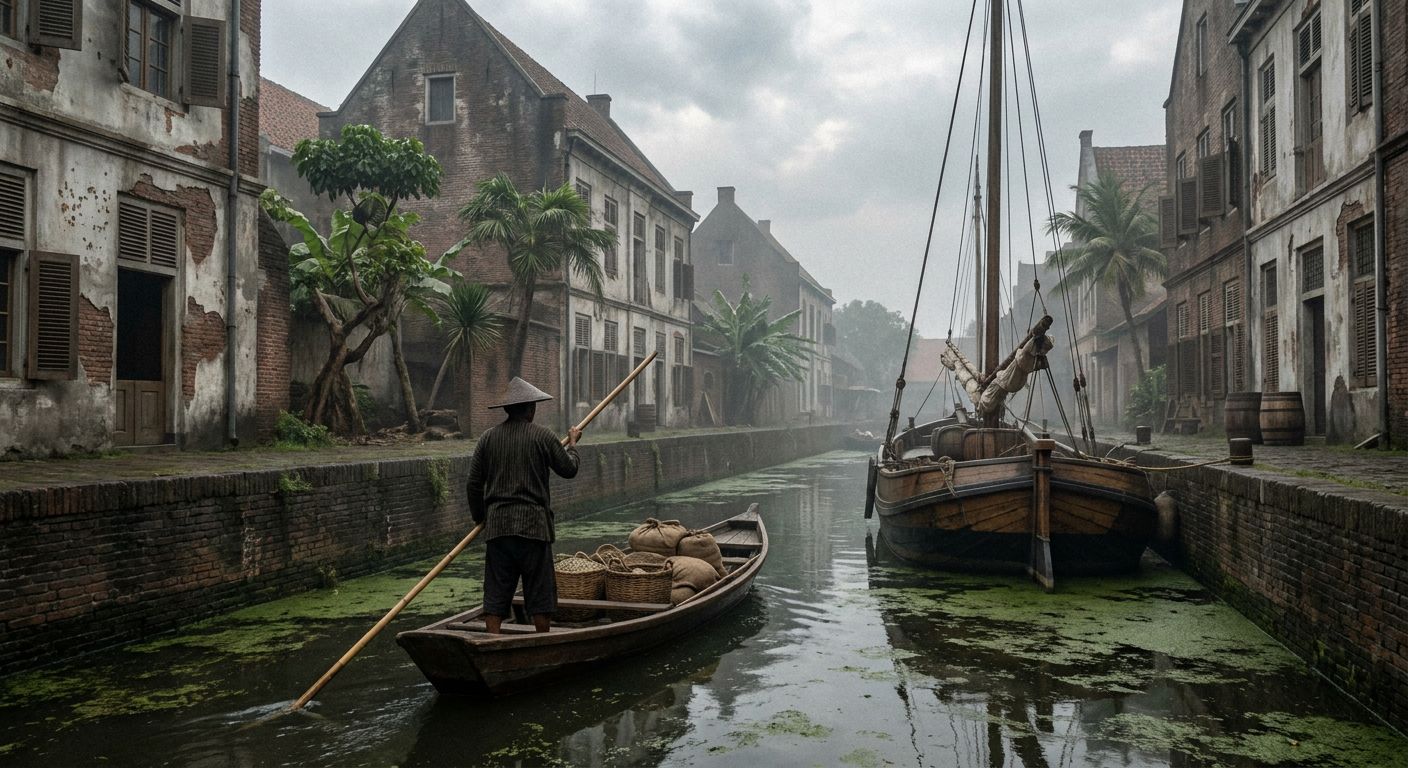
In the early 17th century, the landscape at the mouth of the Ciliwung River was a lush tapestry of mangrove swamps and the bustling port town of Jayakarta. It was a strategic hinge between the Indian and Pacific Oceans, a place where local princes and Javanese traders exchanged rice and pepper. But in 1619, the arrival of Jan Pieterszoon Coen, the Governor-General of the Vereenigde Oost-Indische Compagnie (VOC), signaled a violent and permanent transformation. Coen didn't just want to trade; he wanted to dominate. After razing Jayakarta to the ground, he envisioned a "New Batavia"—a city built not in harmony with the tropical archipelago, but as a rigid, stone-and-water mirror of Amsterdam.
The Dutch East India Company was the world’s first multinational corporation, and Batavia was to be its corporate headquarters. This wasn't merely a change in name; it was a radical engineering project that sought to impose European order on a landscape that resisted it. By digging a network of straight, stagnant canals and erecting high-gabled brick houses, the VOC fundamentally altered the hydrology, the social hierarchy, and the very air of Southeast Asia.
A City Carved from the Swamp
To walk the streets of 17th-century Batavia was to experience a profound sense of cognitive dissonance. The Dutch settlers, homesick and stubborn, ignored the realities of the equatorial climate. They insisted on building narrow, multi-story townhouses with small windows and heavy wooden doors, designed to trap heat in the frigid Netherlands but which became sweltering ovens in the Java sun. The VOC’s architects laid out a rectangular grid, bisected by canals intended for transport and defense, mirroring the gracht-strewn layout of the Low Countries.
The construction itself required an immense mobilization of labor and materials. Since the local volcanic soil was ill-suited for heavy European masonry, the Company imported thousands of tons of stone and brick, often using them as ballast in incoming ships. The Ciliwung River was tamed—or so they thought—into a series of regulated channels. However, the Dutch failed to account for the heavy tropical silt and the torrential monsoon rains. What were intended to be flowing arteries of commerce quickly became sluggish, emerald-green drains, clogged with refuse and sediment.
The Fortress and the Ledger
At the heart of this transformation was the Kasteel van Batavia, a massive coral-stone fortress that served as the nerve center for the VOC’s entire Asian operation. From this bastion, the Company’s bureaucrats managed a trade monopoly that stretched from the Cape of Good Hope to Japan. The castle wasn't just a military structure; it was a physical manifestation of a new kind of power—one where the ledger was as important as the sword.
The VOC’s presence introduced a rigid racial and social stratification to the region. To build and maintain their capital, the Dutch did not rely on the local Javanese, whom they distrusted. Instead, they encouraged a massive influx of Chinese laborers, artisans, and merchants to provide the city’s economic engine. They also forcibly transported thousands of enslaved people from across the Indian Ocean—from India, Arakan, and the Celebes—to serve as domestic workers and manual laborers. Batavia became a demographic crossroads, a city of diverse peoples all living under the shadow of a corporate monopoly that dictated where they could live, what they could wear, and with whom they could trade.
The Stagnation of the "Queen of the East"
By the 1700s, Batavia was known as the "Queen of the East," but the title had acquired a dark irony. The very canals that the VOC had dug to replicate the beauty of Amsterdam had become a death trap. As the city’s population grew and the surrounding forests were cleared for sugar plantations, the erosion increased, further choking the waterways. The stagnant water became a breeding ground for malaria-carrying mosquitoes and waterborne diseases like cholera and dysentery.
The VOC’s insistence on maintaining "Dutch" lifestyles—wearing heavy woolens and drinking warm beer—only exacerbated the health crisis. The mortality rate plummeted so low that the city gained a new nickname: "The Graveyard of the East." In some years, a third of new European arrivals would be dead within six months. This environmental catastrophe forced the Company to eventually abandon the "Old City" (Oud Batavia) near the coast, migrating southward to the higher, drier ground of Weltevreden.
The Ghost of a Corporate Capital
The VOC eventually collapsed under the weight of corruption and debt in 1799, but the marks it left on Batavia—now modern-day Jakarta—remain indelible. The Company changed the region from a collection of maritime principalities into a centralized colonial hub. They shifted the economy from subsistence and regional trade to a massive export-oriented machine, focusing on coffee, sugar, and spices for the global market.
Today, if you visit the district of Kota Tua in Jakarta, you can still see the remnants of the VOC’s ambition. The white-washed walls of the old Stadhuis (City Hall) and the remnants of the canals serve as a haunting reminder of a time when a private corporation held the power of a sovereign state. The VOC did not just build a city; they created a laboratory for colonial capitalism, the echoes of which still resonate in the infrastructure and social fabric of Indonesia’s sprawling capital. The "New Batavia" was a dream of Dutch order that was eventually swallowed by the tropical reality it tried so hard to overwrite.
This story travelled through
Where does this story take you next?
Every story opens a door somewhere else. Pick a thread and we'll tell you that story too.
Curious about something else?
Discover another exploration