The Clay That Built the World
Follow the trail of the humble ceramic jar to discover how the first global trade networks stitched the ancient world together.
This story began with a question: “A history story from around the world”
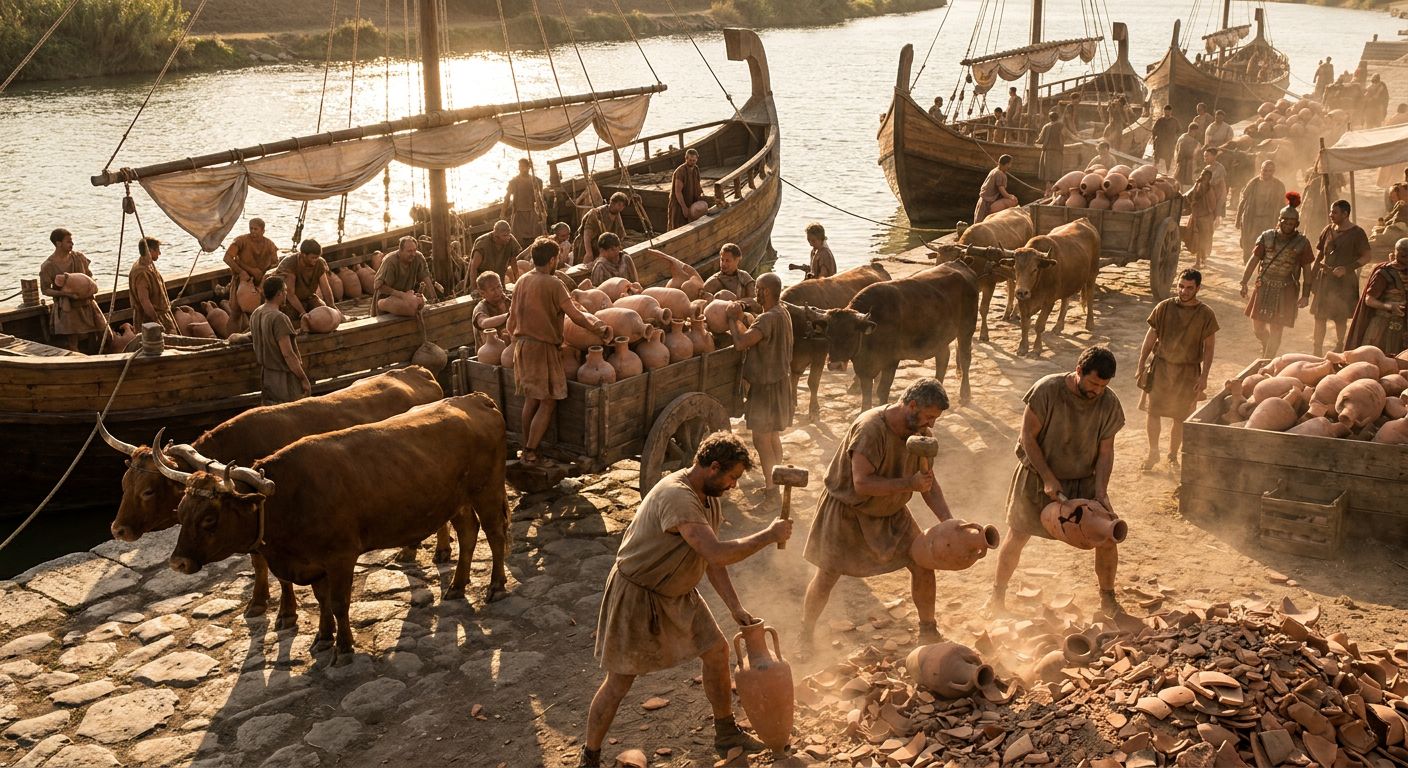
Imagine a single ceramic jar, barely larger than a man’s torso, sitting in a dark corner of a ship’s hold. On its own, it is just clay. But for three thousand years, these jars—known as amphorae—were the heavy-duty shipping containers of the ancient world. They carried the fuel of civilization: olive oil for lamps and calories, wine for ritual and relief, and garum, the pungent fermented fish sauce that the Romans poured over everything like modern ketchup. To follow the path of an amphora is to see the first blueprints of global trade being drawn across the Mediterranean.
The Phoenician Wake
The story of the Mediterranean’s first true merchants begins not with the Romans, but with Phoenicia, a seafaring culture from the coast of today's Lebanon. Around 1000 BCE, they looked westward across a sea most people feared, seeing not a barrier, but a highway. They were the master shipbuilders of their age, carving hulls from the famed cedars of Lebanon and perfecting the art of celestial navigation.
While other empires focused on conquering land through heavy infantry, the Phoenicians conquered markets. They established a chain of "service stations" and trading posts that stretched from Tyre and Sidon all the way to the Atlantic coast of Spain. They traded purple dye extracted from sea snails—so rare it became the color of royalty—for silver, tin, and gold. [n] In doing so, they stitched together disparate cultures, creating a common language of commerce that would outlast their own cities.
The Liquid Gold of the Guadalquivir
By the time Ancient Rome expanded into the Iberian Peninsula, the infrastructure for mass production was already in place. The Romans, however, took it to an industrial scale. In the valley of the Guadalquivir River in southern Spain, they found a landscape perfectly suited for the olive tree. This region, known then as Baetica, became the oil refinery of the empire.
This was not boutique farming. Thousands of kilns lined the riverbanks, churning out millions of Dressel 20 amphorae—a specific, bulbous design meant to hold about 70 liters of oil. Unlike modern flat-bottomed bottles, these jars ended in a heavy ceramic spike. This allowed sailors to wedge them into thick layers of sand in a ship's hold or stack them in interlocking rows, ensuring the cargo didn't shift during a gale.
These jars were stamped with the maker's mark, the weight of the empty vessel, the weight of the oil, and the name of the official who verified the quality. It was a sophisticated system of traceability that would look familiar to any modern logistics manager. The sheer volume of this trade was so immense that it left a permanent mark on the geography of Rome itself.
The Mountain of Broken Shards
If you visit the Testaccio neighborhood in Rome today, you will see a strange, grassy hill rising nearly 115 feet above the street level. This is Monte Testaccio, and it is not a natural formation. It is an ancient landfill consisting almost entirely of the fragments of an estimated 53 million olive oil amphorae. Because the porous clay absorbed the oil and would turn rancid if reused for food, the Romans simply smashed the jars once they were emptied at the nearby Tiber docks.
The mountain is a ledger of imperial consumption. [n] By studying the layers of shards, archaeologists can track the economic health of the empire, seeing when trade flourished and when it began to stutter under the weight of civil war or plague. Every piece of broken ceramic represents a journey of over a thousand miles, a testament to a world where a soldier on the Scottish border could expect to flavor his grain with oil pressed in the Spanish sun.
The Decline of the Unified Mediterranean
The collapse of this integrated system didn't happen overnight. As the Roman administration fractured, the grand shipping lanes became more dangerous. Piracy returned to the coves where the Phoenicians once traded, and the massive olive estates of Baetica were broken up or repurposed. The Mediterranean, once a "Roman Lake," began to divide into competing spheres of influence: the Byzantine East, the Islamic Caliphates, and the emerging kingdoms of Western Europe.
Yet the legacy of the amphora lived on in the very soil of the Mediterranean. Today, divers still find "amphora graveyards" on the sea floor—perfectly preserved stacks of clay that never reached their destination. These underwater ghosts raise a haunting question for the modern era: if our own global shipping networks were to vanish tomorrow, what physical monument would we leave behind that could tell our story two thousand years from now as clearly as a mountain of broken clay?
This story travelled through
Where does this story take you next?
Every story opens a door somewhere else. Pick a thread and we'll tell you that story too.
Curious about something else?
Discover another exploration