The City of Light and Lapis: How Trade Painted the Renaissance
Beyond the canals and gondolas lay a secret empire of minerals and oxides that allowed Venetian masters to paint with the colors of the world.
This story began with a question: “How did Venice’s control over Eastern trade routes dictate the literal color palette of the Renaissance?”
If you stand in the Gallerie dell'Accademia and look at Titian’s Assumption of the Virgin, the first thing that hits you isn't the scale, but the blue. It is a blue so deep and resonant that it seems to vibrate against the eye, a color that feels less like paint and more like liquid light. In the 16th century, this wasn't just an artistic choice; it was a display of geopolitical power. While painters in Florence or London struggled with dull, muddy earths and unstable copper greens, the Venetian masters were working with a spice-rack of minerals and oxides that arrived on their docks from the furthest reaches of the Silk Road.
Venice did not just dominate the seas; it curated the very spectrum of what was possible in European art. Because the Republic held the keys to the Eastern Mediterranean, its lagoons became the gateway for pigments that were, gram for gram, more expensive than gold. The city’s wealth was written in color, and the Renaissance palette was, in reality, a map of Venetian trade routes.
The Blue from Beyond the Sea
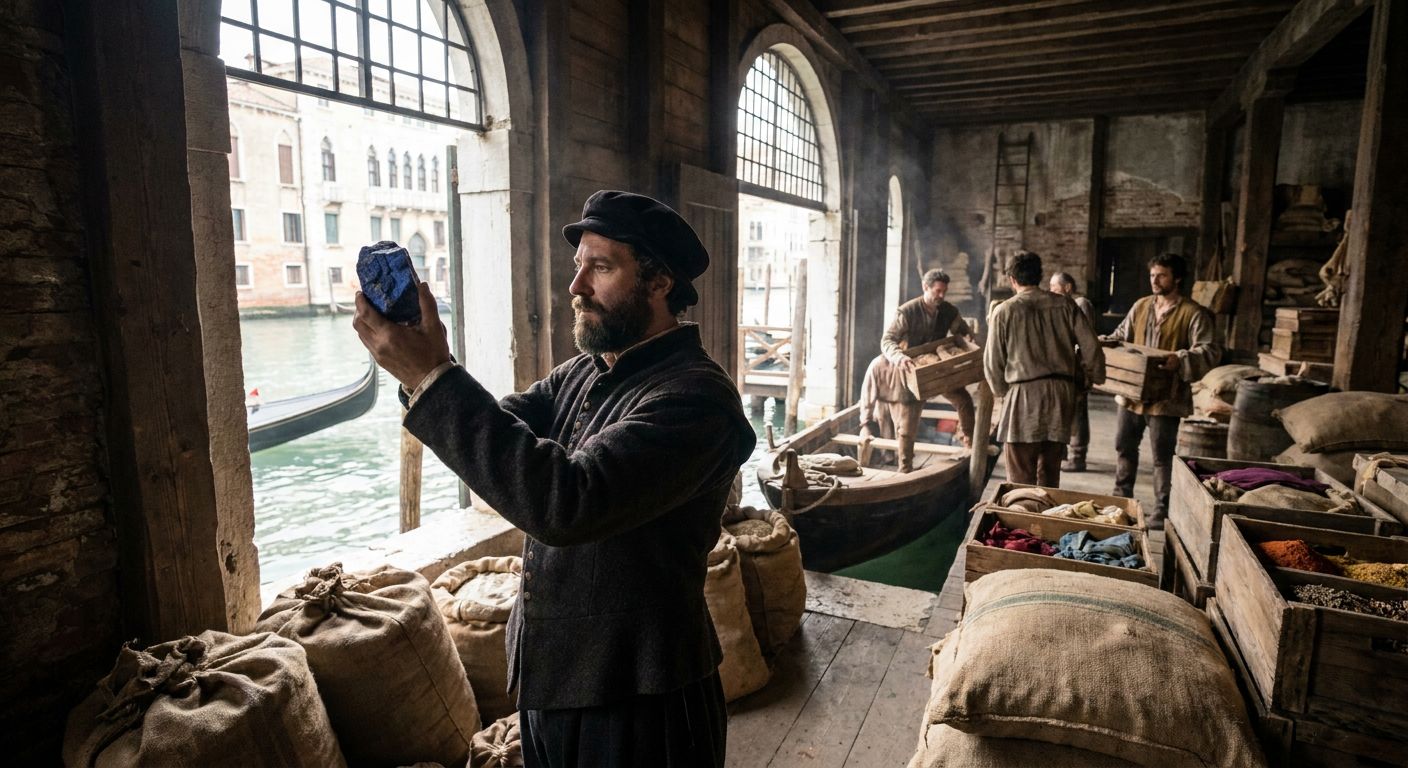
The most prestigious color in the Venetian arsenal was ultramarine. The name itself—oltremare—literally means "from beyond the sea." For centuries, the only source of this pigment was the Sar-i Sang mines in the remote mountains of modern-day Afghanistan. To reach a canvas in Venice, the raw lapis lazuli stone had to be hauled by camel caravan across the Hindu Kush, traded through the markets of Baghdad or Damascus, and finally loaded onto Venetian galleys in the ports of the Levant.
Venetian merchants held a virtual monopoly on this transit. While other cities received the "sweepings"—lower-grade stones that produced a gray-blue—the wealth of the Serenissima ensured that its painters had access to the purest crystalline chunks. But the stone was only the beginning. The process of turning lapis into pigment was a form of industrial alchemy. The stone had to be ground, mixed with wax and resins, and kneaded in a lye solution to separate the blue crystals from the gray impurities.
The Republic’s control over these routes meant that Venetian painters could afford to be extravagant. While a Florentine painter might reserve a tiny dab of ultramarine for the Virgin Mary’s robes, Titian would wash entire skies in the stuff. The very atmosphere of Venetian painting—that sense of "colorito" over the strict "disegno" of the Romans—was a direct result of having a surplus of the world’s most expensive dust.
The Chemistry of the Lagoon
It wasn’t just what the ships brought in; it was what the city did with it. By the 15th century, Venice was a hub of chemical innovation, largely thanks to its world-famous glassmaking industry on the island of Murano. The glassblowers were masters of metallic oxides, discovering how to turn clear silica into vibrant rubies and deep cobalts. This expertise bled directly into the painter’s workshop.
Venetian artists were among the first to experiment with "lake" pigments—organic dyes like cochineal or madder root that were chemically bound to an inert base like alum. The same merchants who brought silk from the East also brought the insects and plants used to dye them. Painters like Veronese realized that if they layered these translucent glazes over lead white, the light would pass through the color, hit the white base, and bounce back, creating a glow that mimicked the shimmering surface of the Adriatic itself.
The city’s humidity also forced a change in medium. In the damp air of the lagoon, traditional fresco (painting on wet plaster) crumbled and peeled. Venetian artists were pushed toward oil painting on canvas—a technology borrowed from the sailmakers of the Arsenale. The texture of the canvas and the slow-drying nature of oils allowed for the blending of colors that were previously impossible, leading to the smoky, atmospheric transitions known as sfumato.
The Monopoly on Red
If blue was the soul of Venice, red was its heartbeat. The city was the primary European entry point for "grain" (kermes) and later cochineal, dyes that produced a searing, royal crimson. But Venice also produced its own signature pigment: Venetian Red. Unlike the expensive organic dyes, this was an earth pigment, a ferric oxide found in the nearby hills. However, the Venetians perfected a way of refining it to a precise, warm terracotta that became the standard for skin tones and architectural shadows across the continent.
This abundance of color created a fierce rivalry with the artistic centers of the Italian mainland. Giorgio Vasari, the great biographer of the Renaissance who championed the intellectual "drawing" of Florence, often looked down on the Venetians as mere "colorists." He argued that they relied on the beauty of their materials to mask a lack of structural rigor. But for the Venetians, color was not a surface treatment; it was the structure.
By the time Titian reached the height of his powers, his workshop functioned like a sophisticated laboratory. He was known to keep his paintings turned to the wall for months, occasionally bringing them out to add another layer of "flesh"—a glaze of oil and pigment that added depth and life. This technique was only possible because he had a constant, reliable supply of the highest quality oils and minerals, a luxury afforded by the very ships that patrolled the Mediterranean to keep the Ottoman navy at bay.
A Palette Fades
The decline of the Venetian color monopoly mirrored the decline of its maritime empire. As Portuguese explorers found a sea route around the Cape of Good Hope to the Indies, the traditional Silk Road routes—and Venice’s role as the middleman—began to erode. By the 17th and 18th centuries, the center of gravity for trade, and subsequently for the innovation of color, shifted toward the Atlantic powers.
Yet, the legacy of that Venetian "alchemy" remains in every museum in the world. The way we perceive the "glow" of the Renaissance is not just a trick of the light; it is the physical presence of Afghan mountains, Mediterranean chemistry, and the vast, ambitious reach of a city that decided to paint itself in the colors of the world. Even today, the phrase "Venetian Red" evokes a specific warmth, a reminder of a time when a merchant’s ledger and an artist’s brush were two ends of the same golden thread.
The shift in trade routes didn't just change who got rich; it changed how the world looked. If the Portuguese hadn't found their way around Africa, perhaps the cool, muted tones of the Northern European masters would never have risen to challenge the sun-drenched vibrancy of the Mediterranean. But for one glorious century, the world’s most precious materials flowed through a single set of canals, turning a city of water into a city of light.
This story travelled through
Where does this story take you next?
Every story opens a door somewhere else. Pick a thread and we'll tell you that story too.
Curious about something else?
Discover another exploration