The Blue Smoke and the Buried Seam: A History of Appalachia
Beyond the mist-covered ridges lies a land of deep time, where ancient peaks and coal-rich hollows forged a culture of fierce independence and hidden diversity.
This story began with a question: “What is the story of Appalachia?”
If you stand on a ridge in the Great Smoky Mountains at dawn, you will see exactly why the Cherokee called this land Shaconage—the place of the blue smoke. A soft, cerulean haze clings to the hollows, a breath exhaled by the dense forest itself. These mountains do not jaggedly pierce the sky like the Rockies or the Alps. They are rounded, slumped, and ancient, wearing their age like a heavy velvet cloak of moss and oak.
To understand Appalachia, you have to look past the stereotypes of isolation and poverty to see a landscape that has been a collision zone for half a billion years. It is a place where the earth itself crumpled under the weight of continents joining together, and where, much later, the human spirit would do the very same. The story of Appalachia is one of immense natural wealth and the complicated, often heartbreaking struggle of the people who live atop it.
The Oldest Bones on Earth
The Appalachian Mountains are among the oldest in the world. When they first rose during the formation of the supercontinent Pangea, they were as tall and fierce as the Himalayas. Over three hundred million years, wind and water have acted as slow, rhythmic sandpaper, grinding those peaks down into the rolling highlands we see today. This deep time created a biological treasure chest. Because the north-south orientation of the range acted as a refuge during the last Ice Age, the region became one of the most biodiverse temperate zones on the planet.
Hidden beneath this greenery, however, was the fuel that would change the region’s destiny. During the Carboniferous period, vast tropical swamps died and were compressed into thick seams of coal. For eons, this energy lay dormant, protected by the verticality of the terrain. It made the region a fortress—difficult to enter, difficult to leave, and entirely unique in the American imagination.
A Tapestry of Displaced Souls
The human history of Appalachia is a layering of migrations. Long before European contact, the Mississippian culture and later the Cherokee, Monacan, and Haudenosaunee peoples managed these forests, creating sophisticated trade networks and agricultural systems. The arrival of Europeans in the 18th century brought a new wave of settlers, primarily Scotch-Irish and Germans, who were pushed toward the mountains because the fertile coastal plains were already claimed by wealthy plantation owners.
These settlers brought with them a fierce independence and a musical tradition rooted in the ballads of the British Isles. In the isolation of the high hollows, these traditions didn't just survive; they mutated. West African rhythmic influences brought by enslaved people and later Black coal miners merged with Scots-Irish fiddling to create the distinctive high-lonesome sound of bluegrass. Appalachia was never the monolithic, white enclave it is often portrayed to be; it was a cultural crucible where the Melungeon people, European immigrants, and Cherokee remnants shared seeds, songs, and survival tactics.
The Extraction Machine
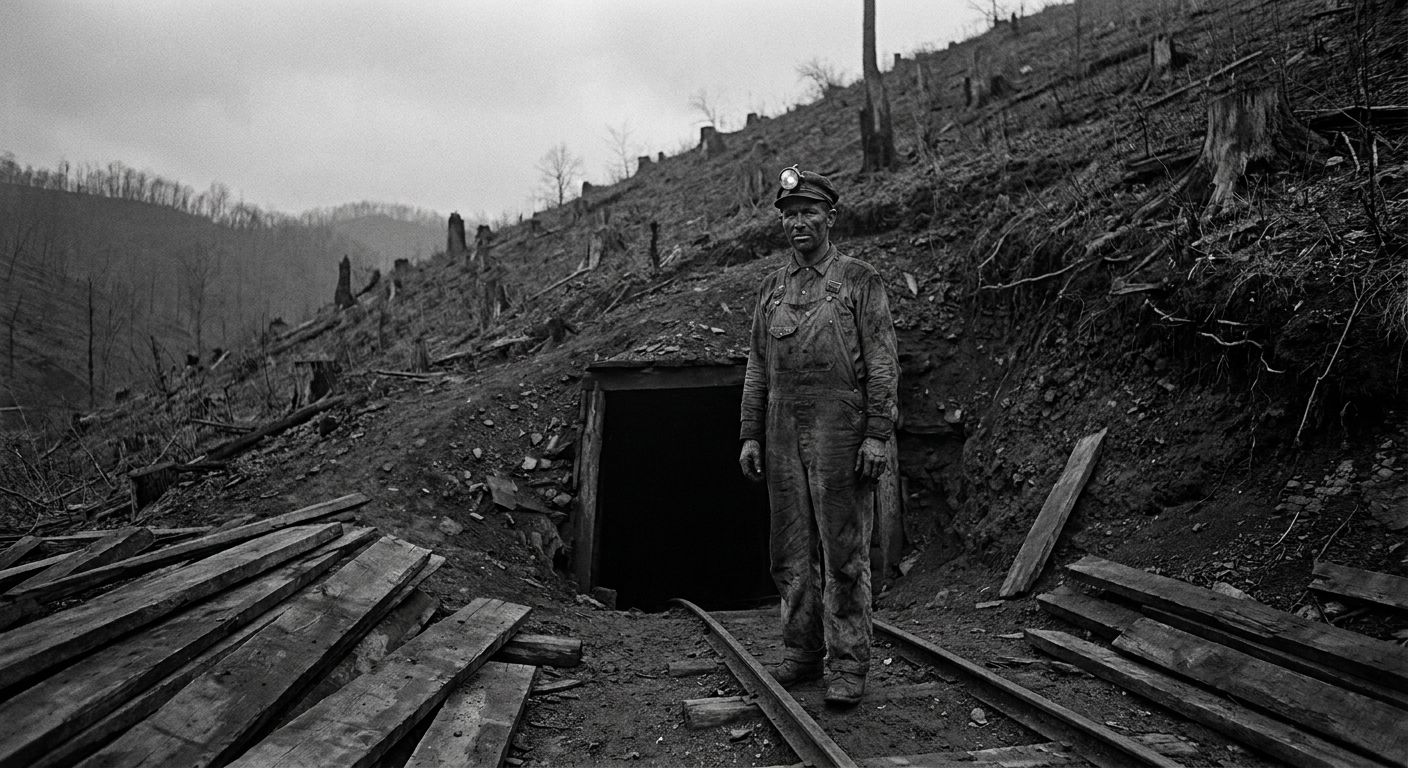
By the late 19th century, the outside world realized that the "fortress" of Appalachia sat on a gold mine of timber and coal. The Industrial Revolution had a voracious appetite, and the mountains were the pantry. This era transformed the region from a collection of subsistence farming communities into a series of "company towns."
In these towns, the coal company owned everything: the houses, the churches, and the general store. Workers were often paid in "scrip"—private currency that could only be spent at company-owned businesses. This created a cycle of debt and dependency that stripped the agency from generations of families. The landscape changed, too. The massive old-growth forests were clear-cut to provide railroad ties and mine supports, and the very tops of mountains were eventually removed to reach the coal seams beneath, forever altering the hydrology and silhouette of the range.
The Spirit of the Hollows
Despite the pressures of extraction and the "hillbilly" caricatures often projected by urban media, a powerful sense of place remains the heartbeat of Appalachia. There is a specific vocabulary here—words like "hollow" (pronounced holler) for a valley, or "poke" for a bag—that signals a deep connection to the geography. The region has a long history of resistance, from the Whiskey Rebellion to the Battle of Blair Mountain, where ten thousand miners rose up against coal operators in the largest labor uprising in American history.
Today, Appalachia is in the midst of another transition. As the world moves away from coal, the region is grappling with how to reinvent its economy without losing its soul. You can see it in the revival of heirloom cider orchards in Virginia, the outdoor recreation boom in West Virginia, and the enduring strength of community gardens in Kentucky. The "blue smoke" still rises every morning, a reminder that while the humans and their industries come and go, the mountains themselves are playing a much longer game.
The story of this land is not a tragedy, though it has tragic chapters. It is a story of endurance—of a land that refuses to be leveled and a people who refuse to be forgotten. To walk a trail in these woods is to walk through a library of deep time and human struggle, where every creek and ridge has a name and a memory.
This story travelled through
Where does this story take you next?
Every story opens a door somewhere else. Pick a thread and we'll tell you that story too.
Curious about something else?
Discover another exploration