Saint Petersburg: The City Held Up by a Hidden Forest
Determined to drag Russia into the future, Peter I used Dutch hydraulic secrets to force a stone masterpiece to float on a deadly bog.
This story began with a question: “How did Peter’s obsession with Dutch engineering physically pull a stone capital out of a swamp?”
If you stand today on the banks of the Neva River in Saint Petersburg, you are standing on a miracle of stubbornness. The river is wide, cold, and deceptively fast, cutting through a delta that was once little more than a collection of sodden islands and malarial thickets. For centuries, this was a place where nobody built anything permanent. The land was so saturated that it behaved more like a liquid than a solid, yet today it supports millions of tons of granite, marble, and gold.
The transformation of this bog into a maritime capital was not a natural evolution of urban planning. It was a violent collision between the obsession of Peter I of Russia and the laws of physics. Peter had returned from his "Grand Embassy" to Western Europe not just with a haircut and a pipe, but with a mind reshaped by the Dutch. In the shipyards of Zaandam, the Tsar had lived incognito as a common carpenter, "Peter Michaelov," blistering his hands to learn the geometry of hulls and the physics of buoyancy. He had spent months in Zaandam and Amsterdam, fascinated by how the Netherlands had wrestled their entire civilization from the sea. When he looked at the swampy mouth of the Neva, he didn’t see a wasteland; he saw a blank canvas that could be conquered with Dutch hydraulic engineering.
The Forest Beneath the Streets
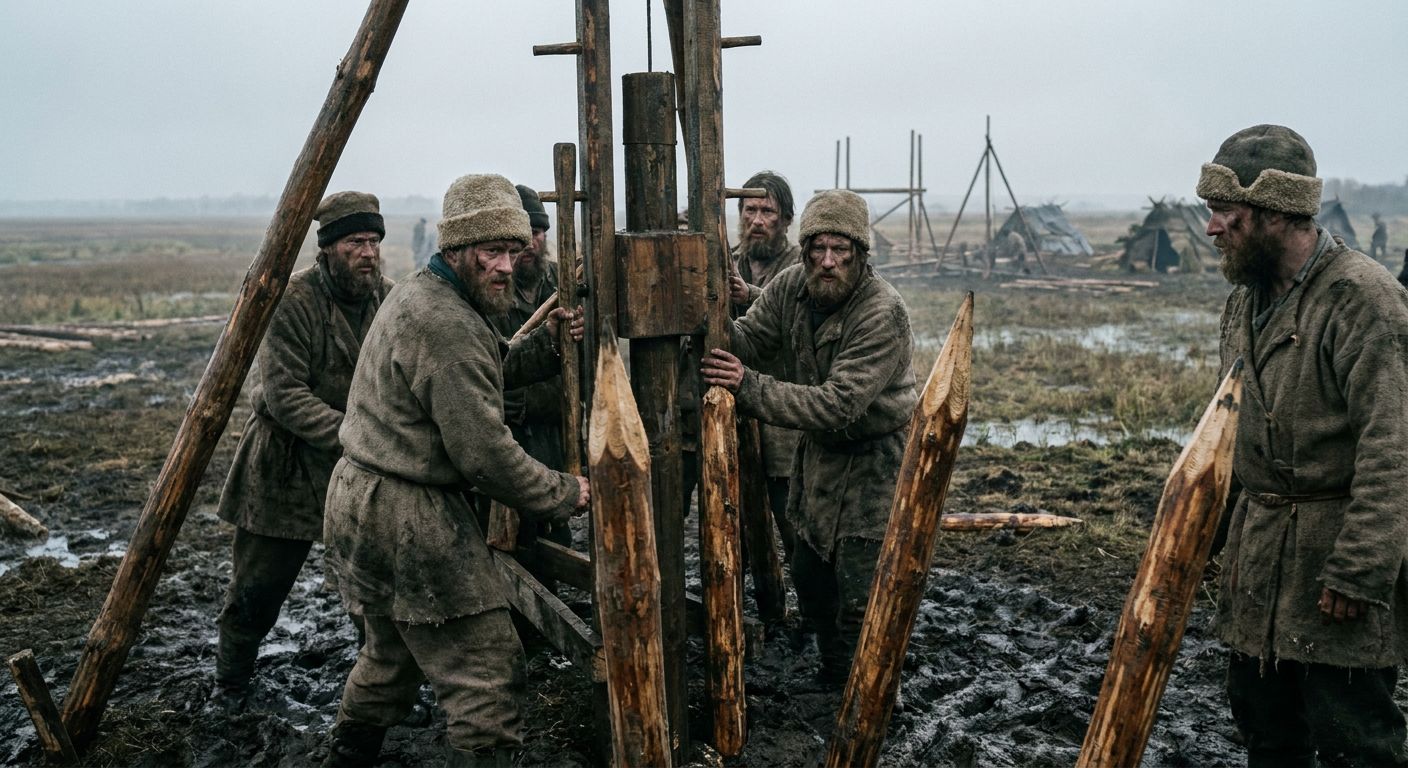
The primary problem of building Saint Petersburg was that the ground simply wasn't there. The Neva delta was a chaotic mess of silt and peat. To build a stone city, Peter first had to construct an artificial underground forest. This was the Dutch method: driving thousands of sharpened wooden piles—mostly larch and oak—deep into the mud until they hit a stable layer of clay or sand.
Laborers, many of them conscripted peasants and Swedish prisoners of war, worked in waist-deep water. They used primitive hand-cranked pile drivers to hammer these logs into the muck. Once the piles were level, they were capped with heavy timber planks, creating a floating platform upon which the first stones could be laid.
Every palace, every cathedral, and every government office in the historic center is held up by this invisible wooden skeleton. Because these piles are completely submerged in anaerobic (oxygen-free) mud, they do not rot; the lack of oxygen prevents the fungi that cause decay from surviving. Over three centuries, the minerals in the silt have gradually permeated the wood, effectively petrifying the logs and turning the swamp into a foundation as hard as rock.
Engineering the Delta: The Dutch Drainage System
Peter’s vision was not just for a city on water, but a city of water. He initially envisioned a capital where everyone traveled by boat, just as they did in Amsterdam. To achieve this, he ordered the carving of an intricate network of canals. These weren't just for aesthetics or transportation; they were vital drainage arteries intended to lower the water table and keep the newly reclaimed land from dissolving back into the delta.
He recruited Dutch engineers to design the locks and sluices, but he soon realized that the Dutch model needed a Mediterranean flair to match his imperial ambitions. This led to a strange architectural marriage. While the skeleton of the city was Dutch engineering, the skin was increasingly Italian and French.
Domenico Trezzini Galeno, an Italian-Swiss architect, became the master builder who reconciled the two. Trezzini understood that in this climate, stone was heavy and dangerous. The silt could only support a certain weight before the Dutch piles would begin to sink or tilt. He designed buildings with "tectonic lightness," using stucco and bright paints to mimic the grandeur of Rome while the Dutch piles groaned under the weight below.
The War Against the Neva
Despite the engineering triumphs, the Neva remained a temperamental tenant. The river is prone to "wind-induced surges," where westerly winds from the Gulf of Finland push the water back up the river, causing it to overflow its banks almost instantly. The city’s history is a timeline of catastrophic floods, the most famous of which occurred in 1824, nearly drowning the dream Peter had built.
To combat this, the embankments were eventually encased in massive blocks of red and gray granite. This gave the city its distinctive, rigid look—a stone straightjacket for a wild river. The sheer volume of stone required was staggering. Peter famously issued a "stone tax," decreeing that every boat and carriage entering the city had to bring a contribution. Large ships were required to deliver 30 stones, each weighing at least ten pounds, while small boats brought 10 stones. Even peasants arriving by cart had to surrender three stones at the gates. If you wanted to enter the Tsar’s new world, you had to literally help build the ground you stood on.
The Cost of the Dream
The physical pulling of this capital out of the swamp came at a human cost so high that Saint Petersburg is often called "the city built on bones." The damp, freezing conditions and the grueling labor of dredging canals by hand led to the deaths of tens of thousands of workers. Yet, the result was a city that defied its own geography. By importing the hydraulic secrets of the Low Countries, Peter I didn't just build a port; he proved that a monarch’s will could rewrite the map of Europe.
Today, the canals still reflect the pastel facades of Trezzini’s palaces. The integrity of the city remains dependent on the water level; if the water table were to drop and expose the larch piles to the air, the "hidden forest" would rot, and the palaces would crumble. The city remains a precarious masterpiece, anchored in the silt by three hundred years of petrified wood and the unwavering stubbornness of a Tsar who refused to let the earth stay liquid.
This story travelled through
Where does this story take you next?
Every story opens a door somewhere else. Pick a thread and we'll tell you that story too.
Curious about something else?
Discover another exploration