Axarquía: The Vertical Kingdom of the East
High above the Mediterranean, a labyrinth of white villages and vertical vineyards tells a story of Moorish resistance, sweet raisins, and a landscape that refuses to be tamed.
This story began with a question: “What is the story of Axarquía?”
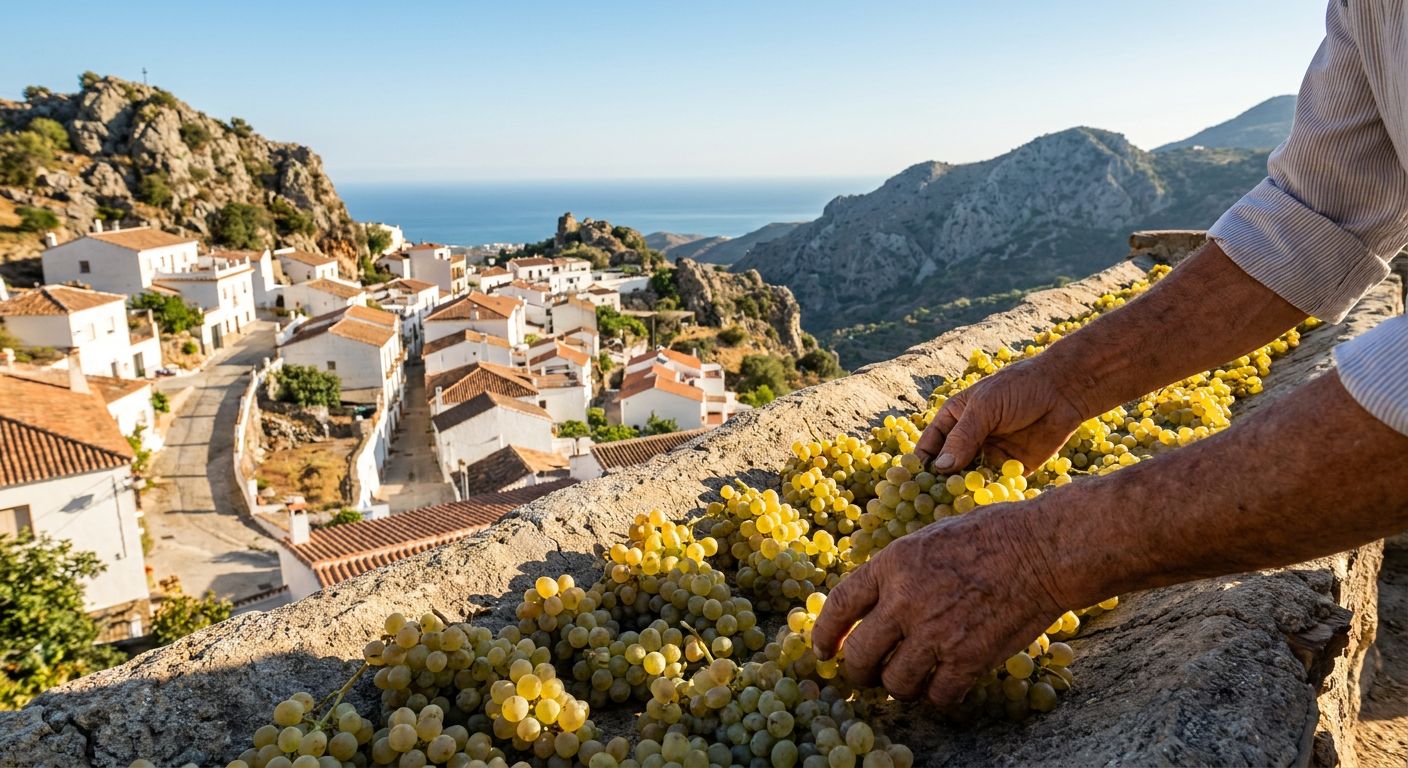
If you stand on the balconies of Comares, a village white-washed and perched so high it seems to snag on the clouds, you are looking at a landscape that refuses to be tamed. Below you, the Axarquía unfolds in a dizzying tumble of slate-gray ridges, deep ravines, and hillsides draped in the silver-green of olive trees. To the south, the Mediterranean glimmers like a hammered sheet of lead; to the north, the limestone peaks of the Sierra de Tejeda stand like jagged sentinels.
This is the eastern shoulder of Málaga, a region whose name comes from the Arabic Ash-sharquía, meaning "the eastern land." For centuries, it has been a place of refuge and resistance, a frontier where the lushness of the subtropics meets the harshness of the high mountains. Unlike the flat, industrialized plains of the Guadalquivir, the Axarquía is a vertical world. Here, the story of the land is written in stone, sugar, and the resilient spirit of people who have spent a millennium carving a living out of the dust.
The Legacy of the Al-Andalus Frontier
The soul of the Axarquía was forged during the seven centuries of Moorish rule. While the great cities of Córdoba and Granada were centers of philosophy and science, the Axarquía was the empire’s orchard and its fortress. The Berbers who settled here in the 8th century recognized a familiar topography—the rugged terrain reminded them of the Atlas Mountains of North Africa. They brought with them the acequias, a sophisticated system of irrigation channels that still hum with running water today, turning these arid slopes into productive terraces of almonds, citrus, and vines.
This was not a peaceful existence. As the Christian Reconquista pressed south, these mountains became a jagged defensive line. The "White Villages" or pueblos blancos that dot the ridges today—places like Frigiliana and Salares—were originally built as defensive bastions. Their streets are deliberately narrow and winding, a labyrinth designed to confuse invaders and provide shade against the brutal Andalusian sun. Even the architecture of the church towers often betrays their secrets; many began life as minarets, their brickwork still showing the intricate geometric patterns of Mudéjar craftsmanship.
The Bitter Harvest of 1569
The most dramatic chapter in the region’s history unfolded in the late 16th century. Following the fall of Granada, the Muslim population—the Moriscos—were forced to convert to Christianity. They were allowed to stay, but their culture, language, and religion were systematically suppressed. In 1568, the tension snapped, leading to the Rebellion of the Alpujarras, which quickly spilled over into the Axarquía.
The final stand took place atop the Peñón de Frigiliana, a massive limestone outcrop overlooking the sea. Thousands of Moriscos retreated to this natural fortress, hoping the sheer cliffs would protect them from the Spanish crown’s battalions. The siege was brutal. When the defenses finally collapsed, many chose to throw themselves from the cliffs rather than be captured. The aftermath changed the region forever: the Morisco population was expelled, and the Axarquía was resettled by families from northern Spain, who had to learn the secrets of the Moorish irrigation systems from scratch to keep the land alive.
The Era of Sweet Gold and Sun-Dried Gems
As the blood of the rebellion faded into the soil, the Axarquía found a new identity through two specific products: sugar and raisins. For centuries, the coastal strips around Torre del Mar were dominated by sugarcane plantations, a crop introduced by the Arabs that once made this coastline the sugar capital of Europe. Huge brick chimneys from the industrial era still stand as lonely monuments to the factories that processed the "sweet gold."
Higher up the slopes, the Muscatel grape became the region’s true currency. The sun of the Axarquía is fierce, and the locals turned this to their advantage by creating paseros—inclined drying beds made of stone and sand. Even today, you can see these rectangular patches on the hillsides. The grapes are laid out by hand to wither in the sun, concentrating their sugars into the world-famous Málaga raisins. This labor-intensive process, which involves no machinery due to the steepness of the terrain, was recently recognized by the UN for its global agricultural importance.
A New Frontier: The Tropical Shift
Walking through the Axarquía today, you will notice a strange new hue on the hillsides. The dusty green of the olives is being replaced by the deep, waxy emerald of avocado and mango trees. Because the mountains shield the coast from northern winds, the Axarquía possesses a microclimate found nowhere else in Europe. It is effectively a pocket of the subtropics in the Mediterranean.
This shift has brought wealth, but it has also brought a new kind of tension. These "tropical" crops require vast amounts of water in a region that is increasingly prone to drought. The La Viñuela reservoir, a turquoise jewel at the heart of the district, often sits at worryingly low levels, sparking debates about how to balance the demands of global exports with the ecological limits of the land.
The story of the Axarquía is far from finished. It remains a place where the air smells of jasmine and woodsmoke, where the ghosts of the Al-Andalus frontier linger in every horseshoe arch, and where the people continue to look toward the mountains, negotiating their survival with the same grit as the ancestors who first climbed these ridges a thousand years ago.
This story travelled through
Where does this story take you next?
Every story opens a door somewhere else. Pick a thread and we'll tell you that story too.
Curious about something else?
Discover another exploration